This Modesto property manager takes in homeless as city struggles to spend federal dollars
For more than a year, local organizations have struggled to house homeless people despite having $3 million in emergency housing vouchers.
Lori Beltran is offering a solution.
The property manager has taken in roughly 20% of the tenants in Stanislaus County who hold these vouchers.
It’s enough people to fill an “entire complex,” she said, surprised by her own feat.
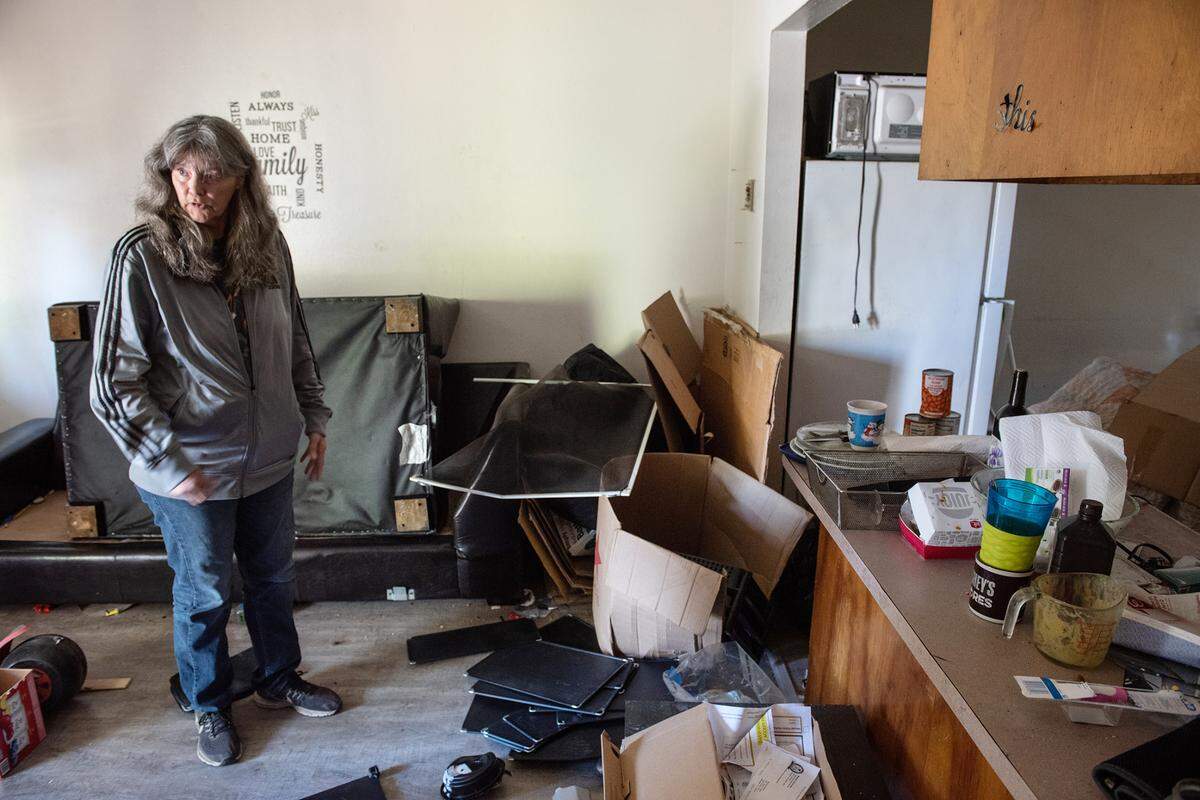
Beltran is soft-spoken but persistent, with long gray hair and bangs that nearly cover her eyes. She manages three buildings in Modesto, a total of 61 units, and has rented 17 of them to individuals on public assistance, most with the emergency vouchers.
Last summer, the Stanislaus Regional Housing Authority received 200 vouchers from the Department of Housing and Urban Development (HUD), but only 76 people have secured housing so far. Used correctly, the vouchers likely can cover much of a person’s rent indefinitely.
The problem is that there aren’t enough rental units in Stanislaus County to keep up with demand. As housing prices rise, these homeless men, women and teenagers face tough competition for the few affordable units that qualify under the voucher’s strict pricing criteria. Moreover, landlords routinely reject these voucher holders, who often lack reliable income, credit and rental history.
Not Beltran, though. She’s part of a small group of advocates making progress one homeless person at a time, despite a hostile housing market.
An emergency voucher brings Christmas home
She has not wavered in her support for the homeless people who come to her with vouchers in hand. “I don’t see it as a service, I see it as the right thing to do,” she said. The owners, a group of investors who live in Granite Bay, asked that she serve as their spokesperson.
Part of Beltran’s conviction is rooted in her own experience: In 2013 and 2014, she lived in her Nissan. Homelessness exacerbated her health problems, ultimately leading to a stroke, kidney disease and a nerve condition that leaves her exhausted after a few hours of movement.
Her life was rough, she said, but she knows many today have it worse. “People come in with vouchers, and if you sit down and talk to them, the stories are just horrific.”
Every time a vacancy opens up in one of her buildings, she alerts the staff at Downtown Streets Team, a homeless services organization, so it can refer its affiliated voucher holders first. For one tenant who was about to lose his housing, Beltran reached out to another local organization so he could secure a housing voucher and stay in one of her units.
“When you see people that you’re putting into these units and they’ve got tears going down their face, it’s their first place or their first place in a long time. It’s awesome,” she said. “It really is.”
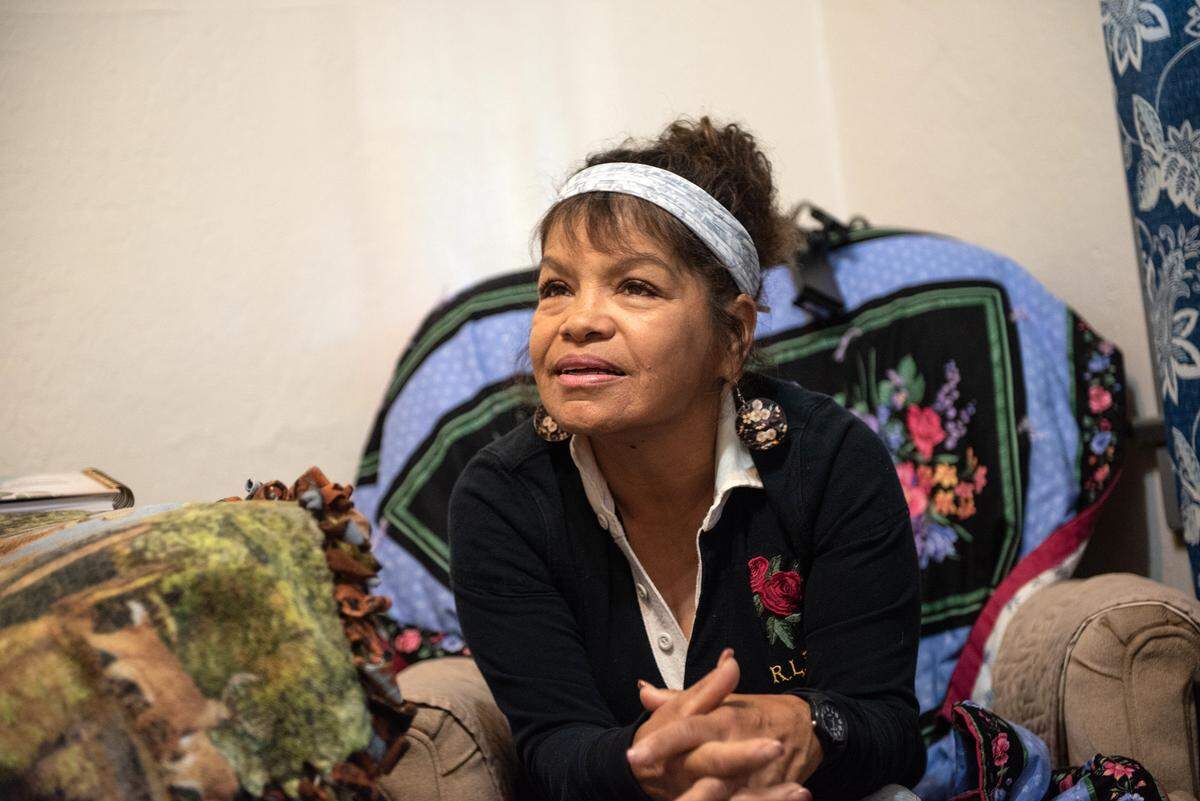
Lupe Vargas was one of those people. Today, she lives in a shotgun-style one-bedroom in one of Beltran’s properties, an aging yellow building that straddles half a block in downtown Modesto.
“I get emotional because I didn’t think that I would ever have a place,” Vargas said, welling up with tears.
It’s an eccentric apartment, with two Murphy beds, a closet she turned into a “prayer room,” and a photo of her chihuahua, Nana, on the front door. At market rate, it would be $1,200, but since Vargas has no income at the moment beyond disability, she pays only $50 a month. The emergency voucher also covers the cost of the security deposit and the utility setup, which is unusual for a HUD voucher.

Like Beltran, Vargas is an exception. Most voucher holders fail to find an apartment within eight months, at which point their vouchers expire and cycle to a new person in need. Whatever vouchers remain unused as of September 2023 will return to HUD.
Fearful that her opportunity might pass by, Vargas started searching for an apartment a month before she officially received a voucher. In two months, and just a few weeks after she received the voucher, she found an apartment in one of Beltran’s buildings.
“It’s not going to come to you,” she said, “you have to go look.”
In the 10 years she has cared for Nana, this is the first Christmas they have a tree. “It’s a little one, but it’s OK,” she said proudly.
Flooded with vouchers and water pouring down
“She’s one of the tenants I can count on,” said Beltran, but other newly housed and federally supported tenants have created thousands of dollars in problems, days of grueling repair work and recurring frustrations.
“When we put them into a unit, half of them don’t know how to take care of themselves,” she said, “They’ve been living on the streets. Cleaning the house was putting a McDonald’s bag in the Dumpster.”
Of the 17 people she has housed through the public assistance programs, she has asked three tenants to leave, including one formal eviction that cost the property owner $4,000 in fees and forced Child Protective Services to intervene.
In one instance, a tenant flooded his apartment “eight, nine times,” to the point where water was flowing down the stairs outside the building. He tried to soak up the water by pouring tortilla chips on the ground of the apartment, said Beltran.
She hasn’t done the repairs yet but said they could cost as much as $8,000.
The tenant, who had gotten sober by the time he moved in, had started using drugs again. What Beltran wants is “aftercare,” case management that can support struggling tenants after they move in so that they don’t relapse on drugs and destroy apartments.
“It takes a village to make a tenant,” she said.
She has other complaints, too. The payment system for the federal vouchers is sometimes slow, forcing her to lose rent and reflecting poorly on her performance as a property manager.
If the tenant uses a voucher, the unit must undergo a special inspection by the Stanislaus Regional Housing Authority before anyone can move in.
Beltran said the inspectors are sometimes slow to act. In one currently vacant apartment, she said, it has taken more than two weeks so far for the inspector to finish. In the meantime, the tenant remains homeless while Beltran’s employer must swallow the utility payments.
Michele Gonzales, regional director of the housing choice voucher programs, said payments typically process within 30 days and inspections take three days, though delays can occur if paperwork doesn’t arrive on time. Any other delays, she said, are “unacceptable.”
The ‘village’ that makes the tenant
Many of the challenges facing the emergency voucher program are entrenched. Federal regulations are slow to change, and even aggressive action by lawmakers is unlikely to cool the region’s housing market in the near future. What city and county officials can do, however, is find more people like Beltran who are willing to accept voucher holders.
But Beltran’s complaints are many landlords’ worst nightmares, so the city of Modesto is moving to assuage their fears. In October 2020, the city awarded a contract to the Downtown Streets Team to support efforts at housing the homeless, like case management for the 24 emergency voucher holders that the organization has placed into housing.
“Once we get somebody moved into housing, it’s not, ‘Here’s your keys and good luck,’” said T. Colin Brown, a project manager with Downtown Streets Team. After move-in, the organization begins with weekly “check-ins” that continue as needed.
“There’s a perception that, you know, if you house homeless people, they’re gonna tear up the unit, which I can tell you in my time with Downtown Streets Team, that’s 99% of the time not the case, especially with that support to show you how to be a good neighbor, how to talk to your landlord or how to communicate when there is an issue or something needs to be fixed,” he said.
Many of Beltran’s tenants receive this kind of “aftercare,” though she wants to see even more of it.
The emergency voucher program also offers its own carrot to landlords: a cash incentive. In addition to guaranteed rent, deposit and utility payments, the federal housing program will also provide a bonus to any landlord who accepts these emergency vouchers. While the sum can vary, it averages to about $1,000 per tenant, said Brown.
Battling ‘source-of-income discrimination’
While case workers strengthen relationships with these landlords through support and cash, Aurora Thome is taking a different approach: sue them. Thome, based in Modesto, works at California Rural Legal Assistance, Inc., and is the director of a statewide program called the Tenant Justice Project, which focuses on landlord-tenant matters.
She’s part of a team of lawyers working to enforce a new California law, effective January 2020, that bans landlords from discriminating against tenants who use housing subsidies. It’s called “source-of-income discrimination,” she said, and it can include any landlord who refuses to comply or negotiate with a public agency, to make repairs, or to make housing available for people with vouchers or other public assistance.
There’s not a lot of awareness about the law, however, and there is no clear agency in charge of handling complaints, she said: “The way this act is really enforced is through lawsuits.” Thome noted a few cases that her team has tackled.
The law has its limits, too. “It’s not illegal to have expensive housing,” she said, “If there’s vouchers available but there’s nowhere to use them, there’s this kind of de facto source-of-income discrimination because no one with a low income can actually afford housing.”
The surest way to house the homeless is to create a set of housing units specifically for this population, where there will be no competition or source of income discrimination for vouchers. But those units, known as permanent supportive housing, are slow to build and cost millions of dollars. Since 2019, Modesto has built about 200 such units, the same number of vouchers distributed by HUD.
The math would pencil out if not for one glaring fact: Stanislaus County has more than 1,800 homeless people, according to the most recent point-in-time count.
While the city builds more housing, most homeless people will continue to compete for housing on the free market. Meanwhile, sympathetic property managers and landlords, case workers, and attorneys will keep working to break the cycle of homelessness: trying to get vouchers for those in need when there aren’t enough to go around, helping the homeless find housing when the supply is limited, and providing tenants with near constant support to ensure they don’t get evicted again.
This story was originally published November 22, 2022 at 3:00 AM.