DHS blames CA sanctuary law in Modesto triple homicide. Newsom, expert push back
A federal Homeland Security statement blaming California’s sanctuary law for the release of the suspect accused in last week’s Modesto triple homicide is drawing pushback from Gov. Gavin Newsom’s administration and an immigration law expert, who say federal authorities had opportunities to act before the killings occurred.
The Department of Homeland Security issued a statement Monday arguing that California’s sanctuary policies allowed 28-year-old Joaquin Escoto to remain in the country after a 2025 DUI arrest, despite an immigration detainer lodged by U.S. Immigration and Customs Enforcement.
Escoto is accused of fatally stabbing three family members inside a home in the 1600 block of Monterey Avenue on May 28.
Police identified the victims as 23-year-old Fabiola Gonzalez-Nuñez, 54-year-old Maria Sylvia Nuñez-Villalobos and infant Mateo Gonzalez. Gonzalez-Nuñez was the child’s mother, while Nuñez-Villalobos was his grandmother.
An uninjured 3-year-old also was found in the home. He is confirmed to be Mateo’s brother, Gonzalez-Nuñez’s and Escoto’s son.
Escoto faces felony charges of homicide and cruelty toward a child.
DHS blames California policy
In its statement, DHS said ICE placed a detainer on Escoto following a DUI arrest in San Joaquin County in June 2025 but that California officials released him rather than transferring him to federal custody.
“This monster’s heinous crime could have been prevented if sanctuary politicians in California simply cooperated with ICE law enforcement,” Acting Assistant Secretary Lauren Bis said in the release.
The statement said Escoto had four prior DUI arrests and alleged that California officials refused to cooperate with ICE after his most recent arrest. DHS also said Escoto had previously been deported in 2018 before unlawfully reentering the United States.
The release specifically criticized California’s sanctuary policies and Gov. Gavin Newsom.
Newsom administration responds
Newsom’s office disputed that characterization Tuesday.
“This situation is tragic and our hearts go out to the victims,” Diana Crofts-Pelayo, chief deputy director of communications for the governor’s office, said in a statement to The Modesto Bee.
Crofts-Pelayo said federal authorities had their own opportunities to arrest Escoto after he allegedly reentered the country illegally following a prior deportation.
“Sounds like the federal government had multiple opportunities to arrest this person for federal crimes of unlawful reentry after being notified by local law enforcement,” she said. “Had they charged the suspect with unlawful reentry after learning of his 2025 arrest, local law enforcement would have honored the federal warrant.”
The governor’s office also said California does not interfere with federal immigration enforcement and noted that state prisons have coordinated the transfer of more than 12,000 individuals into ICE custody since 2019.
According to the governor’s office, state law permits coordination with ICE in cases involving serious or violent felony convictions and other specified offenses.
How SB 54 works
Kevin Johnson, an immigration law professor and former dean of the UC Davis School of Law, said the statement by DHS omits important details about how California’s sanctuary law operates.
The California Values Act, also known as Senate Bill 54, generally limits state and local law enforcement agencies from participating in federal immigration enforcement activities.
Johnson said the law was designed to encourage immigrants to cooperate with police as victims and witnesses without fear that local officers are acting as immigration agents.
“State and local police operate separately from the federal government when it comes to immigration,” Johnson said.
He noted that California law contains exceptions that allow cooperation with ICE for people convicted of certain serious or violent crimes, but generally not for less serious offenses.
“The person at issue was arrested for DUI and was released as required by California law,” Johnson said.
Expert challenges DHS narrative
Johnson said a DUI arrest typically would not trigger the provisions of SB 54 that allow law enforcement agencies to hold someone for immigration authorities.
“It’s not a violent crime,” Johnson said. “I’m not saying it’s a good crime, but it’s not of the level of seriousness that California law requires somebody to be held until ICE can pick them up.”
Johnson said courts have upheld SB 54 against legal challenges and found it does not interfere with federal immigration authority.
He argued the federal government still possesses the power to identify, arrest and deport undocumented immigrants regardless of California’s policies.
“ICE officers have the ability to use local police databases to identify people of interest to them,” Johnson said. “They can arrest who they want for immigration violations.”
He said federal authorities could have pursued Escoto for unlawful reentry before the killings if they considered him a priority. “If they wanted to deport him, they could have deported him because he was undocumented,” Johnson said. “They had the power before this sad apparent crime spree to remove him from the country, and they didn’t.”
Johnson described the killings as a “horrible crime” and “human tragedy” but said it was unfair to place sole blame on California’s sanctuary law.
“It doesn’t seem to me that it was possible to predict that he was going to kill his family,” Johnson said.
He added that it was unclear whether ICE would have taken Escoto into custody even if he had been held after the DUI arrest. “It’s odd to be blaming the local police for releasing a drunk driver, which is ordinarily what you do after a short period of time,” Johnson said.
Sheriff’s Office confirms detainer
ICE spokesperson Jason Sweeney declined to provide additional comment beyond directing The Bee to the DHS news release.
The Stanislaus County Sheriff’s Office confirmed Tuesday that ICE has lodged an immigration detainer related to Escoto’s current incarceration at the Stanislaus County Public Safety Center.
Sgt. Nathan Crain, a Sheriff’s Office spokesperson, said that besides the immigration detainer, he was not aware of any communication between his department and ICE regarding Escoto since his arrest in the homicide case.
Crain declined to comment on the DHS statement itself and referred questions regarding SB 54 to previous county explanations of the law.
Investigation continues
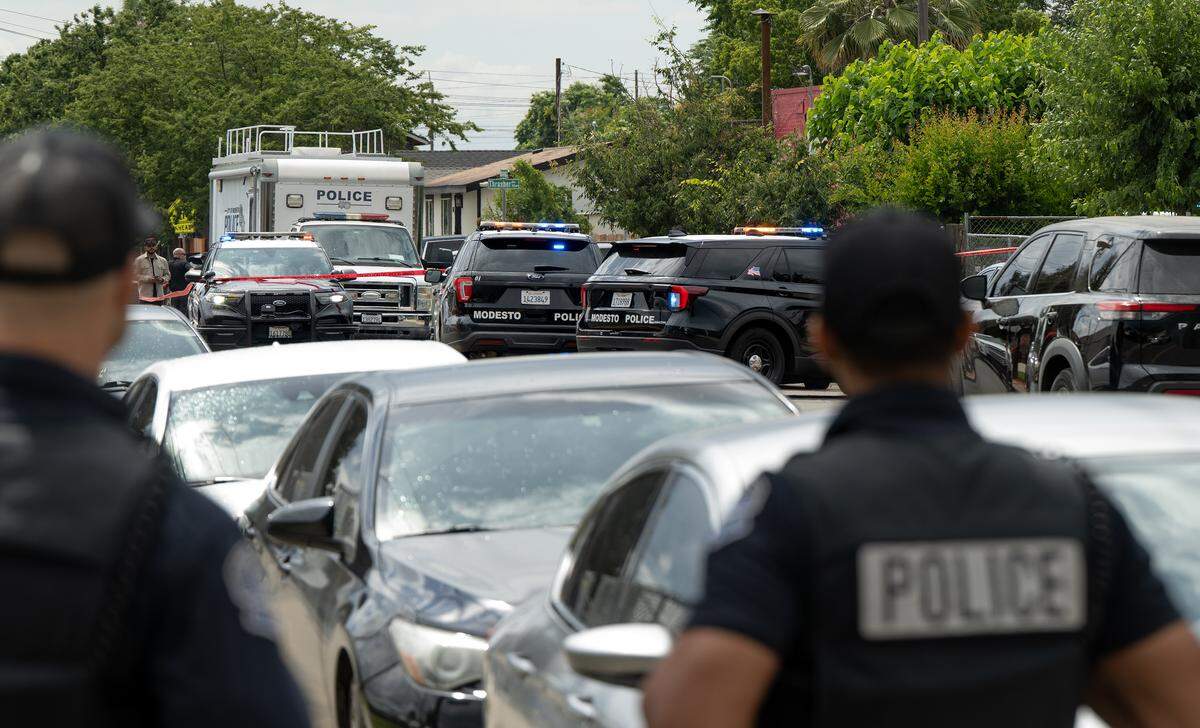
The political dispute comes as the Modesto Police Department continues its investigation of the killings.
Tuesday, the department publicly asked any additional witnesses to come forward. Anyone with information is asked to contact Detective Caldera at 209-572-9538 or calderaa@modestopd.com.
Escoto remains in custody as the criminal case proceeds through Stanislaus County Superior Court.
This story was originally published June 2, 2026 at 3:44 PM.