Homeless people in Stanislaus County have over $3 million in federal support. They can’t spend it
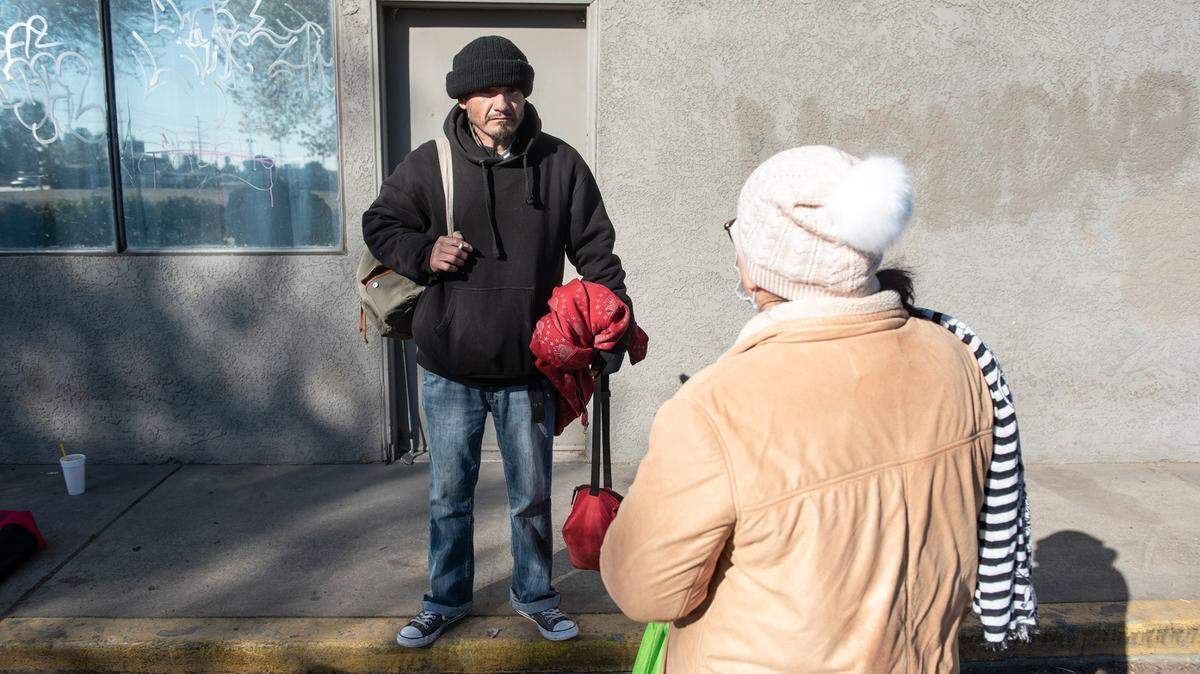
Across Stanislaus County and the Central Valley, government officials and other community leaders continue working to reduce homelessness, but data from one of the most generous federal housing programs in history show how intractable the problem can be.
Last year, as part of its COVID-19 relief package, the U.S. Department of Housing and Urban Development (HUD) offered the Stanislaus Regional Housing Authority 200 emergency vouchers, the equivalent of $3.17 million, to provide housing for those struggling with homelessness across eight counties in the Northern San Joaquin Valley and the Sierra. More than a year later, the majority of the vouchers are unused.
Instead of getting roofs over their heads, these applicants are now trapped between federal regulations and a tight housing market, unable to find homes on which to spend the money.
The emergency housing voucher (EHV) program launched in May 2021 with the goal of getting 70,000 people housed across the nation. Unlike the regular housing voucher program, formerly known as Section 8, EHV specifically targets people experiencing homelessness, those at risk of becoming homeless and those fleeing situations of domestic abuse and trafficking. The program offers tenants help with security deposits, utilities set-up, and even cash incentives to landlords who might be hesitant about renting to someone with a voucher.
Those additional benefits are unprecedented for a federal housing program, said Michele Gonzales, director of the housing authority’s voucher program.
Soon after the program launched, organizations serving the homeless started referring their clients to Gonzales for emergency vouchers. In total, the Stanislaus Regional Housing Authority received 388 referrals, of which all but about 20 came from Stanislaus County.
By the end of the year, the organization had distributed “the majority,” and by March 2022, all 200 emergency housing vouchers were handed out.
Steep competition, reluctant landlords
“It’s not as easy as it appears,” said Gonzales. A voucher can cover some or all of a person’s rent as long as the renter’s income stays below a certain level. But to use the voucher, the person first needs to find a landlord who will accept it.
Rising rents and a lack of housing supply have led to steep competition across the county. In such a hot market, those with vouchers can be a particularly tough sell for landlords, said Gonzales, because many lack strong credit histories or have prior evictions on their records.
Further, HUD has a set of rules about the way vouchers must be used and how much a person can pay. The formula takes into account two factors: the current rent estimate in the area and the person’s income. A single person at the highest end of the program’s income threshold, making $27,900 a year – about equivalent to a full-time, minimum wage job – would need to find a one-bedroom apartment for no more than $1,519 a month, including utilities, in order to use a voucher. The average market rent in Modesto is $1,535 a month without utilities, according to Rent.com.
In that scenario, 40% of the person’s income, or $931 a month, still would have to paid out of pocket. The rent cap would be lower if the landlord doesn’t cover utilities.
Gonzales said most of the domestic violence survivors or homeless individuals who receive emergency housing vouchers make much less than $27,900 a year, which means they have an even lower rent limit in their housing search.
Normally, anyone with a voucher has four months to use it, or it expires. HUD granted the Stanislaus Regional Housing Authority an exception last year that gives voucher holders an additional four months.
However, in the current housing market, few homeless individuals or domestic violence survivors with vouchers have been able to find homes that meet the federal government’s requirements.
The result is a revolving door where applicants cycle through their failed eight-month searches, one dashed hope after another. The housing authority’s exception will expire at the end of this year, meaning applicants once again have just four months to search.
Program intentionally oversubscribed
Since the program launched in summer 2021, 75 people have secured homes through the EHV program, often after months of looking. An additional 150 are still searching, but if they don’t succeed before their eight-month window closes, others will try in their place.
The housing authority has oversubscribed the program because it knows that many people won’t be able to find homes in time.
The whole program will sunset in September of 2023, at which point any unused vouchers return to HUD.
“The most frustrating thing for us is that on one hand, we’re being pushed to issue these vouchers, which I understand completely. HUD wants to get them leased up as soon as possible,” Gonzales said. But there’s a downside. Having 150 people using the same vouchers to look for similarly priced apartments in the region, all at the same time, can “saturate the market,” she said. “It kind of does a disservice to the voucher holders.”
On the national level, HUD is celebrating the program. “We are pleased to announce that over 35,000 households have been averted from homelessness and have successfully leased their own rental housing thanks to our Emergency Housing Voucher Program” said HUD Secretary Marcia L. Fudge in an October press release. Further, the release says, EHV is getting people into homes faster than any other comparable federal housing voucher.
There are substantive differences, though, between EHV and the other programs. In the regular housing voucher program, there’s not the same push to issue housing vouchers quickly. In fact, the Stanislaus Regional Housing Authority has decided in most cases not to issue regular vouchers because of the lack of housing supply, said Gonzales. HUD data confirm that no one in the eight-county region is currently searching for housing with a regular voucher.
Given the lack of supply, Gonzales added that when the housing authority does issue regular vouchers, it gives preference to people who are housed but struggling to pay for rent. She encouraged anyone who meets that criteria and the income requirements to apply.
Other communities struggling
The Stanislaus Regional Housing Authority is just one of many agencies across the state struggling to roll out the emergency vouchers. In Fresno, 27 people have secured housing through the emergency voucher program while 91 people are out searching. According to HUD data, the city has yet to reissue an additional 46 vouchers that expired after homeless individuals or domestic violence survivors failed to find housing.
HUD reports show that the county of Sacramento is roughly on par with Stanislaus County, having secured homes for just over a third of voucher holders.
In terms of reducing homelessness, the challenge is even greater. If all 200 vouchers were used this year in Stanislaus County, it would reduce the homeless population by roughly 11%.
“It’s just a very challenging population to help because there’s so many obstacles,” Gonzales said.
This story was originally published November 15, 2022 at 5:00 AM.