Why does this Stanislaus County ZIP code have the area’s most COVID cases?
Genevieve Ramirez did everything she could to keep her family safe from the coronavirus.
She would only leave her West Modesto home, which she shared with her mother and sister, to buy groceries. She wore a mask religiously and didn’t attend any large gatherings, said her son, David Ramirez.
Ramirez said his mother would almost run through stores to buy essentials and get out as quickly as possible.
“I always told her she needed to just slow down and not get so panicky, but she would almost get into a state of panic when she would have to go into stores because she was afraid,” Ramirez said. “She also knew if she were to contract it, she was going to expose her mom and sister to it because she would bring it into the house.”
Despite her best efforts, the three West Modesto women could not escape the pandemic.
Ramirez said his mother, Genevieve, 73, and grandmother Frances Jacobo, 90, were the matriarchs of the family, as well as every member’s best friend. They died from COVID-19 complications four days apart on Aug. 28 and Sept. 1.
Genevieve’s sister contracted the disease as well, and has survived.
The three Mexican-American women lived in an 1,100-square foot, three-bedroom house in the Emerald Gardens neighborhood near Mark Twain Middle School and Modesto High School. The family has owned the house since 1962, said Marvin Jacobo, Frances’ son.
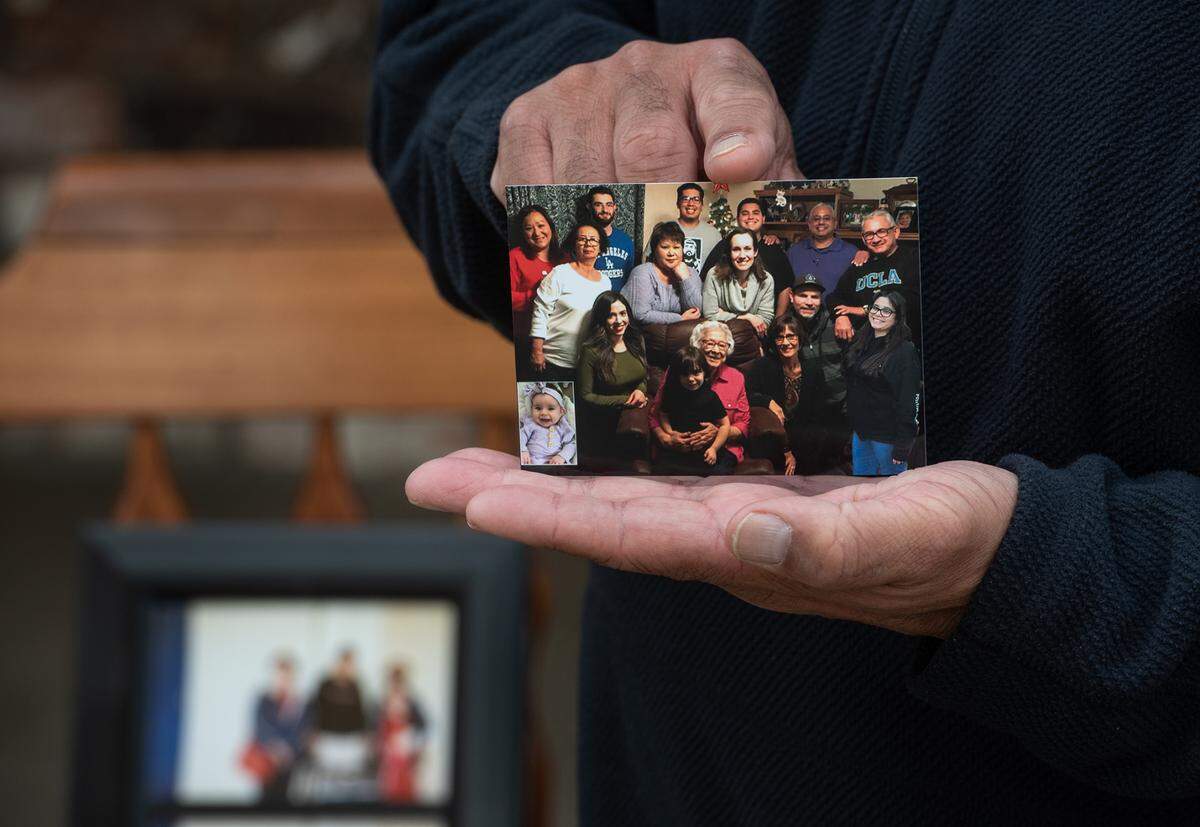
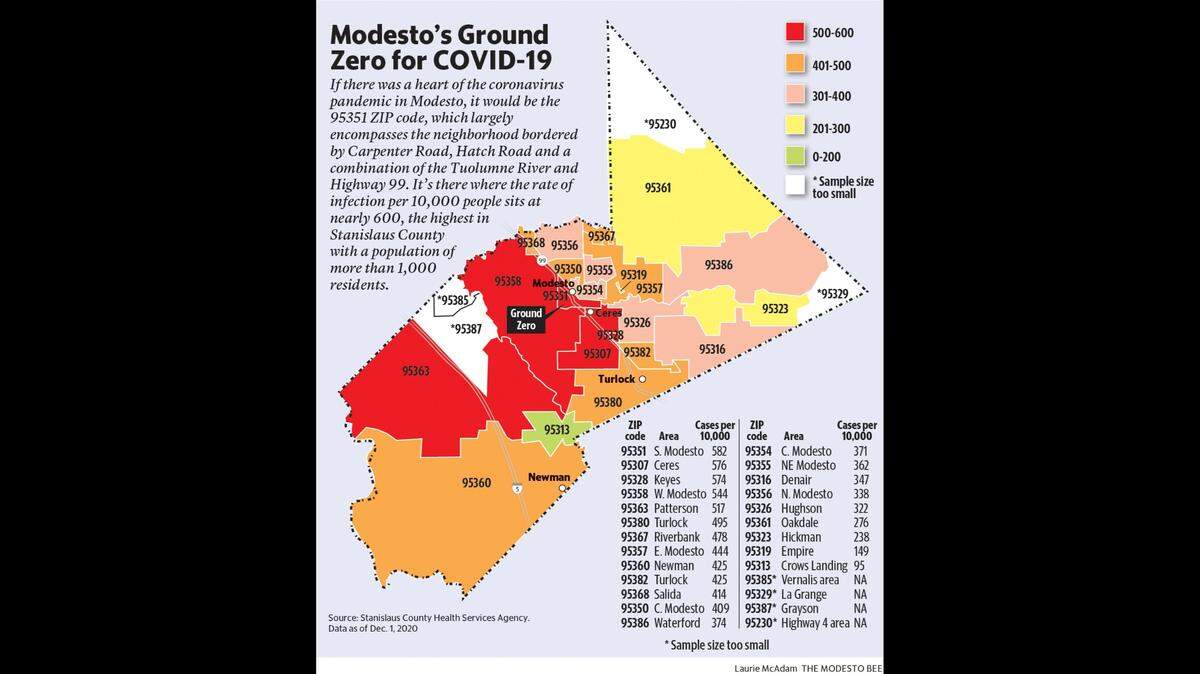
Their household represents three of the more than 2,700 known COVID-19 cases in the 95351 ZIP code. The Stanislaus County neighborhood holds the distinction as the ZIP code with the highest COVID-19 case rate in the county: Roughly 580 per 10,000 residents.
If there was a heart of the pandemic in Modesto, it would be this neighborhood bordered by Carpenter Road, Hatch Road and a combination of the Tuolumne River and Highway 99. The predominantly Latino neighborhood has a median annual income of $31,600, about half of the national average, and a higher-than-average household size of 4.3, according to Census data.
As COVID-19 surges once again in California, this one ZIP code grimly illustrates how the pandemic has disproportionately harmed low-income and majority Latino communities, in part because essential workers in food production and warehousing may get exposed on the job, then bring the virus home to multi-generational households. Latinos in Stanislaus County account for 64% of known COVID-19 cases despite making up 47% of the population.
While community organizations, the county and churches have tried to slow the spread and support residents in the 95351, the cases have not stopped. To health officials, the neighborhood serves as a forewarning of the long winter ahead.
“The numbers are going up across the county, so our message really needs to be: wear a mask and social distance as much as possible,” said county epidemiologist Lana O’son. “...We need to stay vigilant because we don’t want our hospitals to get overwhelmed like we’re seeing in other states right now.”
How COVID-19 spread through one Modesto house
A retired nurse, Genevieve at first thought her head pain and runny nose were consistent with her typical sinus infections.
When Ramirez took his mother to the Memorial Hospital emergency room two days after those symptoms started, the staff took X-rays, agreed with her diagnosis, and sent her home with antibiotics and an inhaler. They also tested her for COVID-19. Ramirez said they did not use a rapid-testing kit, and she returned home to wait for the results.
Later that night, Genevieve developed a cough. Two days later on Aug. 13, she collapsed because her oxygen levels had dropped. The hospital admitted her immediately. The family learned that she had tested positive that day, Ramirez said.
Ramirez said the two other women in the house, grandmother Frances and Genevieve’s sister, along with Marvin Jacobo, quickly drove to Salida to get tested.
By Aug. 16, Frances was feeling COVID-19 symptoms. Marvin transported his mother, a retired farm worker, to the hospital as well. It was the last time Jacobo would interact with his mother in person.
In their last call, Jacobo recalled her asking, “Why is this happening to me?” and struggling to breathe. Questions about their preexisting conditions, Jacobo said, indirectly minimize the danger of the pandemic.
“For us to lose them this way, it’s not about my mom being 90 years old,” Jacobo said. “This was about something that was preventable and something that did not have to happen.”
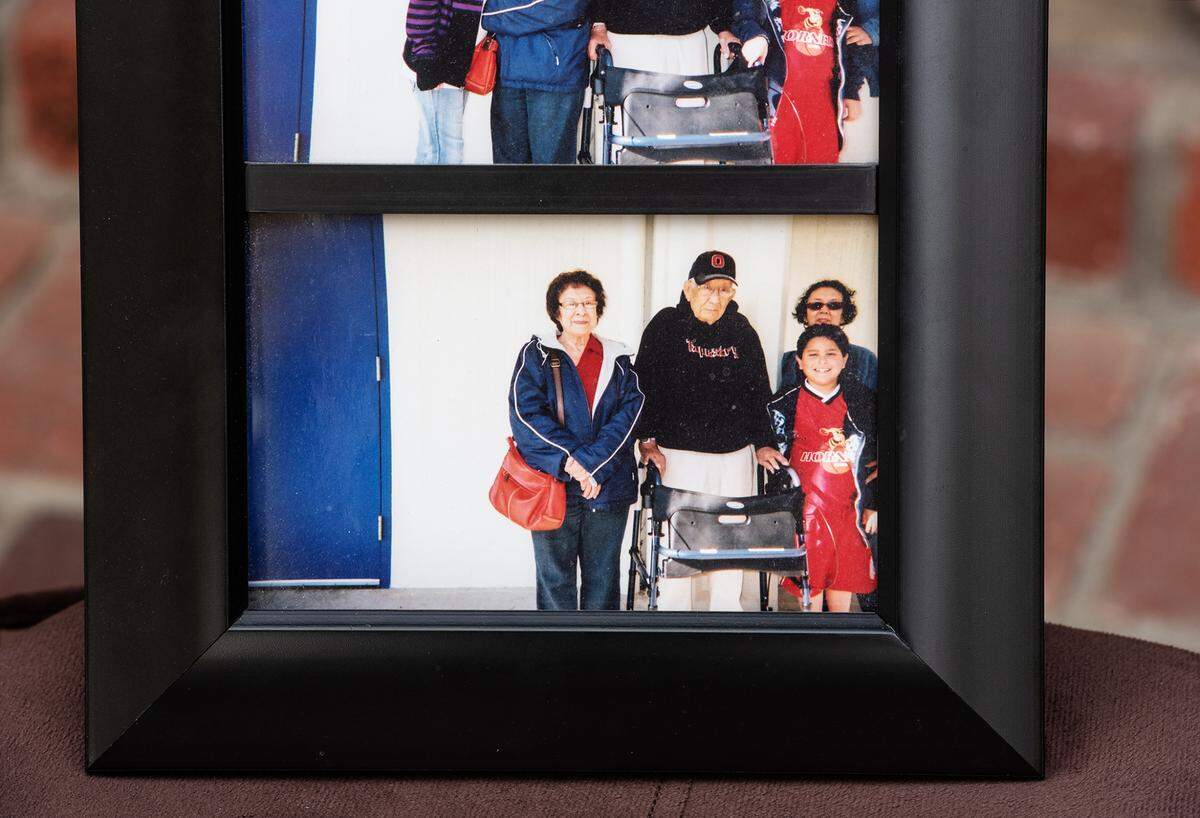
Before doctors put Genevieve in a medically induced coma, Ramirez said his mother was extremely healthy and could keep up with her 4-year-old great-granddaughter. In her last moments, she could only mouth, not speak, “Love you.”
The family held a dual burial for Genevieve Ramirez and Frances Jacobo in November, after the younger sister recovered from COVID-19 both at a hospital and a rehabilitation center.
”Everything revolved around our family (for my grandmother) and it shows because we are weathering this tragedy as a family,” Ramirez said. “We are sticking by each other and we are taking care of each other all because of these two women who prepared us.”
Why has this neighborhood been hit so hard?
Stanislaus County Health Educator Bobby Moser, like others interviewed for this story, said the high population of essential workers in west and south Modesto may not get paid time off and must often work in-person, meaning they have more chances of exposure.
The prevalence of low-income, multi-generational households also contributes to the spread, Moser and epidemiologist O’son said, partly because families have close contact with each other and may have difficulty isolating. About 47,000 people live in the 95351 ZIP Code, according to Census data.
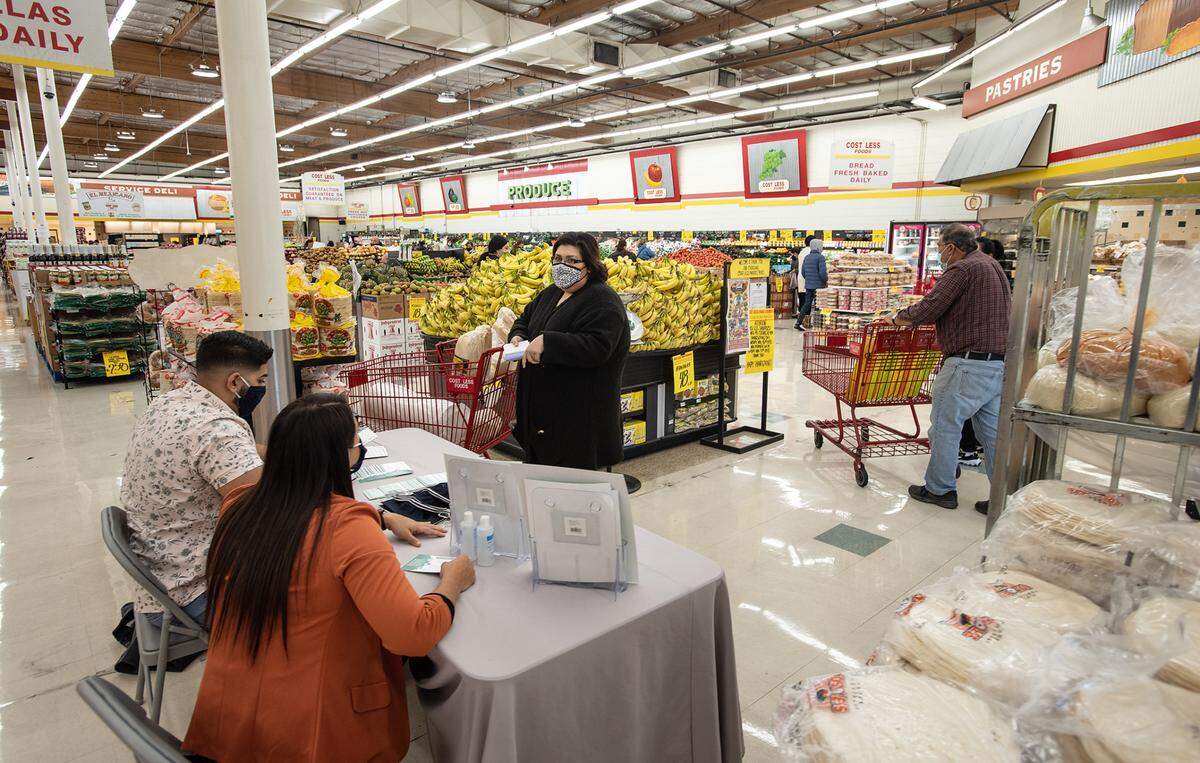
Area residents are also more likely to lack access to health care or insurance, Moser said, and have fewer places to exercise and buy fresh produce compared to other county ZIP codes. Although the neighborhood includes smaller markets, the Cost Less on East Hatch Road is one of the only major grocery stores within the neighborhood.
“They’re running against the wind already,” Moser said, “and COVID-19 has just exacerbated all of those discrepancies that were already there in those communities.”
Investigators have seen high numbers of positive cases connected to warehouses and factories as of mid-November, O’son said. But it’s unclear which businesses in Modesto have become hotspots for COVID-19. The county denied The Bee’s public records request for the names of businesses recording outbreaks of 10 or more cases, saying it believes the public will be deterred from reporting outbreaks if the information is disclosed.
But it’s clear residents of the ZIP code are moving in and out of their large households and businesses where they work.
One West Modesto woman dramatically illustrates the difficulty in containing the virus in large families where economic survival means continuing to work despite illness. Maria, who requested anonymity because she fears losing her jobs, said she initially attributed a tingling in her throat to allergies for about three days.
Then on July 18, she developed extreme pain and one of her household members went to the hospital for COVID-19 a couple days later. Her entire multi-generational household eventually contracted the disease, and Maria said the first one to get the virus caught it at work, and was asymptomatic.
During a doctor’s visit on July 22, her test results came out positive and he sent her home with medication. Although Maria acted cautiously, she said she did not expect to get sick with the respiratory disease because she was healthy and took care of herself.
“It’s a virus that just gets you,” Maria said. “You need to take precautions. If they’re asking you to wear a mask, you need to wear it. … If they’re asking you to maintain your distance with other people, you need to do it because you don’t know if someone is really sick.”
Over the next week, her symptoms worsened and she self-monitored her oxygen levels. When she explained the continuing illness, the Modesto sanitation company she worked for gave her another 14 days off in addition to the initial two weeks off they allowed after the household exposure.
In late August, Maria said her employer asked her to return to work. She tried to push through, climbing ladders and stairs, but she could not breathe after an hour of carrying the sanitizing hose machines. I can’t do this job anymore, she told management, so they asked for a doctor’s note.
Maria personally delivered the requested note in late September and explained how the doctor said she can no longer work under strenuous conditions. The notice didn’t have an end date considering he doesn’t know if she will ever recover. Experts are still researching long-term effects of coronavirus infections, Maria said.
Her employer stamped the letter and gave her a copy, then later called her to work in a different department involving tasks she felt more comfortable with physically.
But after she called in sick on Nov. 13, Maria said she received a letter saying she had 72 hours to present herself to work. By the time she understood the notice through the brain fog caused by COVID-19, management told her she was fired on Nov. 20.
They said they could not find the doctor’s note she gave them, and if she had issues to take it up with her union.
Financially, Maria cannot afford to not work and said she has considered asking the union about her options. Currently, she works through temporary employment agencies and is packing chocolates in lightweight boxes.
Maria is still dealing with long-term complications from the disease, ranging from chest pain, difficulty breathing, lapses in memory and confusion. Even when running errands such as loading water into her car, she feels a pressure in her chest that makes breathing difficult.
“I feel like I want to cry when I remember all of this,” Maria said. “Another thing that’s very sad: it’s been two to three weeks now that my hair has been falling out. It’s horrible. Imagine ... my house, car, my sweaters, all of my clothes are covered in hair.”
Efforts to slow coronavirus spread
How the 95351 ZIP code — home to True Light Community Church — accounts for the most COVID-19 cases since tracking began comes as no surprise to Pastor Carl Bryant.
West Modesto is predominantly Latino and African American, Bryant said, and the trend follows national statistics showing COVID-19’s disproportionate effects on communities of color. True Light’s membership is about half Black, and Bryant said a Spanish-speaking church also meets in their building off Paradise Road when indoor services are allowed.
To support the west Modesto church’s roughly 45 members, Bryant said church leaders call them on a weekly basis to see if they need anything. At least one member has tested positive for the virus, but Bryant said nobody has entered the building while infectious.
No outbreaks have occurred at St. Stanislaus Catholic Church either, said Deacon Jose Reyes, parish life coordinator.
But the church, which owns one campus on Maze Boulevard in west Modesto and another just outside the 95351, has held at least a dozen funerals for COVID-19 victims. About 4,500 families are members of the church, Reyes said, and 60% are Latino.
Like households and businesses, Reyes said west and south Modesto churches are feeling the loneliness, financial impact and uncertainty of the coronavirus. At the same time, he said he acknowledged how residents’ COVID-19 experiences vary from the loss of a job to dying alone at a hospital.
“We are all under the same storm, but we are not all under the same boat because each family, each group, each community is experiencing the pandemic in different ways,” Reyes said. “...But I think once we all understand the seriousness of it, we will really embrace what we need to do to do our part. If everybody does their part, I’m sure that the pandemic will be just a memory of the past.”
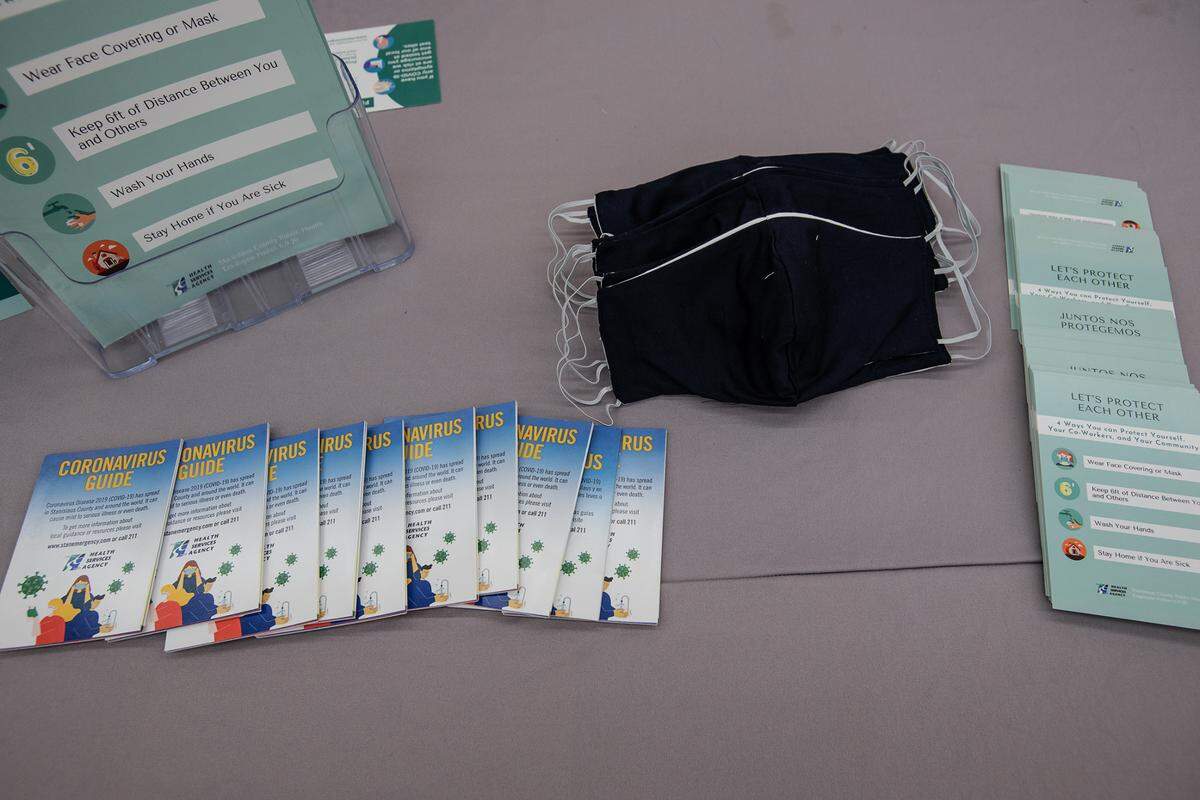
For its part, Stanislaus County investigates and tries to prevent future COVID-19 outbreaks, O’son said. When the county gets notified of a COVID-19 patient who worked during their infectious period, O’son said a team calls businesses for contact tracing, asks about social distancing protocols, provides recommendations to stop the spread, performs a site visit and offers in-person coronavirus education sessions to employees there.
In addition to the business outreach team of about 10 people, Moser said the county has two employees dedicated to educating the most impacted communities with the highest case rates. The county also partners with community-based organizations, providing funding and technical help to organizations Moser said know their neighbors best.
The West Modesto Community Collaborative was one of the five nonprofits the county paid about $1.2 million in August to support “hard-to-reach populations,” according to Board of Supervisor documents.
Since March, Executive Director Perfecto Munoz said some of the collaborative’s efforts include distributing coronavirus information in Spanish whether over Facebook live or with flyers at churches and referring residents who test positive to hotel room quarantine programs if they lack space to isolate at home.
While the county can provide resources to slow the spread of the coronavirus, Munoz said community members drive change.
“Change only occurs when people in the community become the change agents,” Munoz said. “For me, that’s critical to how we address this virus. We have to come together as a community and make the conscious decision that these are the things we need to do and how we’re going to collaborate together.”
Other non-profit leaders have called on the county to act further and directly support communities the coronavirus has hit the hardest.
Latino Community Roundtable President Aaron Anguiano said little progress has been made in slowing the spread in underserved communities such as west and south Modesto. The ethnic disparity for Latinos remains unchanged from May, when the county first reported COVID-19 data by race.
Anguiano recommended the county give grants to families who lost loved ones to COVID-19, saying federal CARES Act money can help cover funeral expenses and lost household income. Creating a centralized county website explaining where to go for coronavirus-related assistance can help residents find services immediately, said Anguiano, adding that communities would benefit from a county rent and utility assistance program, too.
Streamlining communication about assistance programs can also give residents adequate time to apply, said South Modesto Partnerships President Jose Sabala. Another solution is providing more resources in Spanish, Sabala said. He gave an example of how mostly English messaging on county business grants contributed to South and West Modesto businesses not knowing about the opportunity before his organization contacted them.
“We need more assistance in providing information to our communities in a timely fashion,” Sabala said in an email. “What we have found is that deadlines for applications to grants or resources for businesses and families get to us way too late. It is as if our community gets the crumbs.”
This story was originally published December 3, 2020 at 5:00 AM.