Latinos being hard hit by coronavirus in Stanislaus County. What the data reveals
The impact of the coronavirus on the Latino community is an untold story.
According to newly released ethnicity data from Stanislaus County health officials, Latinos account for 64 percent of the 488 confirmed cases of COVID-19 illness, even though they represent 47 percent of the county’s population.
The numbers released this week revealed a huge ethnic disparity. Only 23 percent of those who have tested positive are white residents, who represent 41 percent of the county population.
Six percent of confirmed cases are Asian, 4 percent are African-American and 1 percent are Pacific Islander.
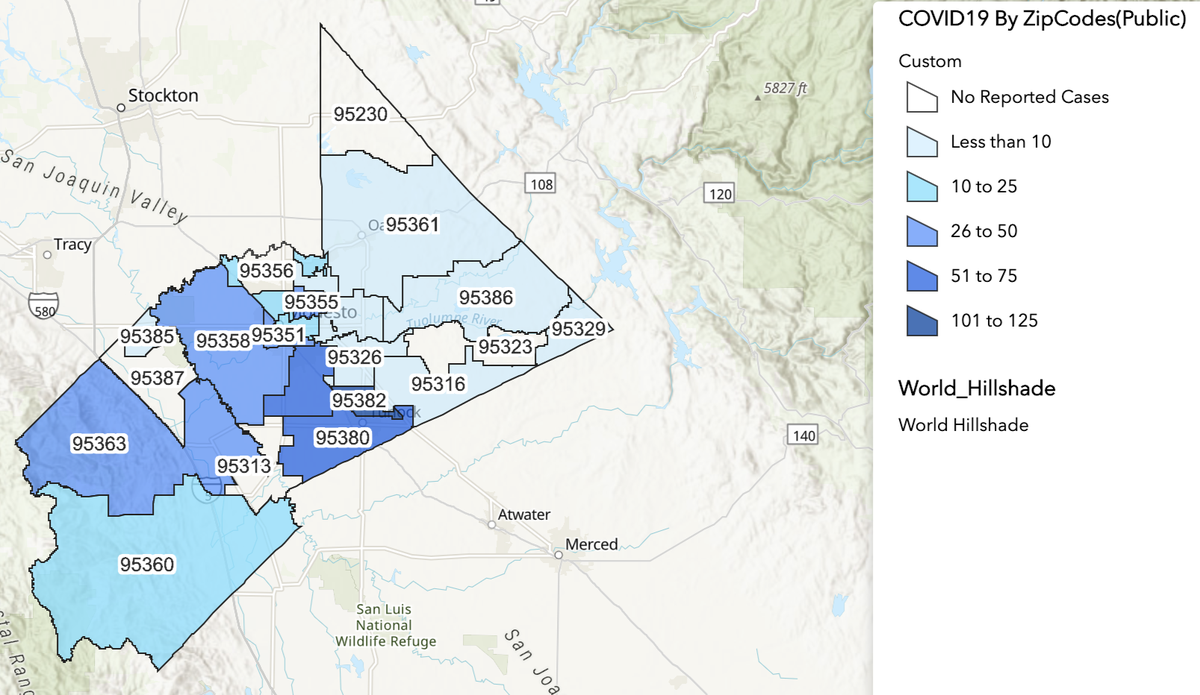
The impact on the Latino community is also reflected in incomplete state statistics and revealed in zip code data released by the county this week.
The predominantly Latino neighborhoods of west and south Modesto, where median income is $31,600 annually, have a higher concentration of COVID-19 cases at 9.18 per 10,000 residents.
The impact of the coronavirus has been lighter in neighborhoods with higher incomes. The caseload rates are 4.6 percent per 10,000 in northeast Modesto, where median income is $55,000, and 4.3 per 10,000 in central Modesto, where median income is $39,200.
While the numbers are relatively small — 43 cases in west and south Modesto (95351), 22 in central Modesto (95350) and 27 in northeast Modesto (95355) — health experts believe the positive tests are a fraction of people infected by the coronavirus.
Latinos work in essential industries
One reason cited for the higher level of infection in Latinos is that many have continued to work during the statewide shutdown.
“Latinos are more vulnerable because they face greater barriers to health and are more likely to be working in essential service roles,” said Sandra Hernandez, chief executive officer of the California Health Care Foundation, a nonprofit dedicated to advancing improvements in health care delivery.
Hernandez took part in a TV news station forum Thursday on COVID-19 impacts on Latinos in the Bay Area.
According to the takeaways, sheltering in place is difficult for many Latinos who fear they need to keep working to pay steep costs for housing. They fear the virulent COVID-19 disease but are more afraid of being unemployed. Undocumented people are cut off to federal assistance if they test positive and are unable to work.
Chronic conditions such as a diabetes are prevalent in the Latino community increasing the risk of a serious or deadly bout with coronavirus.
With the release of the data, Stanislaus County officials defended their efforts to inform the Latino community about the threat of C0VID-19, which have included the Stanemergency Facebook page in Spanish, radio spots and health advisories for Spanish speakers.
Homero Mejia, who has done community work for years, said he finds Latinos in Stanislaus County are aware and concerned about the coronavirus, but several things could make them vulnerable to the outbreak.
Social distancing doesn’t come naturally for some Hispanic families, which are often larger, making it difficult to isolate a person who’s sick in a room inside the home, he said.
Economic pressures may force multiple families to share a dwelling. According to Census data, the average family size is 4.3 in west and south Modesto, higher than other zip codes and the national average of 2.6.
Some community advocates urged caution in discussing the race and ethnicity data out of concern of spurring race-baiting or decreasing compliance with health orders to control the outbreak.
Mejia said Latino employees working for essential industries may have gotten a late start on securing gloves or masks to protect themselves on the job. The charter school outreach manager serves on the board of several nonprofit groups.
Coverage of the pandemic is nonstop on Spanish media outlets, said Mejia, who also contributed a voiceover for Sheriff Jeff Dirkse urging people to cancel Cinco de Mayo events and observe distancing if they gathered with family members.
“Older people are not on social media and are more vulnerable because of their age,” Mejia said. “Once the county knows this is happening, they could potentially do more (public education.)”
Aaron Anguiano, president of the Latino Community Roundtable, said Hispanic workers for food outlets, warehouses and supermarkets have a higher risk of infection. If the state allows bars, theaters and other businesses to reopen soon, more low-wage workers will be exposed to infection, he said.
“Yesterday, I went to (a supermarket) and saw employees who were not wearing masks,” Anguiano said. “Right now, the rate of infection seems like it’s going higher. I’m worried we are not flattening, yet.”
The pandemic suddenly touched Anguiano’s family in the past week. His brother in Guadalajara, Mexico, experienced abdominal pain and respiratory symptoms and was diagnosed with COVID-19. He was placed in the hospital earlier this week and given a 5 percent chance of living.
Dr. Silvia Diego, a Modesto physician, said the contagious virus can quickly overcome a patient. An expectant mother with symptoms was in the doctors office one morning and by afternoon was fighting for her life. She was sent to a Bay Area hospital and recently returned home after almost two weeks on a ventilator.
“I have another family who tested positive and the mom and babies have no resources,” the doctor said. “If the mom gets sick, what happens to the children?”
STANISLAUS DATA INCLUDES MORE DETAILS
The county did not release specific data on how many working-age Latinos have tested positive. People age 60 and older represent about 25 percent of cases countywide and the largest bulk of cases (72 percent) are in the 21 to 59 range.
More than 70 percent of cases have resulted from contact with an infected person, which theoretically could mean a workplace infection. It’s also consistent with reports the illness has spread among family members in homes.
Still, areas of Modesto with higher incomes are not immune, according to zip code data.
The suburban area north of Standiford Avenue to Del Rio (95356), where median income is $62,000, has 25 cases or 8.15 per 10,000 residents.
The downtown, combined with the La Loma and airport neighborhoods (95354), has 10 cases or 3.96 per 10,000. Median income is $36,300.
The zip code data shows Ceres, Salida, Patterson and Turlock have elevated rates of infection. Turlock’s 95382 has a county-high 28.75 cases per 10,000 residents, mainly due to an outbreak at Turlock Nursing and Rehabilitation Center resulting in 131 cases among residents and staff and 11 deaths.
More health information and support
Royjindar Singh, a spokesman for the county Office of Emergency Services, said the agency has partnered with a Latino Emergency Council in spreading the message on the dangers of coronavirus.
Learning that migrant farmworkers tune in to Spanish radio, Singh said, the county bought air time for broadcasting safety messages several times a day.
Since last week, the county has also promoted the new coronavirus testing sites in Keyes and Patterson, which are strategically located for Hispanic residents.
Golden Valley Health Centers, which operates community clinics in Stanislaus and Merced counties, listed nine different efforts to get information on the coronavirus to farmworkers, Latino residents and patients in the language they speak.
It could be public health information only goes so far in slowing the spread of contagious disease.
Hernandez, of the California Health Care Foundation, said in addition to health information, treatment resources should be targeted to the Latino community in a culturally and linguistically appropriate way.
County Supervisor Terry Withrow said Friday he expects part of the $96 million in federal CARES Act funding to the county will be directed to support small businesses in the Latino community and address other needs.
“We are looking at getting to those people who have not been able to apply for the federal money that’s out there,” Withrow said. “We are trying to come up with a plan to deploy in the community.”
This story was originally published May 9, 2020 at 7:53 AM.