Pesticides waft near Stanislaus County schools. Which are at highest risk?
AI-generated summary reviewed by our newsroom.
- Advocates press California to ban fumigants and expand one-mile school buffers
- DPR plans new 1,3-Dichloropropene rules, field studies, aiming for Jan. 1, 2026 effect.
- Data show 24 Stanislaus schools within 0.25 mile of restricted pesticide use.
Over the past two months, Aoly Vilchez, a mother of a freshman at Gregori High School, has received more than 20 notifications from the state, alerting the use of pesticides near her son’s school.
With over 2,400 students and surrounded by extensive agricultural areas, Gregori is among the top four schools in the county for risk of pesticide exposure.
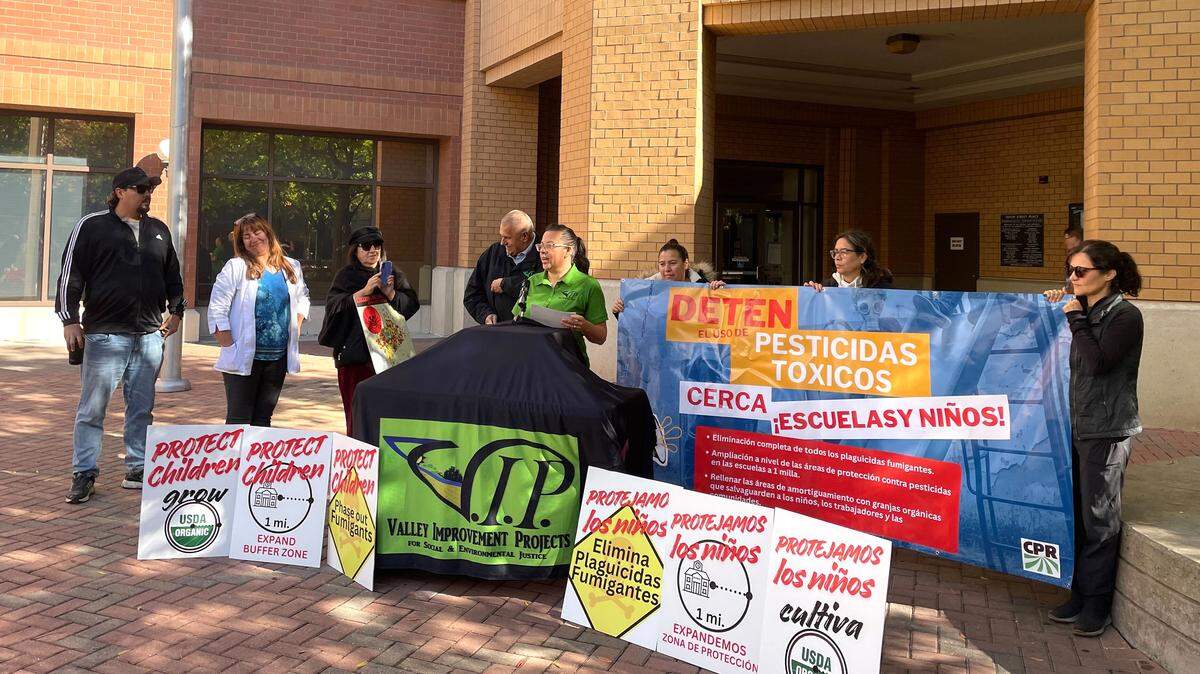
Vilchez joined community members in Stanislaus County on Tuesday as part of a statewide effort to end the use of harmful fumigants near schools.
Modesto was among five California communities participating in a coordinated press conference as part of a day of action led by the Californians for Pesticide Reform. The event highlighted concerns over the state Department of Pesticide Regulation’s new rules on 1,3-dichloropropene and data showing increased use near schools and daycares.
The press conference on Tenth Street Plaza in Modesto, hosted by the local nonprofit Valley Improvement Projects, was held alongside similar events in Watsonville, Fresno and Oxnard.
DPR recently finalized regulations on 1,3-Dichloropropene that still permit exposure levels up to 14 times higher than the lifetime cancer risk threshold set by the Office of Environmental Health Hazard Assessment, or OEHHA.
While 1,3-D is banned in more than 40 countries, it’s still widely applied in Stanislaus County, particularly before planting sweet potatoes, almonds and cherries.
Community members are calling for a statewide phaseout of all fumigant pesticides, an expansion of school buffer zones to at least one mile and the transformation of these buffer areas into organic farms and green spaces. Buffer zones are designated areas around pesticide application sites where certain activities are restricted to reduce human exposure.
“We oppose a system that treats children as acceptable collateral damage,” said Bianca Lopez, co-founder of VIP and member of the Environmental Justice Advisory Committee at the DPR.
In a statement to The Bee, the Department of Pesticide Regulation said it is collaborating with the OEHHA to develop regulations that would further limit the use of 1,3-D. Proposed measures include expanded buffer zones and ongoing evaluations of exposure risks to better protect nearby residents. These regulations would build on restrictions that DPR implemented in January 2024, which OEHHA reviewed in a consultative role. If approved, the new rules would take effect on Jan. 1, 2026.
DPR is also conducting field studies with OEHHA to better understand worker exposure to 1,3-D, and said the findings will guide future policy decisions. The department also added that OEHHA’s Proposition 65 guidance serves a different purpose than the regulatory limits set by DPR.
“While Prop. 65 is a guide for when a warning is needed (and can prod businesses to reduce use beyond what a regulation requires), DPR regulations restrict use,” the statement reads.
“The California Department of Pesticide Regulation (DPR) is committed to protecting public health and the environment through science-based regulation of pesticide use, including 1,3-dichloropropene (1,3-D). We recognize the concerns raised by community members and advocacy groups and take them seriously,” the statement read.
Between 2023 and 2024, 1,3-D emissions decreased by 29% primarily due to the change in fumigation methods required by the 2024 regulation, the department added.
School exposure
During the 2024–25 school year, 24 schools in Stanislaus County were within a quarter-mile of areas where restricted pesticides were applied, with more than 10,340 pounds of these higher-risk chemicals used, according to data compiled by VIP.
The schools nearest the largest amounts of pesticide applied that year were Chatom Elementary, Chatom State Preschool, Cunningham Elementary and the Cunningham Head Start-Turlock Joint Elementary daycare.
1,3-D is the most applied pesticide near the schools in Stanislaus County.
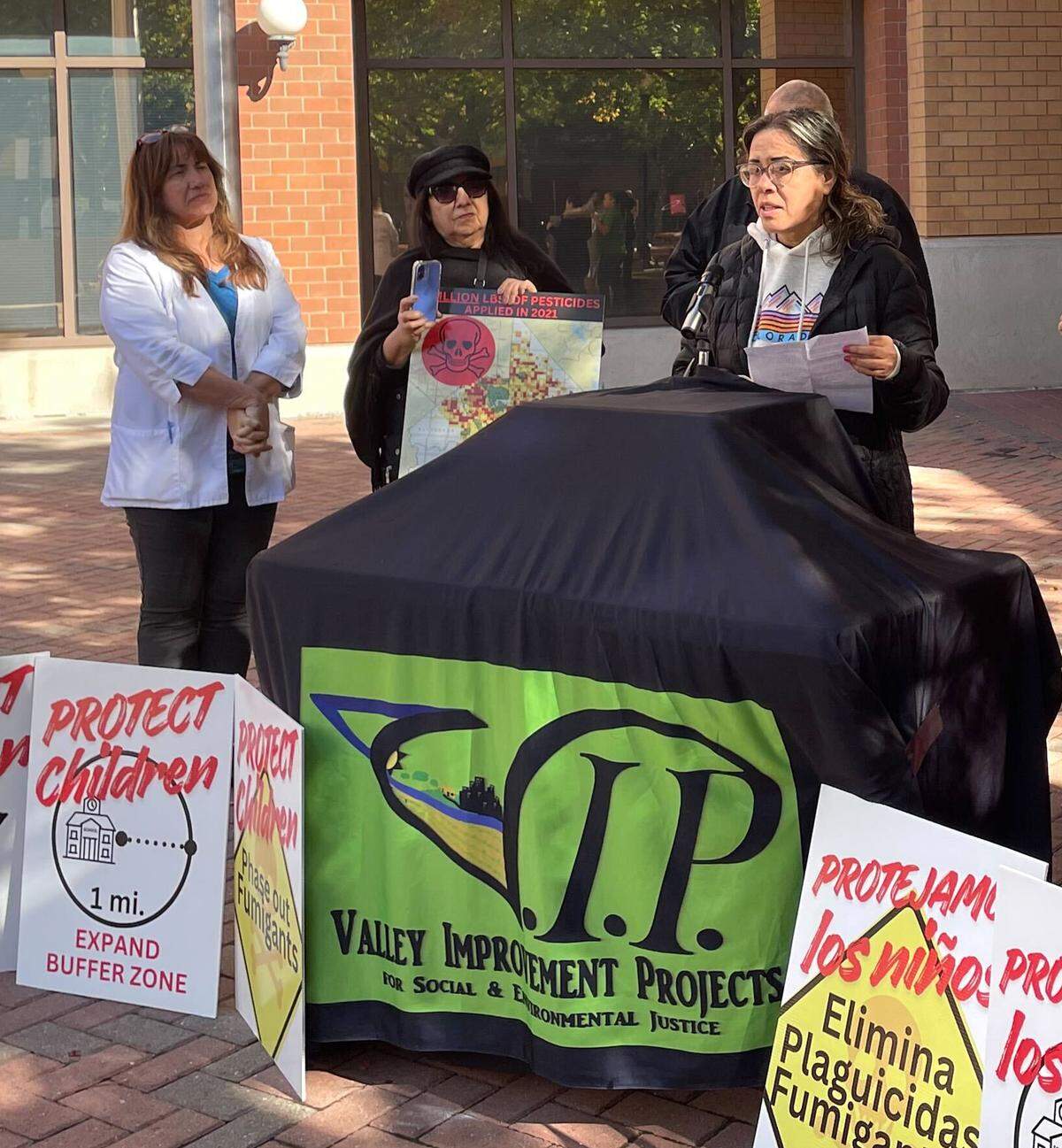
“Simply knowing what pesticide will be applied, when, and roughly where does not replace the need for precise, accessible and consistent data on the real levels of exposure in the air our children breathe every day,” Vilchez said in Spanish.
Over the past three years, Stanislaus County has recorded two incidents of pesticide drift — the unintentional movement of pesticide particles or vapors through the air during or after application — at schools. One incident occurred at Modesto Christian School and the other at Great Valley Academy. A combined 25 people at the two schools had symptoms of pesticide exposure.
Pesticide drift can expose nearby residents to harmful chemicals, potentially causing eye and throat irritation, nausea and, depending on the chemical, more serious health effects.
“What connects both incidents is something deeply concerning: School staff did not know how to properly report a pesticide drift incident,” Lopez said. She said when incidents go unreported, the state gets to ignore the problem, thinking the system is working.
Residents can register for notifications through “Spray Days,” a statewide online system that alerts the public when restricted materials pesticides are scheduled to be used. Users can use an interactive map to see next-day applications, receive 48-hour notices for fumigants and sign up for text or email alerts about restricted-use pesticides.
The system was launched in California earlier this year.
Health risks
Mechelle Perea, a nurse practitioner and professor at Stanislaus State University’s School of Nursing, said children are most vulnerable to the health effects of pesticide exposure because their bodies are still developing. She noted that children often spend time on the ground, where pesticide residues can accumulate, or in grass that may be affected by drift.
Exposure to 1,3-D, including in the womb, has been linked to cancer, neurological and brain disorders, respiratory problems and kidney disease.
“If we would never allow a bottle of poison to sit open on a counter, why would we allow fields of poison to surround our schools,” Perea said.
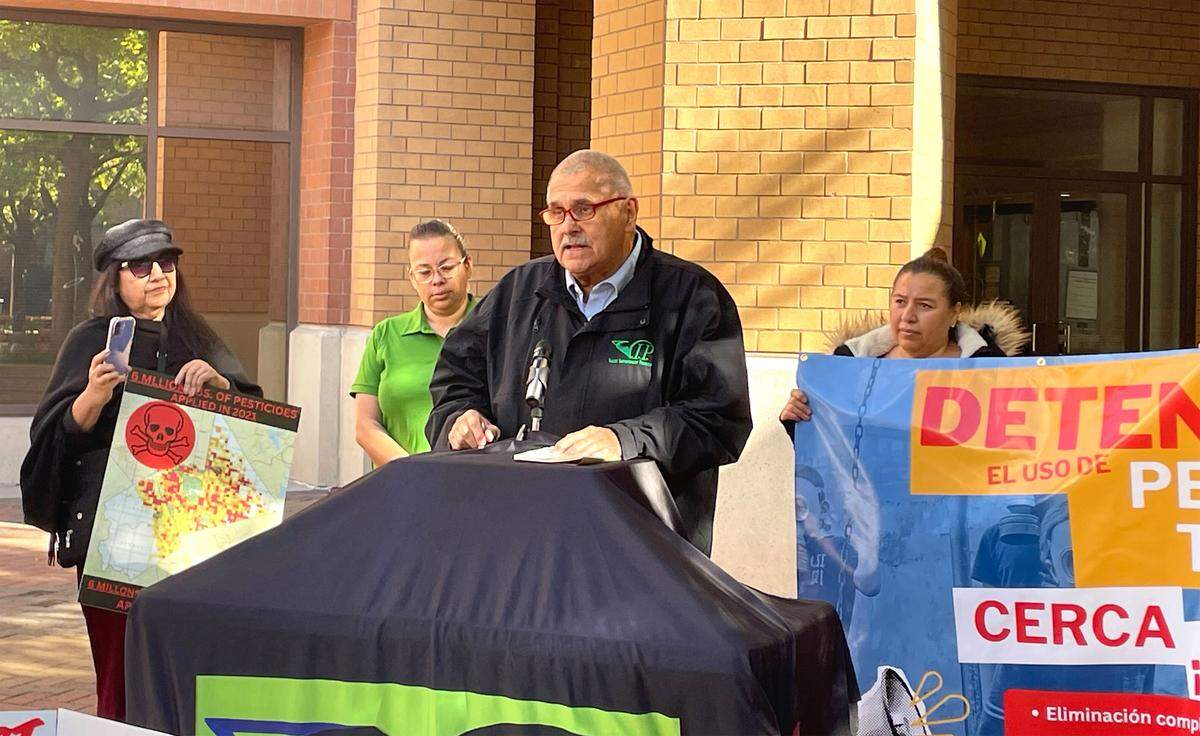
John Mataka, Grayson resident and member of VIP, said the state’s policy is an example of environmental racism, as Latino and Indigenous farmworker communities bear the highest exposure rates.
Solutions and demands
The Stanislaus County Emissions Reduction Plan, backed by VIP and the Central California Asthma Collaborative, is a grassroots initiative that identifies local pollution sources and proposes solutions grounded in environmental justice and public health.
In addition to pesticide use, the plan highlights pollution from heavy-duty trucks and diesel emissions, dairies, landfills and rail yards. Proposed measures include expanded asthma education, development of zero-emissions freight infrastructure and policy reforms focused on land use and coordinated enforcement.
The plan also calls for expanding buffer zones, providing funding and incentives for organic farming practices and including pesticide use data and trends in agricultural reports.
Mataka urged counties, cities and school districts to act immediately by implementing stronger protections that go beyond state minimum standards. “Waiting for Sacramento to do something is accepting continued harm,” he said.