What is pesticide drift and why is Stanislaus environmental group worried about it?
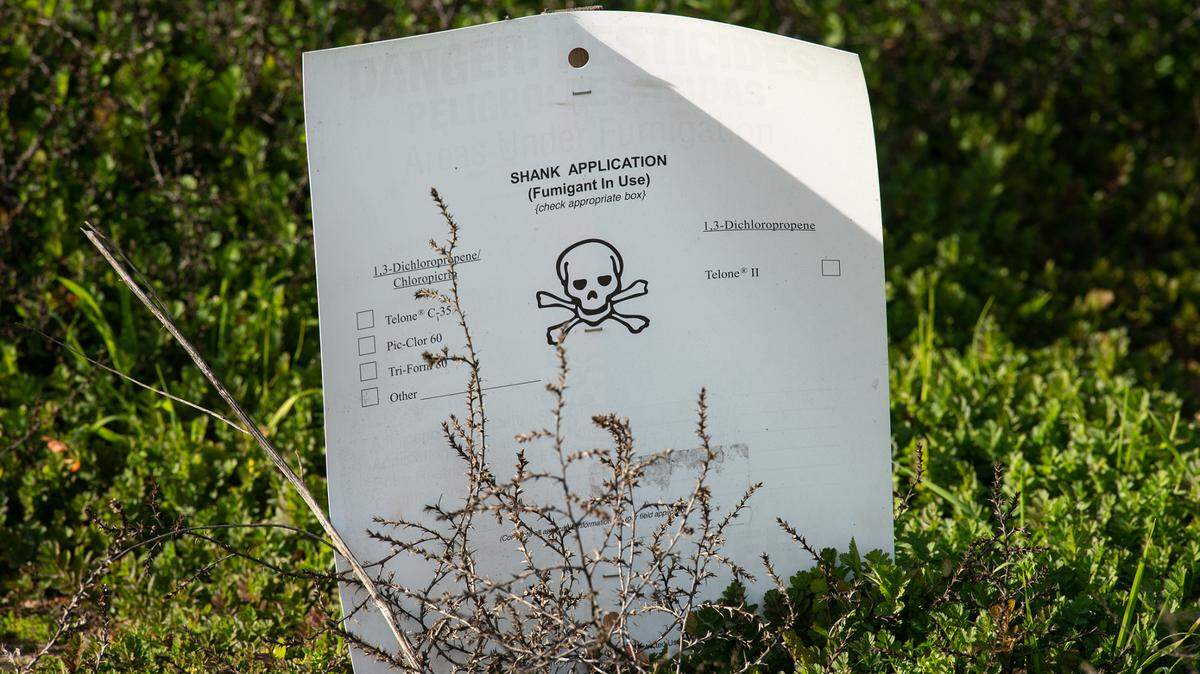
Valley Improvement Projects released its Stanislaus County Emissions Reduction Plan the same day the the state listed the county as the fourth largest user of a highly regulated pesticide.
At an Oct. 1 meeting, VIP co-founder Bianca Lopez introduced the emissions reduction plan, which incorporated community feedback. One of the recommendations relevant to pesticide use was an increase in buffer zones for fumigants.
Currently, the buffer zone to help mitigate the drift of a sprayed pesticide from its intended crop, is a quarter mile. This plan advocates for an increase to a mile-wide buffer.
“One quarter mile isn’t sufficient for us, and we have a lot of data that shows that pesticides drift well beyond a quarter mile,” Lopez said.
Stanislaus County residents gathered on the first of this month in the Waterford community center and on Zoom to hear from the California Department of Pesticide Regulation (DPR) and the Stanislaus County agriculture commissioner on what is being done to regulate pesticide use by growers.
Lopez wore to the meeting a shirt that read in English and Spanish, “Stop pesticide secrecy.” After opening the meeting, she gave the floor to DPR staff for a brief presentation on their role and structure.
In 2024, Stanislaus was ranked fourth among California counties in use of a pesticide, known as 1,3-dichloropropene or by its brand name, Telone, according to a DPR draft report issued Oct. 1. Telone is a pesticide that can cause skin and eye irritation and breathing issues in the short term, and can increase risk of cancer in the long term.
Fidel Perez, chief of enforcement regional offices at DPR, said he and his colleagues work with county Agriculture Commissioner Linda Pinfold to clarify laws and regulations around pesticide use and conduct investigations and inspections into pesticide use.
Pinfold is responsible for approving permits for growers to apply regulated pesticides within the county. “As those products start to get used outside, there is further evaluation of the process to determine if changes need to be made to protect the safety of the applicator, the field workers working around those products and the neighboring communities,” she said.
One thing Lopez said VIP is pushing for is an increase in the use of alternatives like cover crops or moss. “Those are nonsynthetic ways, alternative to grow, and mitigate some of the pests,” she said.
Growers who use regulated pesticides like Telone are required to notify residents when they plan to spray so that they can mitigate any potential exposure. DPR uses an online portal called “SprayDays” to track when and where regulated pesticides are being used in the county.
None of California’s counties exceeded DPR’s standards for air pollution in 2024. The newly released report said that the implementation of new regulations, which changed the way that farmers apply fumigants, contributed to a reduction in air pollution — especially related to almonds.
Melanie Pellegrino, an agricultural/ weights and measures inspector for the county, said she and her colleagues review applications for use of restricted pesticides. They look at what other pest-eradication strategies have been explored before resorting to the use of pesticides.
Information about non-pesticide mitigation strategies is self-reported by growers. But Pellegrino said they don’t have an incentive to jump straight to expensive pesticides — it’s often a last resort after realizing not treating the crop will result in losing it all together.
Laura Plascencia, a community organizer for VIP, said DPR should increase its monitoring in Stanislaus County. “We have the quarter-mile buffers where our children are going to schools, and we’re having, you know, some of these pesticides drift over,” Plascencia said.
Stanislaus County saw over 300,000 pounds of Telone in 2024, down from over 500,000 in 2023. “We are seeing that the air monitoring is continuing to show Telone in the air,” Plascencia said.
Ken Everett, deputy director of DPR’s pesticide programs division, said that in cases where DPR entirely removes a product from circulation, there can be unintended consequences if growers don’t have an alternative to mitigate those pests.
Another recommendation in the plan is to create a “true school notification,” which would require direct notification to school principals and designated school contacts before pesticides are used.
Pellegrino said that one of the concerns would be cost to small growers. “As we start to regulate more of these things, smaller family farms start to get pushed out because they don’t have the economic resources to go outside of the monoculture system.”
Based on this feedback, Lopez said she would incorporate into the plan funding to address the costs for compliance for small growers from historically disadvantaged communities.
To report pesticide use incidents, DPR recommends contacting your local agricultural commissioner, DPR itself at CDPRWeb@cdpr.ca.gov or file a complaint with California’s Environmental Protection Agency.
Everett said the science around pesticides is always changing and as they get more information, they have to make changes. “Education has always been our primary mission, not just for compliance, but for safety for everybody and our environment,” Everett said.