California launches 1st online system to notify public of pesticide applications
After years of advocacy for advance warnings about pesticide exposure, the California Department of Pesticide Regulation on Monday launched Spray Days. The online statewide system alerts the public to upcoming pesticide applications.
The system lets users search an interactive map for next-day pesticide applications, with a 48-hour notice for fumigants, and sign up for text or email alerts about restricted-use pesticides, which the CDPR classifies as the most hazardous.
“This is a first-in-the-world pesticide notification system,” said Californians for Pesticide Reform Co-Director Angel Garcia in a press release. “Since California uses more pesticides than any other state, including more than 130 pesticides that are not approved in the European Union, farmworker communities have demanded a ‘heads up’ in order to take measures to reduce the risk of exposure to our loved ones. We need far better protections from the state, but this is a giant step forward toward transparency about toxic pesticide use.”
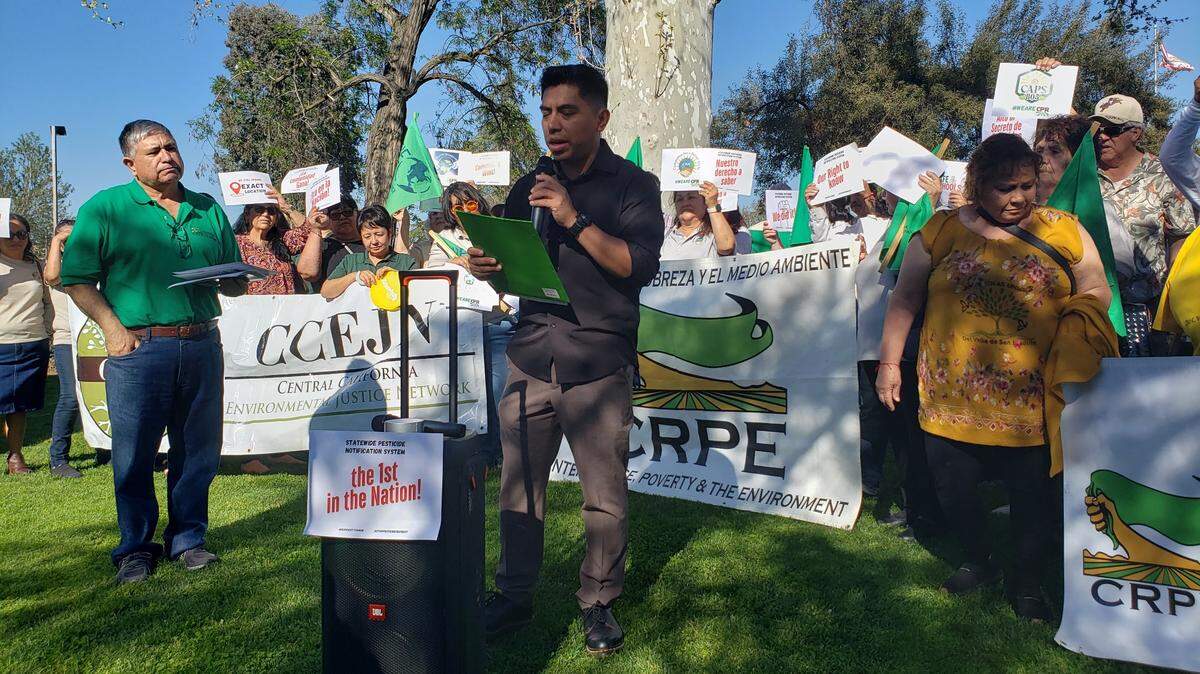
To celebrate the launch, the Center on Race, Poverty & the Environment and Californians for Pesticide Reform hosted a news conference in Shafter, attended by more than 50 supporters. At the same location, the CDPR held an official presentation on the system and provided signups for text and email alerts.
Erika Alfaro, a public health nurse in Northern California and member of Safe Ag Safe Schools, said the system will allow agricultural communities to take simple but important precautions—such as closing windows, removing clothes from outdoor lines or keeping vulnerable individuals, including pregnant women and people with asthma, indoors.
Bianca Lopez, co-founder of the environmental justice nonprofit Valley Improvement Projects, called the launch a significant step forward and a victory not just for California, but for the entire nation. “It’s launched in one of the most disadvantaged communities in the Central Valley, and it was because the people made it happen. That’s what’s most exciting about it,” she said.
Lopez attended the event in Shafter, where she noted that people from across the state had gathered.
Attendees had the opportunity to register on-site, but Lopez said some community members encountered glitches while trying to do so. One individual, who lives in an unincorporated area, was unable to find his or her address in the system. Someone from the CDPR suggested using the nearest Walmart as a reference point.
“It just kind of highlighted how unaware even the staff are about what goes on and what it looks like on the ground for communities,” Lopez said.
In 2022, Stanislaus County was among the four counties that partnered with the CDPR on pilot projects to help develop the statewide notification system.
According to the CDPR, the two most heavily applied pesticides in Stanislaus County are horticultural oil and Telone, both commonly used in almond orchards. Both are classified as respiratory toxins, and Telone also carries a cancer risk.
Precise spray location data still missing
Despite the system’s launch, concerns remain — chief among them the lack of precise location data. Spray Days notifies users only if pesticide applications are scheduled within a square mile, without specifying exact locations.
Lopez said knowing the precise location is important for protecting oneself, particularly from pesticide drift.
Growers, however, have pushed back against providing more detailed location data, arguing that it could compromise their privacy and attract protesters seeking to disrupt pesticide applications.
To address concerns, the CDPR has established a Spray Days review process, which includes an Environmental Justice Advisory Committee, annual recommendations for system improvements and a yearly public comment period.
Lopez expressed skepticism about whether the CDPR would implement suggestions made through the review process.
“While I’m a little reluctant to believe that CDPR is going to be willing to make adjustments later through its review process, I do want to think that they will keep improving it, because we should be learning as we’re going,” Lopez said.
She also added that the name Spray Days doesn’t convey the seriousness of pesticide exposure.
Residents who want to track pesticide applications can visit the Spray Days website to access the map and sign up for notifications. The Valley Improvement Project is also available to help individuals with the registration process.
This story was originally published March 25, 2025 at 2:24 PM.