New congressional districts split Modesto’s white and Latino communities
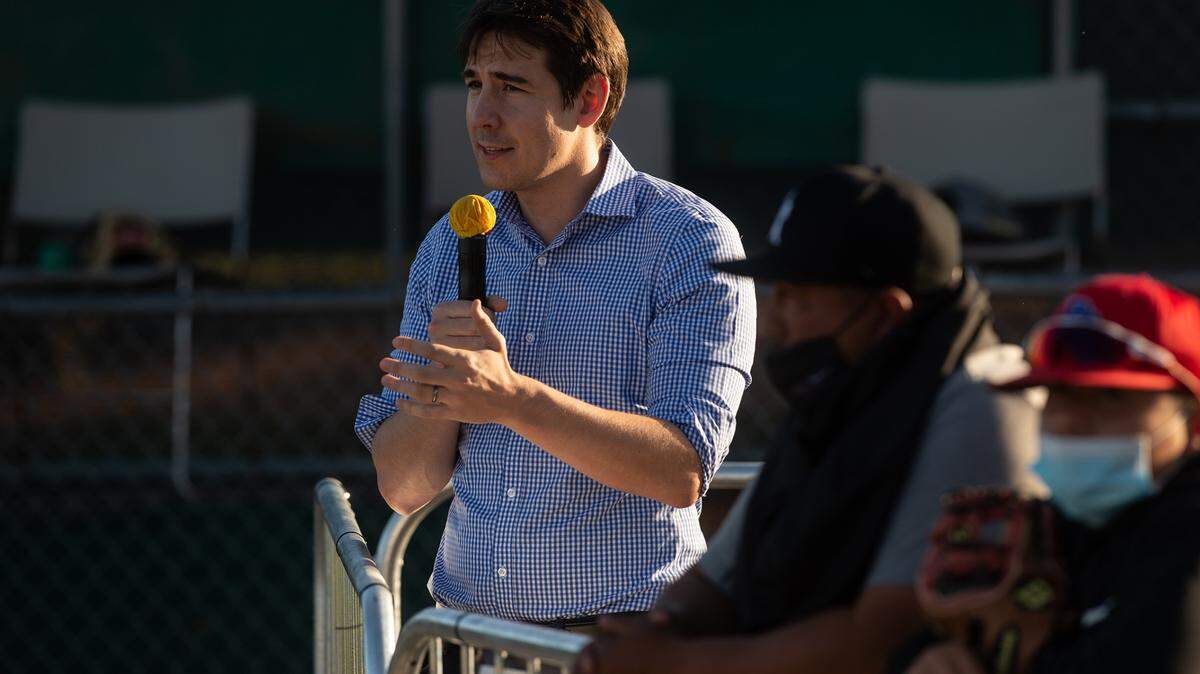
Once his previous district was demolished in redistricting, U.S. Rep. Josh Harder’s most urgent problem last week was deciding which newly configured House district he might seek. He quickly settled on the 13th, which includes the west side of Stanislaus County he’s very familiar with, but means the Democrat will have to get to know Merced County, Madera and west Fresno County — and the people in those areas will have to get to know him.
Now perhaps Harder’s biggest problem is being a white man running to represent a district that was carved out for a Latino candidate.
Losing no time, Harder on Tuesday announced that U.S. Sen. Alex Padilla — one of California’s best-known Latinos — endorses Harder’s run. That’s pretty smart politicking.
This doesn’t mean Latinos have given up the idea of a Latino representing the 13th District, 50.2% of whose voters (and 65% of whose residents) are Latino compared to 37% white. Harder’s opponents have yet to declare themselves, as far as I’ve heard.
But anyone of any race or ethnicity going up against the formidable Harder machine has an upward climb. He has proven himself one of the most effective fundraisers in Congress, and retains the same loyal volunteer and campaign team he used to unseat longtime GOP incumbent Jeff Denham in 2018 and to rebuff Republican Ted Howze in 2020.
Latinos didn’t panic when a white guy — Dave Geer, who died in 2014 — in 2009 won the Modesto City Council seat that had just been created for a Latino candidate. Geer left office in 2013, and that area of west and south Modesto since has had minority representation in Tony Madrigal.
When I say certain districts were intended for Latino candidates, I’m referring to provisions of state law requiring that communities of interest not be splintered into districts with white majorities, a cynical but effective way to keep minorities out of office. It’s illegal, and officials tasked with creating voting boundaries — whether for city council or state or federal districts, as required after the U.S. Census every 10 years — take that mandate very seriously.
The downside is creating “us v. them” districts, which doesn’t promote unity. And that’s the reality now facing Modesto, most of whose white voters will be in one House district, and Latinos in another.
Who will represent Modesto in Congress?
Because congressional candidates don’t have to live in districts they seek to represent, Harder might have chosen to run for the new Fifth District, which includes his traditional base — most of Modesto and much of Turlock, along with the rest of east Stanislaus County. But redistricting commissioners threw into the Fifth District all Mother Lode areas to the east, stretching from El Dorado County all the way down to Kings County.
The result is that the Fifth will be 71.3% white and 18.1% Latino, and Republicans outnumber Democrats 42.8% to 31.3% — majority conservative, a rarity in blue California. Although Harder is a centrist, most of the Fifth’s voters will want a representative leaning right, not left — a reality that will be hard for some Modesto Democrats to accept (west and south Modesto will be in the 13th District sought by Harder).
If longtime conservative Congressman Tom McClintock of Elk Grove wants to represent the Fifth, it could be his for the taking. But his wife of 34 years, Lori, died last week and his political aspirations aren’t clear at this point.
Any observer can easily see both House districts in Stanislaus County represented by white office holders. Harder will have to make a good case for his ability to represent Latino interests. Enlisting Padilla’s support is a savvy start.
This story was originally published December 28, 2021 at 11:45 AM.