How to strike black gold in your own backyard, plus save a little money
With recent news about big changes in our garbage rates and habits, including sorting organics, it occurs to me that I’ve acquired a somewhat helpful skill over years of practice without realizing it. I know how to make dirt from table scraps.
It’s compost, to be accurate. If you’re at all curious — most normal people probably aren’t, I’ll admit — I’m happy to share what I’ve learned in hopes of spreading good tidings of the great joy of producing a rich soil amendment that you can merrily mix into your garden and landscaping.
It’s super easy, it’s gratifying and it’s almost free. Keep reading to learn how.
This composting advice won’t do anything to lessen the shocking jump in your garbage bill, though. Residents of unincorporated towns throughout Stanislaus County — like Salida, Denair and Crows Landing — will pay from $13 to $30 more each month, depending on where they live, county supervisors recently decided. That’s a lot of money.
It’s required by state law addressing methane, which contributes to climate change. Cities make their own rules; Oakdale leaders, for example, recently approved a monthly $10.72 rate hike. The Modesto City Council is expected soon to debate adding a third bin to residents’ two-can routine, or pay someone to sort organics in green bins; either will require higher rates, like everywhere else in California.
The other day, a big truck rolled through our Salida neighborhood, dispensing new blue and black garbage bins for every home to begin using in the new year along with the green ones we already had. We’re to recycle paper, cardboard, cans, glass bottles and plastic jugs every other week in the blue bin. Organics — branches, grass clippings, leaves, and yes, table scraps — go in the green one every week, and everything else — styrofoam, diapers, toothpaste tubes, dog poop and kitty litter — go weekly in the black one.
The backyard composting that’s become a way of life in our home is not an alternative to the green bin. But it can take care of much of anyone’s food waste and some or all of your leaves. Here’s how.
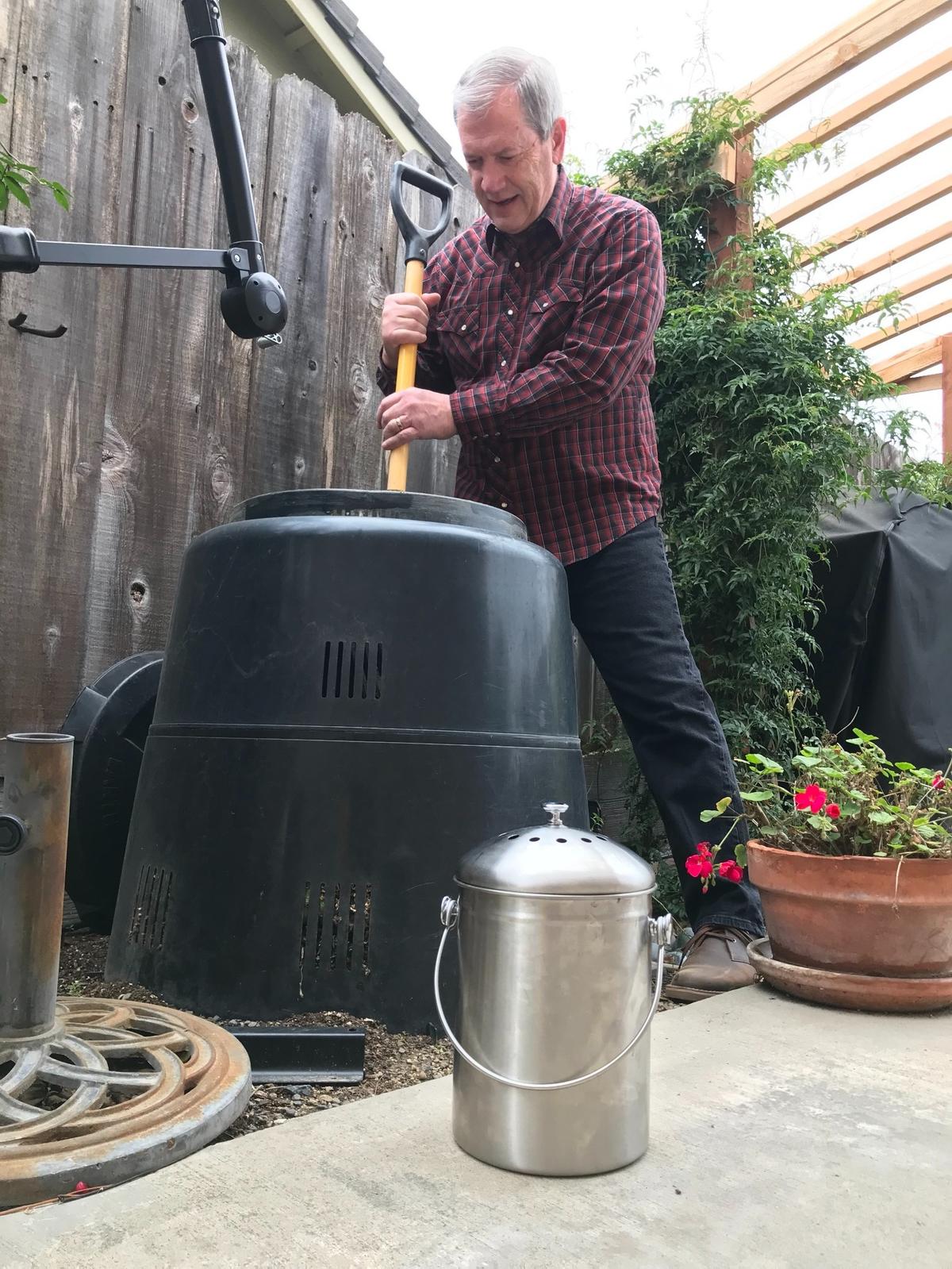
First, get a compost bin. My tree-hugging daughter bought one for me from Modesto City Hall as a birthday present in 2013. You can get one for $39; they take $5 off if you attend a two-part composting course through Modesto Junior College’s community education program, although COVID-19 has sidelined it the past couple of years. Or you can pay from $100 to $400 for a similar bin online or at your local hardware store.
No odors with compost bins
Next, decide where you want to put it. Mine is in our side yard.
Most people who compost keep a small container in the kitchen for table scraps. For years I used a simple Rubbermaid container with a lid. Recently I replaced it with a nifty stainless steel 1-gallon bin whose lid has a charcoal filter. I love it, but it’s not necessary to get that fancy. Mine gets emptied in the compost bin every few days.
Don’t put bones or meat scraps in your compost bin, which “eats” only plant products. No cheese or dairy products, either, and never dog or cat feces.
But you can compost everything else from your kitchen: stale bread, leftover rice and pasta, unwanted fruit, salad remnants, banana peels, orange and lemon rinds, tea bags and so much more. We throw in drier lint, dog hair after brushing, dirt from sweeping the floor, and sawdust.
The trick is to immediately cover your scraps with a thin layer of dirt. If you’re just starting out, get soil from somewhere on your property, or buy a bag of the cheapest dirt you can find at the store. Soon, you’ll just use the compost you’re producing in your bin to cover new scraps. As long as it’s covered, odors, flies and other pests pose zero problem.
Visitors are surprised that my compost doesn’t smell — actually, if you put your face down inside, it smells like sweet, damp earth — never like rotting garbage. Outside the bin, you can’t smell it at all.
Before you know it, the scraps simply disappear, and you suddenly have more dirt — black gold. It’s magic!
Once or twice a year, I harvest our compost to add to the garden or landscaping. You can stop dropping in food scraps for a few weeks and let the entire bin turn to dirt; I prefer to screen the entire contents of the bin by shoveling it onto some wire mesh left over from another project, which I place over my wheelbarrow. The “new” dirt collects in the wheelbarrow for distribution, and chunks too large simply go back in the bin to break down in time.
Common mistakes to avoid
Because my knowledge is limited to a sample of one — me — I asked a real expert for common composting mistakes that you’ll want to avoid. Martin Hildebrandt, who for more than 20 years has taught the MJC course in partnership with City Hall, was eager to share.
Some run into trouble because they don’t stir enough, Hildebrandt said. Microbes in your bin need oxygen to break everything down. I use a digging fork with thick tines to stir about once a week.
People also need to pay attention to moisture, Hildebrandt said, because it doesn’t work right if your pile is too dry or too moist. This is something I picked up with experience, I guess — I just drag the garden hose over for a few squirts if it looks too dry. But how do you really know? “It should be the moisture of a squeezed sponge,” he said. “If you can squeeze water out, it’s too wet.”
Lastly, a good compost pile needs to be fed with a balance of green and brown stuff, he said — nitrogen and carbon, respectively. Most scraps from your kitchen fit the “green” category, so many gardeners keep on hand a couple of big bags of brown leaves gathered in the fall; toss in a couple of handfuls every now and then, and you’re good to go.
Early in my composting experience, I remember that my bin did smell like ammonia for a short time because I had overloaded it with green stuff. I didn’t have a stash of brown leaves at the time, but quickly cured the problem with newspapers torn into strips. Also, I never use fresh grass clippings for the same reason.
Nor do I compost our avocado pits or shells, or peach pits or egg shells. I know others do, but they just take so long to break down, so I don’t. To each his own.
I do cut into manageable pieces large chunks of melon rind, bread, squash and peppers, to reduce the break-down period.
Modesto sells 10 bins a year
An odd beetle or spider will make its way into the bin, which has tiny air slits, and there are plenty of worms throughout. I never worry about them; just part of nature. I always keep the lid on, though, to keep out birds and rats.
Of course, you don’t have to have a hard-plastic bin to do composting. Lots of people make their own, or just dump stuff in a big pile. I wouldn’t do that in an urban backyard, because it will draw vermin.
Curious whether I have many composting brothers and sisters out there, I asked Vicki Rice, Modesto’s recycling coordinator, how many $39 bins City Hall has unloaded over the years. Government is (usually) good at keeping records, and she dug out the answer: 2015 was the highwater mark at 19 bins sold, with lows of only four in 2016 and 2020, and five so far this year, averaging 10 a year for the past nine years.
That’s not much, for a city of about 222,000 people.
I’m under no illusions that backyard composting will be the next fad. Let’s face it; it’s just dirt.
But with all the renewed attention to garbage, maybe a few will think about making their own dirt. Those of us who do know the reward is well worth the effort.
This story was originally published December 26, 2021 at 4:00 AM.