
More public in public safety | Part 1: How civilians might help Modesto police
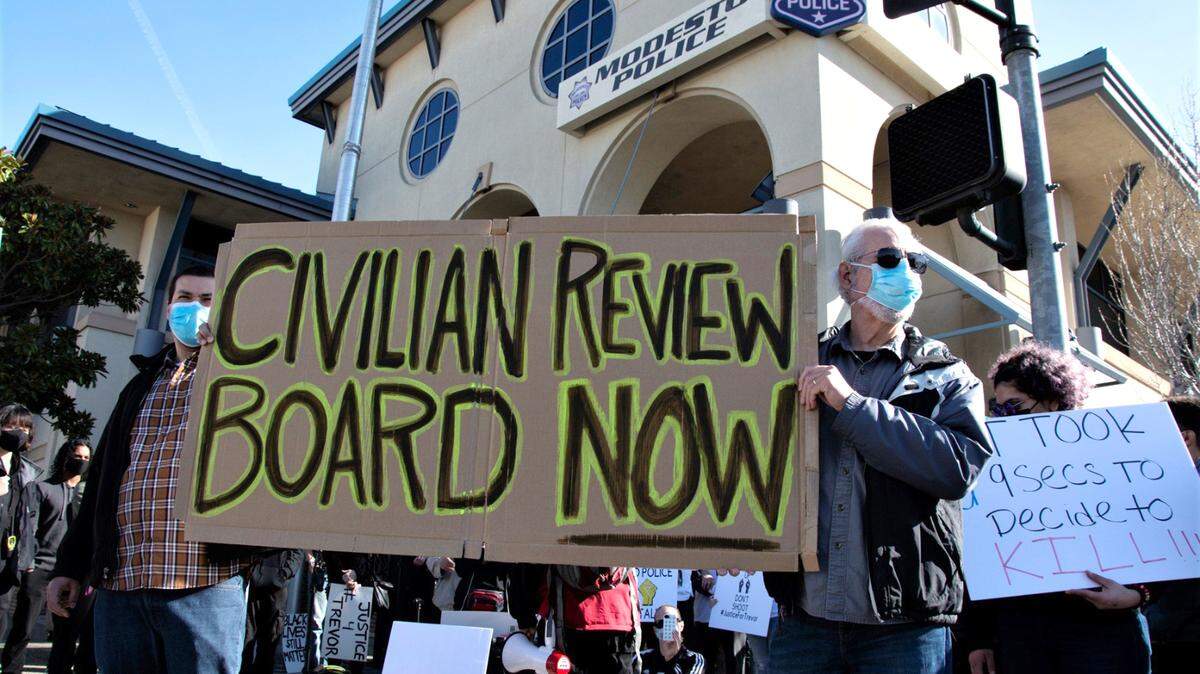
Shortly after 6 a.m., as a Modesto family slept, a SWAT team crashed through the front door and threw a smoke bomb across the living room floor. An officer handcuffed 14-year-old Moises Sepulveda Jr., forced him to the ground, trained a gun on him and stood on his neck, the boy said.
He was lucky. He lived to tell the harrowing tale.
His 11-year-old brother, Alberto, was face-down on his stomach, following orders exactly, when a Modesto police officer shot him in the back, killing him instantly.
Three investigations — all done by law enforcement agencies — found no fault, concluding that the officer’s weapon discharged by error.
What are the chances that any officer in today’s climate would face no consequences?
The year was 2000. Then-Modesto Police Chief Roy Wasden had been on the job one month, and had been dealing with fallout from a gun-sale scandal that factored into early exits of both his predecessor, former Chief Paul Jefferson, and former City Manager Ed Tewes. It’s unbelievable, looking through today’s lens, that they could think selling 231 old handguns on the cheap to 97 members of the Modesto Police Department — in violation of city and state laws — was a good idea.
Police officers are human, and they make mistakes. Sometimes, deadly mistakes. And sometimes they aren’t mistakes at all.
Examples abound of police violence and error. Accounts stemming from the deaths of George Floyd and Daunte Wright, and prosecution of the officers who killed them, are just the latest to rule national news, in addition to 13-year-old Adam Toledo’s death in Chicago. All sparked protests across the United States, forcing a nation to confront difficult questions of racism and police brutality, and to ask whether there is a better way.
One obvious answer is civilian oversight of law enforcement.
Scores of communities have turned, or are turning to, civilian review of police in hopes of enhancing transparency and trust.
It’s time for Modesto to join this wave. Our people — and our police — deserve no less than the best system of preserving and protecting.
Opponents see civilian review as a threat to police. There is no need, they say, for change.
They are wrong.
Benefits of Modesto civilian review
It’s hard to imagine that a decent independent police auditor — a potential component of civilian oversight — would have turned a blind eye to the ill-conceived, illegal 1996-97 Modesto police gun sale. Jefferson could have gotten a $40,000 credit for giving old service weapons to a company providing new ones, but offered them instead to his officers and got only $26,000 in return. Partly because police were policing themselves, the district attorney had little to go on; only one lieutenant was tried in criminal court, and he was acquitted.
Although few cities in 2000 had civilian review panels, one might have provided a venue for the Sepulveda family — and the entire shocked Modesto community — to pour out grief and seek accountability in a public setting. A review board or inspector general (another name for police auditor) might have suggested procedural changes — such as never pointing guns at people complying with orders — before tragedy struck instead of after.
It’s possible that a civilian panel in tune with mental health needs could have suggested deescalation training that might have saved the life of Richard Phillip Robles Jr., who needed patience and compassion as he carried a samurai sword in downtown Modesto in 2009. Instead, a Modesto policewoman quickly shot him dead.
A civilian panel or independent auditor might not have prevented Modesto officers Joseph Lamantia and Robert Laxton from opening fire on Francisco Moran in 2010 as he wielded a kitchen spatula, killing him. But outsiders looking in surely would have raised questions as Lamantia’s bloody record stacked up over the years; four people died of the five he shot in 11 years.
Most officers never fire guns on duty. Questions from outside the department might have been enough to save Trevor Seever’s life — and to keep Lamantia from being fired and prosecuted for killing him Dec. 29 outside a west Modesto church.
A better sounding board
If we had a civilian review board, Seever’s distraught friends and family might not have spent collective hours over several public meetings pleading before the Modesto City Council. Such a panel could have listened to loved ones of Kim Jackson, also killed by Lamantia and other officers as she advanced with knives in 2016; her survivors now seek more than $10 million in a lawsuit.
Could civilian oversight have made a difference when a Modesto officer broke a girl’s wrist as he handcuffed her in 2009, leading to a $495,000 settlement? Or when Modesto officers went in a home without a warrant in 2011 and threatened residents in a car dispute, costing taxpayers $120,000? Or when an elderly woman in 2015 broke her hip after being pushed by a Modesto officer who came in her home without a warrant, costing taxpayers $750,000?
Focusing on local police is a place to start, but such incidents are not limited to Modesto.
- Stanislaus County deputy sheriff Justin Wall shot and killed Evin Yadegar as the Modesto woman, suffering a mental crisis, tried to edge her car away from him in 2017, costing taxpayers $7 million in a wrongful death settlement.
- Daniel Pereira wanted to put shoes on when he was arrested, but deputies forced him to stand barefoot on hot pavement, badly scorching the soles of his feet. Jurors in 2009 awarded him $63,750.
- Then-Ceres officer Ross Bays shot 15-year-old Carmen Spencer Mendez in the back as the youth tried to flee in 2018, killing the boy and costing taxpayers $2.1 million in a settlement.
- Eloy Gonzalez died Sept. 27 of last year at the hands of deputies who escalated tension rather than show patience with the homeless man, who just wanted to be left alone.
The need, here and everywhere, is real.
And now that we see what actually happens — thanks to body camera footage — the need becomes acute. Such video exonerates a majority of officers because most are good, decent people doing an incredibly difficult job with dignity and honor. It also exposes the bad apples like never before.
Relying solely on prosecutors to hold officers accountable has brought negligible results. Since her election in 2006, Stanislaus District Attorney Birgit Fladager had never charged an officer in an on-duty killing until Lamantia.
Timing is right for more transparency
Civilian panels can help police establish and improve policies on body cams, vehicle pursuits, foot pursuits, k-9 deployment, camera surveillance, no-knock warrants and other raids like the one that killed 11-year-old Alberto Sepulveda. And so much more.
Yes, we have the Modesto Police Clergy Council, formed by former Police Chief Galen Carroll in 2013. It’s filled with good people. But the clergy council has zero teeth to effect meaningful change, the kind we envision with real civilian oversight.
The NAACP knows it. Three months after Floyd was killed by Minneapolis police last year, the local chapter joined with several community organizations to pitch the idea of civilian review on the Modesto Bee opinion page. In February, the consortium hosted a digital town hall featuring nationally recognized experts sharing vital information.
Among hundreds tuning in was Modesto Mayor Sue Zwahlen, who recognized the value of civilian oversight as a candidate before taking office a few weeks ago. In the runoff election, Zwahlen bested former Modesto police Sgt. Doug Ridenour, who predictably wanted nothing to do with meaningful reform of his former employer.
Because we now have Zwahlen, because key community groups are on board, because the entire country is talking about Derek Chauvin’s trial and guilty verdicts and Wright’s killing by police a few miles away and Toledo’s killing in Chicago, because Modesto is in between police chiefs and can seek one committed to working with civilians, because the entire Modesto City Council last week commissioned a community listening session as a springboard to improving police culture — the time has never been better for civilian oversight of Modesto police.
This story was originally published April 21, 2021 at 5:00 AM.