Welcome to The Modesto Bee’s Voter Guide to California’s Nov. 5 general election.
Ballots will arrive in your mailbox this week as early mail-in voting opens.
In addition to voting for president, voters in Stanislaus County will have a chance to determine who will represent them in Congress, the Legislature and local government.
We’ve compiled everything you need here to navigate the extensive ballot and help you make informed decisions, including links to election stories and profiles of candidates and measures up for consideration. Select election stories include answers from candidates to questions submitted by The Bee for this guide. You’ll also find links to Bee editorial staff endorsements for various races.
What’s on the ballot?
Here are links to the various contests for voters to decide, depending on where you live. Please check back, as this guide will be updated regularly. Click a link for more details about the candidates in that race:
Bond Measure X - Modesto City Elementary School District Safe and Modern Schools Measure
STANISLAUS COUNTY
Cannabis tax, Measure P - Would establish a tax on cannabis business activities within the county.
CALIFORNIA STATE ASSEMBLY
Assembly District 22:Republican incumbent Juan Alanis of Modesto is challenged by Democrat Jessica Self, a children’s advocate and businesswoman from Modesto.
STATE PROPOSITIONS
Prop 2 -Bonds for Public School and Community College Facilities
Authorizes $10 billion in general obligation bonds for repair, upgrade, and construction of facilities at K-12 public schools (including charter schools), community colleges and career technical education programs, including for improvement of health and safety conditions and classroom upgrades. Requires annual audits.
Put on the ballot by the Legislature, Prop. 2 would allow the state to take out $10 billion in state general obligation bonds, and would provide funding for new facilities, to improve school health and safety conditions at existing facilities as well as for classroom upgrades. It would also expand eligibility for financial hardship grants for small and disadvantaged school districts. The cost to repay the bonds would be about $500 million annually for 35 years. Supporters include the California Teachers Association, California School Nurses Organization and Community College League of California. Opponents include the Howard Jarvis Taxpayers Association.
Amends California Constitution to recognize fundamental right to marry, regardless of sex or race. Removes language in California Constitution stating that marriage is between only a man and a woman.
Put on the ballot by the Legislature, this proposition would remove language in California’s Constitution stating that marriage is between only a man and a woman, matching what the federal courts have said about who can marry. There would be no fiscal impact if approved. It is backed by Equality California, Planned Parenthood Affiliates of California and the Human Rights Campaign, among others. It is opposed by the California Family Council and the American Council of Evangelicals.
Authorizes $10 billion in general obligation bonds for water, wildfire prevention and protection of communities and lands. Requires annual audits.
Put on the ballot by the Legislature, this proposition would allow the state to take out $10 billion in bonds for projects aimed at reducing climate change and its impacts, including $3.8 billion for safe drinking water and water resilience; $1.95 billion for wildfire prevention and extreme heat mitigation; $1.9 billion for protection of natural lands, parks, and wildlife; $1.2 billion for protection of coastal lands, bays, and oceans; $850 million for clean energy; and $300 million for agriculture. The bonds would cost $400 million annually over 40 years to repay. Supporters of the initiative include Clean Water Action, Cal Fire’s firefighter union, the National Wildlife Federation and the Nature Conservancy. It is opposed by the Howard Jarvis Taxpayers Association.
Prop 5 -Voter Requirements for Housing and Infrastructure Bonds
Allows approval of local infrastructure and housing bonds for low- and middle-income Californians with 55% vote.
A constitutional amendment, if passed by a simple majority, would allow voters to lower the approval threshold for local governments and agencies to issue bonds for affordable housing and certain public infrastructure projects to 55% from the current two-thirds requirement. This would increase local borrowing for affordable housing, supportive housing and public infrastructure projects; repaying those bonds would result in higher property taxes. It is supported by California Professional Firefighters, the League of Women Voters of California and Habitat for Humanity California, among others, including Gov. Gavin Newsom. Opponents include the California Taxpayers Association, California Hispanic Chambers of Commerce and Women Veterans Alliance.
Prop 6 - Abolishing Involuntary Servitude in Jails and Prisons
Amends the California Constitution to remove current provision that allows jails and prisons to impose involuntary servitude to punish crime (i.e., forcing incarcerated persons to work).
Amends the state’s Constitution to remove rules that allow forced labor for inmates in jails and prisons, a provision that was a remnant of slavery-era laws. If passed, the change would prohibit the state Department of Corrections and Rehabilitation from punishing prisoners for refusing a work assignment. It also would allow incarcerated persons to voluntarily accept work assignments in exchange for credit to reduce their sentences. The costs are unknown and would depend on how rules in state prisons and county jails would change, according to the Legislative Analyst’s Office.
Raises minimum wage as follows: For employers with 26 or more employees, to $17 immediately, $18 on Jan. 1, 2025. For employers with 25 or fewer employees, to $17 on Jan. 1, 2025, $18 on Jan. 1, 2026.
Put on the ballot by petition signatures, the initiative would then raise minimum wage to $18 in 2025 for large employers and in 2026 for small businesses. (Fast-food workers are paid $20 an hour under a law passed by the Legislature.) State and local government costs could increase or decrease by up to hundreds of millions of dollars annually. State and local revenues likely would decrease by no more than a few hundred million dollars annually. It is opposed by the California Chamber of Commerce, California Restaurant Association and California Grocers Association, among others. No supporters groups are filed with the Secretary of State’s Office but the measure is being funded largely by anti-poverty advocate Joe Sanberg, an entrepreneur and tech investor.
Repeals Costa-Hawkins Rental Housing Act of 1995, which currently prohibits local ordinances limiting initial residential rental rates for new tenants or rent increases for existing tenants in certain residential properties.
Put on the ballot through petition signatures, the measure would expand the authority of local governments to enact rent control on residential properties. Approving the initiative would reduce local property tax revenues by tens of millions of dollars annually due to the likely expansion of rent control in some communities. The measure is backed by the California Nurses Association, California Alliance for Retired Americans, Mental Health Advocacy, Coalition for Economic Survival and TenantsTogether. It is opposed by the California Council for Affordable Housing, Women Veterans Alliance and the California Chamber of Commerce, among others.
Prop 34 - Federal Prescription Drug Revenue Mandate
Requires certain (health care) providers to spend 98% of revenues from federal discount prescription drug program on direct patient care. Authorizes statewide negotiation of Medi-Cal drug prices.
Added to the ballot by a petition drive, this initiative would require some health care providers to spend at least 98% of revenue earned from the resale of Medi-Cal prescription bought at the federal discount on direct patient care. The cost to the state, mainly for enforcement, could be millions but would be footed by the providers. Supporters include the ALS Association, California Chronic Care Coalition and Latino Heritage Los Angeles. Opponents are the National Organization for Women, Consumer Watchdog, Coalition for Economic Survival, the AIDS Healthcare Foundation and Dolores Huerta, among others.
Prop 35 - Permanent Tax on Health Plans to Fund Medi-Cal
Makes permanent the existing tax on managed health care insurance plans, which, if approved by the federal government, provides revenues to pay for Medi-Cal health care services.
Added to the ballot by signatures, the proposition would require the state to spend tax revenue from managed health insurance plans on programs like Medi-Cal and Covered California, the state’s exchange. It would cost the state $1 billion to $2 billion annually at first to boost funding for certain programs, but could top $5 billion a year. The long-term fiscal effects are unknown. It is supported by Planned Parenthood Affiliates of California, the American College of Obstetricians & Gynecologists and the California wing of the American Academy of Pediatrics, among others. No opponents to the measure were submitted to the Secretary of State’s Office.
Prop 36 - Increased Punishment for Theft, Drug Offenses
Allows felony charges for possessing certain drugs and for thefts under $950, if defendant has two prior drug or theft convictions.
The measure, supported by conservatives and law enforcement but opposed by Gov. Gavin Newsom, would roll back parts of Prop. 47, passed by voters a decade ago, and restore some misdemeanor offenses as felonies. Its approval will likely increase criminal justice costs by tens of millions of dollars at the state and local level, and incarcerate more offenders. Other supporters include Crime Victims United of California, the California District Attorneys Association and the Family Business Association of California. Beyond the governor, Californians for Safer Communities and most Democratic legislators oppose the measure, arguing tougher penalties could be meted out at the state Capitol.
Currently not serving time in a state or federal prison for a felony conviction
Currently not found mentally incompetent by a court ruling
WHEN CAN I VOTE IN PRESIDENTIAL ELECTION?
County election offices will begin mailing ballots to voters by Monday, Oct. 7. Drop-off locations are slated to open the following day — Tuesday, Oct. 8, according to the California Secretary of State website.
WHAT’S THE DEADLINE FOR MAILING OR DROPPING OFF MY BALLOT?
Mail-in ballots can be returned by mail or dropped off at your county elections office, the California Secretary of State said on its election website.
You can also take your ballot to any poll place, drop-off location or designated drop box in the state before 8 p.m. on Election Day, Tuesday, Nov. 5.
When mailing ballots, remember that they must be postmarked by Election Day and received by Tuesday, Nov. 12.
WHEN CAN I VOTE IN PERSON?
Poll centers open Saturday, Oct. 26, for early in-person voting in all participating Voter’s Choice Act counties, including Stanislaus.
The polls are open from 7 a.m. to 8 p.m. on Election Day, Nov. 5, according to the Secretary of State site.
Voters who arrive after the polls close at 8 p.m. cannot cast a ballot, but folks already in line “have the right to vote,” California’s Voter Bill of Rights states.
HOW TO VOTE AND WHERE’S MY BALLOT?
California offers several options for casting your ballot. On Oct. 7, county elections officials will begin mailing vote-by-mail ballots to all active voters. If you mail it back, it must be postmarked by Election Day (Tuesday, Nov. 5) and arrive at the Elections Office within seven days. You can also take it to a secure ballot drop box, a voting location or your county voting office any time between Oct. 7 and 8 p.m. Nov. 5.
If you are unsure about your voter registration status, you can check here.
The voter registration deadline is 15 days prior to Election Day. After that deadline and through Election Day you can still register and vote in person using Conditional Voter Registration. This option is available at all voting locations as well as the Elections Office, located at 1021 I St., Suite 101, Modesto.
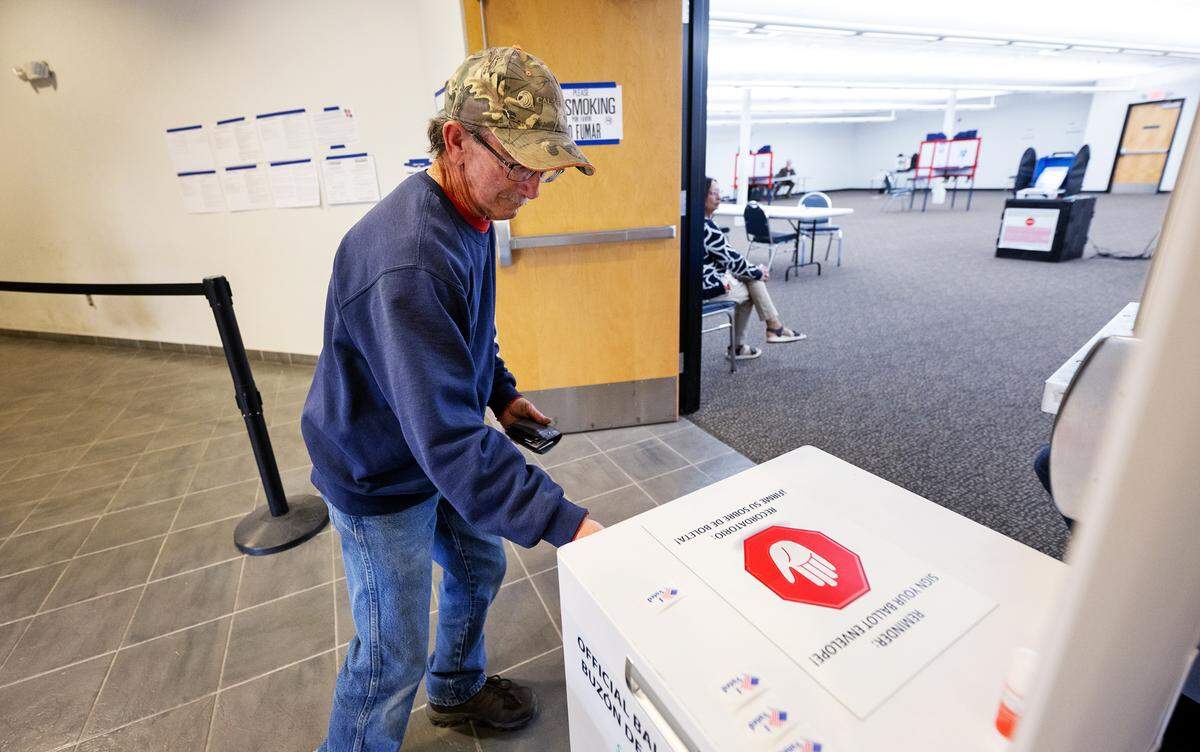
Salida resident Sam Threet drops off his ballot at the Stanislaus County voting center at the Salida library in Salida, Calif., Tuesday, March. 5, 2024. Andy Alfaro aalfaro@modbee.com
VOTING IN PERSON?
See a list of official ballot box locations. Locations will be posted 29 days before the election date. For in-person voting, you can visit your local vote center. If you wish to vote in person but have a vote-by-mail ballot, you must bring and surrender that ballot for a scannable ballot. Voting centers open three days before the election — earlier in some places. Your nearest vote center also provides other services including:
Get a replacement ballot if yours is missing, damaged or you made a mistake.
Register or update your registration before voting.
Drop off your voted ballot at a staffed authorized drop box.
Carlos Virgen is the senior editor for The Modesto Bee. He spent the previous 10 years as assistant managing editor for audience development at The Day of New London, Conn.