Stanislaus County to redraw supervisor districts. Will the map reflect racial diversity?
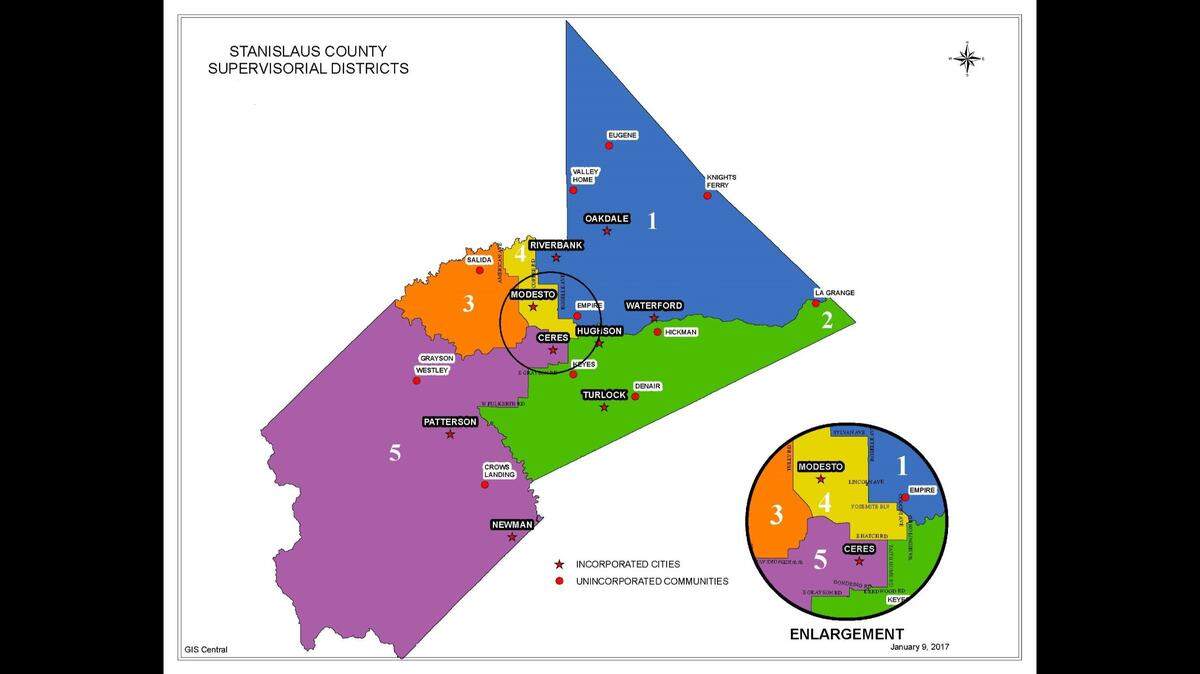
It’s time for redrawing the boundaries of supervisorial districts in Stanislaus County, and this time it won’t be your father’s redistricting plan.
Since the boundaries were last redrawn in 2011, lawmakers rewrote the rules for redistricting counties in order to prevent discrimination and make sure ethnic minorities can elect a candidate of their choice. Cities will go through the same process when data from the 2020 Census is available this year.
“A lot has changed with new state law,” County Counsel Thomas Boze said at the Board of Supervisors meeting Feb. 9. “This is going to be challenging not just for the county to work through but for many jurisdictions.”
County leaders who drew the five districts after the 2010 Census mainly complied with a standard of putting an equal population in each district represented by a supervisor. The five county supervisors are elected by district, with Districts 3 and 4 including large portions of Modesto, District 2 including Turlock and Hughson, District 1 including Riverbank and Oakdale, and district 5 including Ceres, Patterson and Newman.
To comply with the new laws, county leaders and an advisory redistricting panel will need to identify “communities of interest” and their boundaries and consider factors like geographic continuity and natural barriers. The new map also will need to minimize division of cities, Boze said.
Data from the 2020 Census is another key ingredient. The county expects to see the final Census data sometime before July 31.
On Feb. 9, supervisors approved a redistricting framework including a steering committee to consist of county executive staff, a project team and citizens advisory commission to come up with recommendations for redrawing the boundary lines of districts 1 through 5.
According to a staff report, the Board of Supervisors can adopt the new boundaries after Aug. 1. The final district map must be approved 174 days before the June 7, 2022, state primary. That creates a Dec. 15 deadline.
The county will need to hold four public meetings or workshops before the job is finished this year. The coronavirus pandemic slowed down the census in 2020, causing the Census Bureau to miss a Dec. 31 goal of delivering the nationwide count to the White House.
The county is inviting applications through March 12 for the 11-member advisory commission. Five of the panel members, one for each district, will be chosen by the respective supervisor. The six other members, including one for each district plus an additional person, will be chosen at random.
County staff explained that the names of qualified applicants will be placed in a bowl, and the six names pulled out will serve on the commission. Registered voters who live in Stanislaus County can apply to serve on the commission. Applications are available at the stancounty.com website.
A staff report for the Feb. 9 meeting said the county wants fair-minded people for the advisory commission who “represent a diversity of voices and perspectives.” The report continued: “a diverse representative committee will help invite and promote public confidence in the commission’s work and will better prepare the committee to perform its responsibility of engaging community members in the redistricting process.”
The staff report said that racial and ethnic diversity is critically important. But a Supreme Court ruling also stated that race can’t be the predominate criteria for redrawing the map.
In reviewing applications for the advisory commission, the county also will consider “diversity in demographic location, age, gender, language and any other identifying characteristics.”
Supervisors have authority to approve map
By using an advisory commission, as was done in 2011, the Board of Supervisors maintains approval rights over the new map. Another option was giving an independent commission the authority to redraw the map or using a “hybrid” commission that would recommend two or more maps to the board.
With a hybrid commission, the board must adopt one of the maps. Boze said there are onerous restrictions on anyone who serves on an independent or hybrid redistricting commission in California. Among other things, participation is denied to anyone who’s worked for an elected official or contributed $500 or more to a campaign in the last eight years.
According to the county, people serving on an independent or hybrid commission are barred from running for county office in the next five years or working for an elected official or candidate for office in the next four years. In addition, commission members have to wait four years to contract with the county for a job that’s not competitively bid.
“I am totally confident of getting information from the advisory commission and then us making the ultimate decision,” Supervisor Terry Withrow said. “We are all elected representatives and we represent our constituents in the county.”
Withrow said people can expect to see diversity on the advisory commission. “We want to make sure that everybody is at the table,” he said.
To comply with recent laws, the redistricting plan this time requires an effort to identify “communities of interest” through surveys, outreach and input at public meetings.
A community of interest is defined as a population sharing a “common social and economic interest that should be included within a single district for purposes of its effective and fair representation.”
Diversity sought for advisory panel
Homero Mejia, who was a community organizer for a nonprofit for 12 years, said the county will need Latino representation on the advisory commission to create districts that reflect the county’s diversity.
Mejia recalled that one Latino served on the county’s redistricting commission in 2011, which is verified by county board minutes for the May 3, 2011, meeting.
According to U.S. Census QuickFacts, Latinos make up 47.6 percent of the county population and the new advisory commission would need five Latino members to reflect that. “You need to have someone on the commission who people feel comfortable with in making the decision,” he said.
Mejia said the Modesto City Council got it right when Latino neighborhoods in west and south Modesto were placed in a single council district.
“That is something that worked for Modesto. When you keep a community together, they have a better shot at having a representative from the community (in local government),” Mejia said.
On March 16, the Board of Supervisors is expected to approve a time schedule for the redistricting project and approve appointments to the advisory commission.