Modesto police audit evaluates mask ordinance enforcement, body-camera use
The Modesto Police Department received its annual report card, which found its accountability system to be fundamentally legitimate, though not without critical areas for improvement.
Most notably, the report found officers frequently muting their body-worn cameras or delaying recording during use-of-force incidents. It also scrutinized an incident where an officer flicked the groin of an unconscious suspect in an effort to wake him.
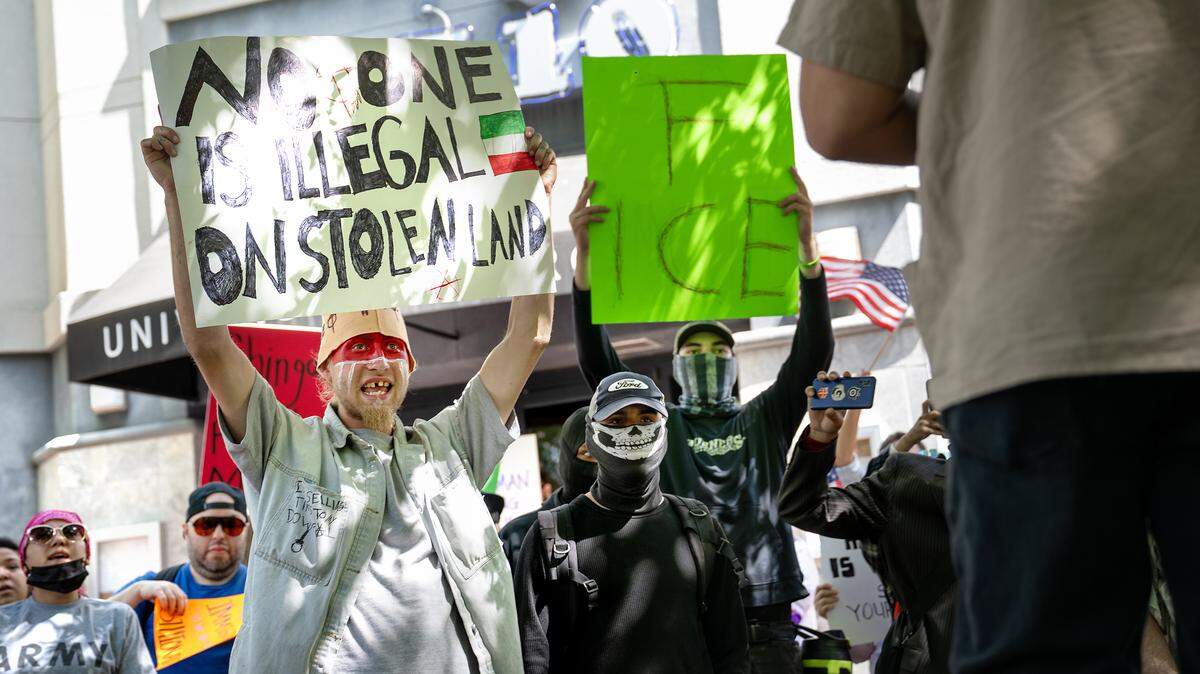
Perhaps most anticipated was the evaluation of MPD’s enforcement of the city’s public assembly ordinance on June 14 at an ICE Out protest downtown. Community members have continuously called for officers’ actions that day to be looked into after five people were arrested for wearing masks.
Compiled by the OIR Group, a Southern California-based law firm that specializes in police oversight, the 40-page report evaluates how the Police Department handled internal investigations throughout 2025. The auditors looked through case files, police reports and body-worn camera recordings.
The auditors looked at 48 cases of misconduct and 55 use-of-force cases from 2025. The report noted an increase in public complaints; in the previous year, they looked at only 28 misconduct cases.
“Most [of the 2025 cases], however, were not supported by the evidence,” the report reads. It also notes that MPD’s new online portal for complaints is a likely contributor to the increase in misconduct reports.
Although there were two shootings by officers last year, those cases are still under review and, therefore, not part of the report’s analysis.
OIR principal Stephen Connolly will present the report to the Modesto Community Police Review Board on Wednesday at 5:30 p.m. at 1010 10th St. Afterward, the department will consider adopting any of the audit’s recommendations made.
Where the department succeeds
The report applauded MPD for routinely conducting formal interviews with individuals rather than relying on body-camera footage alone. Officers were also generally respectful and patient during interviews.
In cases where police officers did violate policy, accountability followed.
Often, the department found and looked into issues that arose beyond what a complaint alleged. Some complaint cases that MPD initiated involved significant acts of misconduct, such as an officer driving under the influence or using a department vehicle improperly while off duty.
“While these lapses are obviously problematic, MPD’s willingness to address them – often with severe disciplinary consequences – is an important counter,” the report reads.
Although OIR does not agree with all of MPD’s assessment in use-of-force cases, it states the review process is effective and incidents are used as learning opportunities, even when force is justified.
Use-of-force cases were overwhelmingly consistent with policy and mostly resulted in minor injuries if any.
Areas for improvement
OIR made nine recommendations for MPD.
During interviews with complainants, the department investigators often justify the officer’s actions and challenge the complainant’s version of events. The report cited seven examples of this.
“We consider greater objectivity and a focus on listening to be the preferred approach,” the auditor wrote.
MPD received 12 complaints alleging bias, none of which were sustained. The auditor agreed with the findings but suggested the department explore other ways to evaluate allegations of bias rather than giving prominence to officer denial.
In a few use-of-force cases, subjects apparently were not interviewed. In others, a sergeant at the scene of the incident was also involved in the review process, which OIR criticized.
Delayed activation or muting of body cameras was an issue highlighted in the previous year’s report. MPD had accepted OIR’s recommendation to address body-camera compliance, but this year’s report shows the issue persists.
“While MPD’s attention to this concern was consistent, and a step in the right direction, we wonder why these issues continue to emerge with any sort of regularity,” the report reads. “It is disappointing that officers’ ‘muscle memory’ is not more firmly established.”
The report also notes that MPD’s policy surrounding body cameras does not require activation but merely suggests it. It offered two suggestions to address the issue.
Another concern that carried on from the previous year was regarding the use of police dogs. In one case, a dog bit an officer in the leg.
Notable cases
The most significant investigation involved a suspect who passed out in the back of a police vehicle while the officers tried to Mirandize him.
One officer suggested that the other tap the individual in the groin to wake him up, which he did several times. The man did not wake up and was taken to jail.
The officer later said he made the groin-tap suggestion jokingly and had hoped the suspect would wake up after hearing him say that.
While a third officer brought this up to a supervisor, the supervisor did not make any notifications up the chain of command and attempted to “address the matter at his level.” The supervisor did later reach out to the District Attorney’s Office “to flag the issue as a potential concern for the pending prosecution.”
The DA’s Office then reached out to Police Chief Brandon Gillespie, who immediately ordered an investigation.
Allegations were sustained against the supervisor, two officers involved, plus another officer who was present but did not take responsive action.
“The substantial discipline that resulted was also a reflection of both the embarrassing nature of the misconduct and the rigor of the MPD response,” the report reads. It does not specify what the disciplinary action was.
Another incident involved an officer threatening to break down a woman’s door and incessantly knocking and ringing the doorbell in an attempt to speak with her. Ring camera footage of the incident also went viral on social media last year after the woman posted it.
The woman filed a complaint about the officer’s rude and harassing behavior, though MPD did not sustain it.
Though not a policy violation, the auditor found the officer’s response to be “a seemingly retaliatory gesture that reflected poorly on him.” MPD should have questioned further, the audit says.
June 14 protest enforcement
The discussion of MPD’s enforcement of the mask ordinance on June 14 is limited to an assessment of two complaint cases.
Seven people were arrested that day — five for wearing a mask. Gillespie is being sued by the American Civil Liberties Union of Northern California for the department’s “selective and disparate enforcement” of the ordinance.
The woman who filed the complaints stated that no warnings were given prior to the arrests and that officer badge numbers were not provided.
OIR found that officers did provide warnings several times, to the whole group and to individuals, but noted that warnings “could just as easily have been misunderstood or misheard as it was willfully disregarded.” It noted that the warnings were competing with the sounds of chanting from protestors. The report also did not find evidence that individuals asked for badge numbers during arrests.
The report describes the first arrest of the day as “calm and uneventful,” noting that the suspect was cooperative.
When the arrested individual stated that he wears masks all the time, an officer responded, “Yeah, well you’re going to jail, have a nice day,” which OIR found did not reflect well on the department.
OIR agreed with MPD’s assessment that the officers had been consistent with policy and expectations, though suggested that further efforts can be made to provide warnings, given the context of the situation.
“At the same time, we appreciated the additional ways in which the Department used the intense reactions to June 14 as an occasion to assess and adjust its approach,” the report reads.
The report also looked into allegations of biased policing, considering that protestors were arrested only from the ICE Out rally, not the No Kings protest that happened later that day.
MPD also found these allegations to be unsubstantiated.
Since the ICE Out rally happened first and was a smaller group, department leadership believed that addressing potentially problematic issues early would ensure no carry over into the larger protest, the audit report notes.
The department also had “effective pre-event communication” with organizers of the No Kings protest, while receiving no response from the ICE Out group.
The audit report says MPD has since assessed some of the tactics used that day, such as the ironic mask-wearing of officers and the use of unmarked vehicles.
“The June 14 protests and subsequent controversy were both a challenge to the agency and a learning opportunity. We found the complaint investigations that we looked at to be thoughtful and thorough – but also appreciate the flexibility with which MPD has modified its approach. The results in subsequent protest scenarios have been gratifying,” the audit report reads.