Pesticide spraying near Stanislaus County school concerns parents. Why it’s legal
Although California laws prevent schools and nearby farmers from applying pesticides when students are present, cities are largely an exception.
On May 1, Patterson city staff sprayed pesticides at Floragold Park next to Apricot Valley Elementary school while kids were outside.
Apricot Valley Elementary dealt with an on-campus pesticide exposure incident on March 13 that left about 40 students and staff with itchy skin and rashes. Many of the parents and students say they still are traumatized from the incident.
“Why would they choose that park to spray at when the kids are celebrating outside?” said parent Kelly Leon at a Patterson Joint Unified school board meeting May 5.
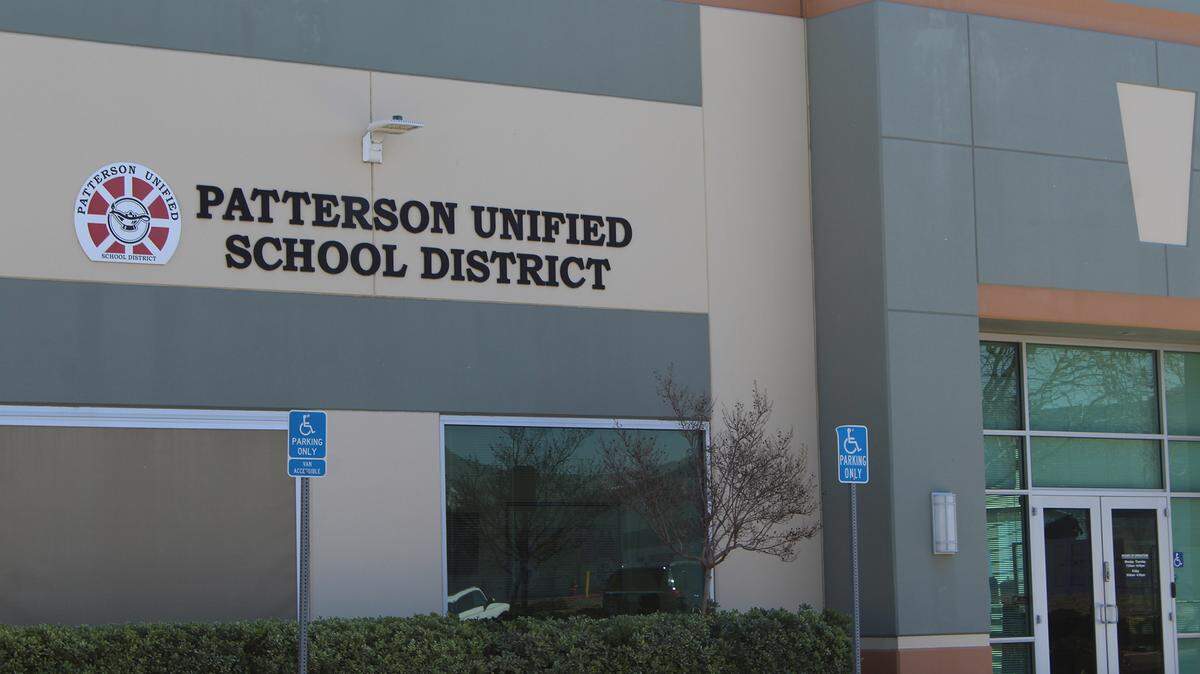
District officials said they had not been notified prior to the spraying at the park. Superintendent Reyes Gauna said he planned to bring it to the city’s attention at his next meeting with city leaders.
What does the law say?
Since 2018, certain pesticide applications for agricultural use are prohibited within a quarter mile of schools and daycare centers. This applies only to weekdays between 6 a.m. and 6 p.m. Starting Dec. 31, these restrictions will apply to private schools, too.
Farmers with fields within the quarter-mile zone are mandated to provide an annual written notification to the school principal or administrator listing all pesticides they expect to use over the upcoming school year. If a farmer needs to use a pesticide not on that original annual list, the school must be notified at least 48 hours in advance.
The Healthy Schools Act requires school districts to send an annual notification to all parents, guardians and staff of all pesticides expected to be applied during the year. Individuals can also register to be notified 72 hours in advance of individual pesticide applications.
“As for the city, there is no requirement for cities to make that notification,” Terry Prichard, who works with Central Region School Insurance Group, said at the board meeting.
This means city workers or contractors spraying weeds on city property adjacent to a school are not subject to the same regulations.
The exception is adjoining city parks regularly used by schools and daycare centers under a use agreement. Those parks are then considered school sites under HSA.
Patterson spokeswoman Victoria Castro said that while the city is operating within regulatory requirements, it recognizes the concerns raised by parents.
She said Patterson will reinforce operational expectations with staff to avoid applications when children are present in the immediate area or on adjacent school grounds.
“At this time, the city does not have a formal notification process for routine park applications near schools; however, we are evaluating whether additional coordination or communication with the community would be appropriate,” Castro said in an email to The Bee.
Stanislaus County cities and their pesticide policies
Patterson stated it uses only low-drift application methods, including backpack sprayers and ground-based equipment. Applications are conducted in accordance with product label requirements and environmental conditions intended to minimize the potential for off-target drift.
In addition, staff involved in pesticide applications complete annual safety training.
The city said it takes public safety and regulatory compliance seriously and has been in communication with the Stanislaus County Agricultural Commissioner’s Office.
“The city remains committed to safe operations, regulatory compliance and responsible application practices,” Castro said.
Modesto contracts with Clark Pest for pest control services. Pesticides are applied on city facilities as needed.
“Any vendors contracted to provide pest control services to the city are required to follow all local, state and federal laws pertaining to the application of pesticides and the required public notifications,” said Cynella Aghasi, spokesperson for Modesto.
The city of Turlock contracts with licensed pest-control professionals for applications, though city staff may perform limited herbicide applications related to landscape and facility maintenance.
Pesticide applications in parks and other public spaces are performed infrequently and on an as-needed basis in response to identified issues, rather than on a fixed routine schedule.
Turlock primarily uses nonagricultural pesticide products that are applied in accordance with label requirements. Because these products do not require public notification under current regulations, it said advance notice is not typically provided.
“All applications are conducted in compliance with applicable laws and label requirements to help ensure public safety,” the City of Turlock wrote in a statement.
In Riverbank, each park requires herbicide spraying about every other month. Insecticide spraying for the trees is done annually and once every other month for buildings.
The city has adopted an integrated pest management policy aimed at minimizing the use of pesticides.
Its 2022 IPM states that Riverbank shall provide the public and its employees with notification of pesticide applications through signs at all school sites as required by the HSA.
This story was originally published May 18, 2026 at 10:41 AM.