Patterson district pledges to restrict pesticide use following campus exposure
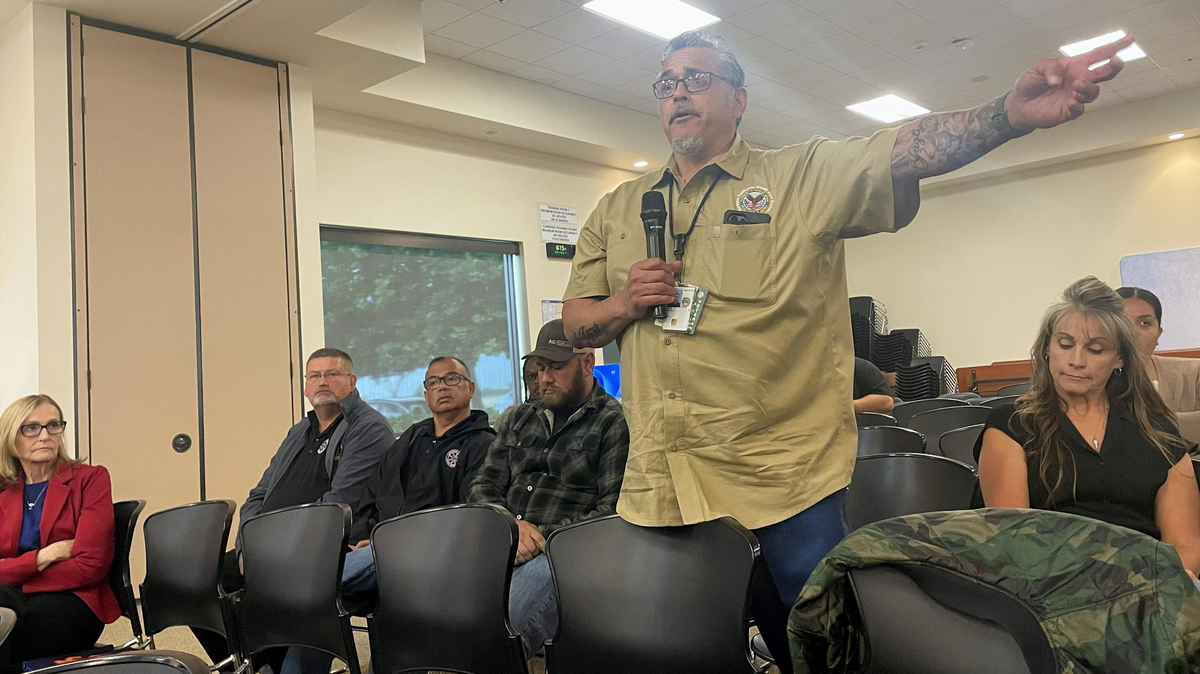
Patterson Joint Unified School District officials apologized to parents for the pesticide drift incident that occurred at one of its elementary schools in March. It made a commitment to reduce its use of chemicals.
“It’s an event that should not have happened, and as a result, it’s caused us to take a look at and review and reflect on our practices,” Dave Smith, director of administrative service at PJUSD, said at a public meeting Monday.
On March 13, around 10 a.m., district management learned that an employee was spraying herbicides at Apricot Valley Elementary. An hour later, students and staff began experiencing itchy skin and rashes, prompting a call to emergency services.
The herbicides used were a combination of Cheetah Pro and Cornerstone Plus.
Initial attempts to decontaminate individuals with soap and water worsened symptoms, so emergency personnel did a second round of decontamination with just water. Later, the district learned that the recommended treatment for one of the chemicals was soap and water, but for the other it was water alone
About five students were taken to hospitals for further evaluation, out of an abundance of caution by parents.
The Stanislaus County Agricultural Commissioner’s Office conducted interviews, took samples of sprayed areas and inspected facilities where pesticides are stored. The office is working on a report about what happened that day and why. It’s expected to be publicly available in a year.
“It’s critical that families and staff can feel assured that their loved ones who come to the schools can feel safe, and they can focus on the free education system that the school district provides,” Agricultural Commissioner Linda Pinfold said.
Two weeks after the incident, school and district staff, along with emergency responders, met to discuss the incident and how to improve. “As significant as this was to students, staff and community, this was rather routine for us,” said Paul Willette, director of ambulance operations for Patterson District Ambulance.
The district also met with the organization Valley Improvement Projects to listen to recommendations on how to give proper notice of pesticide use to families and how to eliminate them altogether.
PJUSD received a state Pest Control Headquarters Inspection report, which found the district to be out of compliance in three categories. The district kept its hazardous communication/handler in a binder instead of a public area and had the wrong brands of herbicide listed in its integrated pest management plan.
Cheetah Pro was not initially included in PJUSD’s integrated pest management plan. An IPM is a document that districts that use pesticides are required to maintain, listing all products they intend to use in a given year. A district planning to apply a pesticide not on this list must provide a written notice at least 72 hours in advance.
On March 22, nine days after the incident, the list was updated to include Cheetah Pro. The district confirmed that the herbicide was inadvertently removed from the list during an administrative update due to it sharing the same active ingredient as Total TNV Herbicide.
The noncompliance areas found on the report have since been addressed, according to the district.
As of March 16, the district has stopped all pesticide spraying.
Training district employees
Every year, district employees who make pesticide applications receive training.
Terry Prichard, who works with Central Region School Insurance Group, provides in-person pesticide safety training every year to all school districts in Stanislaus and Merced counties. In her teachings, she emphasizes pest prevention so that districts don’t have to use chemicals in the first place.
Some alternatives to herbicides include mowing, crack sealing, hand pulling and goats.
Training teaches employees how to read chemical labels and what to do during emergencies.
“Sometimes they pay attention, sometimes they don’t pay attention,” Prichard said at the meeting. “Training is only as good as how much they can be paying it.”
District commitments
The district committed to eliminating its use of chemicals for weed control. It plans to spend about $28,000 on a Weedtechhnics Saturstream — a nonchemical machine that kills weeds using saturated steam and boiling water.
PJUSD said it will use chemical controls only when nonchemical methods “have failed to provide adequate control.” Chemicals would be used only when students and staff are not present.
The district also plans to eliminate its use of the herbicide glyphosate and prioritize organic based pesticides.
Teachers received praise for their response during the incident. Parents, however, shared that their kids heard staff panicking, which further panicked and traumatized them.
Parent Rachel Shaw said her kids still talk about the incident every day and are afraid they’re going to get rashes if they go to school. “It may seem silly, but it really did affect our families,” she said. “Students thought they were going to die.”
Bianca Lopez, co-founder of Valley Improvement Projects, recommended that staff use walkie-talkies during emergencies. She also asked that the district implement these changes into policy to ensure they are set in stone.
This story was originally published May 5, 2026 at 12:49 PM.