Stanislaus investigates spraying at school after reports of rashes, skin irritation
The Stanislaus County Agricultural Commissioner’s Office is investigating the use of weed-control products at Apricot Valley Elementary School on March 13 after emergency personnel responded and provided medical aid.
About 32 students were exposed, with reports of skin irritation and rashes. Roughly 40 staff and students were decontaminated, and three students were taken to a hospital at their parents’ request as a precaution, according to the Patterson Fire Department.
According to Patterson Joint Unified School District, the spraying appears to have violated district protocols. Herbicide applications typically are scheduled when students and staff are not on campus, such as before or after school or on weekends.
“Moving forward, when herbicide applications resume, all spraying will take place on weekends only,” the district stated.
It was determined that two herbicides were used March 13 — Cornerstone Plus and Cheetah Pro. The active ingredient in Cornerstone Plus is glyphosate, while Cheetah Pro contains glufosinate-ammonium. Glufosinate-ammonium is generally considered minimally toxic to humans, though ingestion can be serious. Research has shown that exposure to glyphosate may be linked to a range of health effects in humans, including inflammatory conditions, neurological disorders and reproductive disruptions.
Following the incident, the district has paused all herbicide applications across its campuses as it conducts a full review of the spraying. Patterson Joint Unified School District and Apricot Valley are working with the Agricultural Commissioner’s Office as the investigation continues.
“This partnership will help ensure that all safety standards, procedures, and regulatory requirements are carefully reviewed,” the district wrote.
The district said it is taking additional steps to improve communication and safety procedures, such as posting clear signage prior to any future applications, working with school administrators in advance of any herbicide use and providing notice to families and staff.
“Situations like this are investigated thoroughly,” reads a notice from the county Agricultural Commissioner’s Office. “When concerns arise, our office works to identify what occurred, evaluate any potential health impacts, and ensure appropriate steps are taken to prevent similar incidents in the future.”
Pesticide exposure near schools
During the 2024-25 school year, 24 schools in Stanislaus County were within a quarter mile of areas where restricted pesticides — those considered carrying greater risks — were applied. More than 10,340 pounds of these pesticides were used, according to data compiled by Valley Improvement Projects.
The schools nearest the largest amounts of restricted pesticide applied that year were Chatom Elementary, Chatom State Preschool, Cunningham Elementary and the Cunningham Head Start-Turlock Joint Elementary daycare.
Cherise Olvera, superintendent of Chatom Union School District, said the district works closely with neighboring farmers, who are mindful of their spraying schedules and work to avoid times when students and staff are on campus. Growers regularly check in with the district about any special events or activities so they can plan their applications accordingly.
“Many of the farmers in our area are longtime members of our community. Some have been past students or have family members currently attending, so there is a shared interest in ensuring the safety of students and staff,” Olvera said.
Beth Jimenez, spokesperson for Ceres Unified School District, said her district takes a proactive approach to pesticide use on school property that is consistent with the California Healthy Schools Act.
She said CUSD’s Integrated Pest Management Plan emphasizes nonchemical solutions and least toxic materials. The district updates its publicly available pest management practices and list of pesticides annually. If a pesticide not included in the annual notice is needed, advance notice is posted at the affected school site. In addition, all staff applying pesticides on school grounds must complete an annual training approved by the California Department of Pesticide Regulations.
To date, no incidents of “pesticide drift” from neighboring agricultural operations have been reported at Ceres Unified. Pesticide drift is the unintentional movement of pesticide particles or vapors through the air during or after application.
“In the event of a concern, our staff would act quickly to follow established safety and reporting protocols,” Jimenez said. “Although CUSD does not have the legislative authority to expand state law concerning agricultural pesticide use, we remain committed to providing safe and healthy learning environments for our students and staff.”
Over the past three years, Stanislaus County has recorded two incidents of pesticide drift at schools. One incident occurred at Modesto Christian School and the other at Great Valley Academy, also in Modesto. A total of 25 individuals at the two schools had symptoms of pesticide exposure.
To stay alert about pesticide usage in the area, residents can register for notifications through “Spray Days,” a statewide online system that alerts the public when restricted materials pesticides are scheduled to be used. The system was launched in California last year.
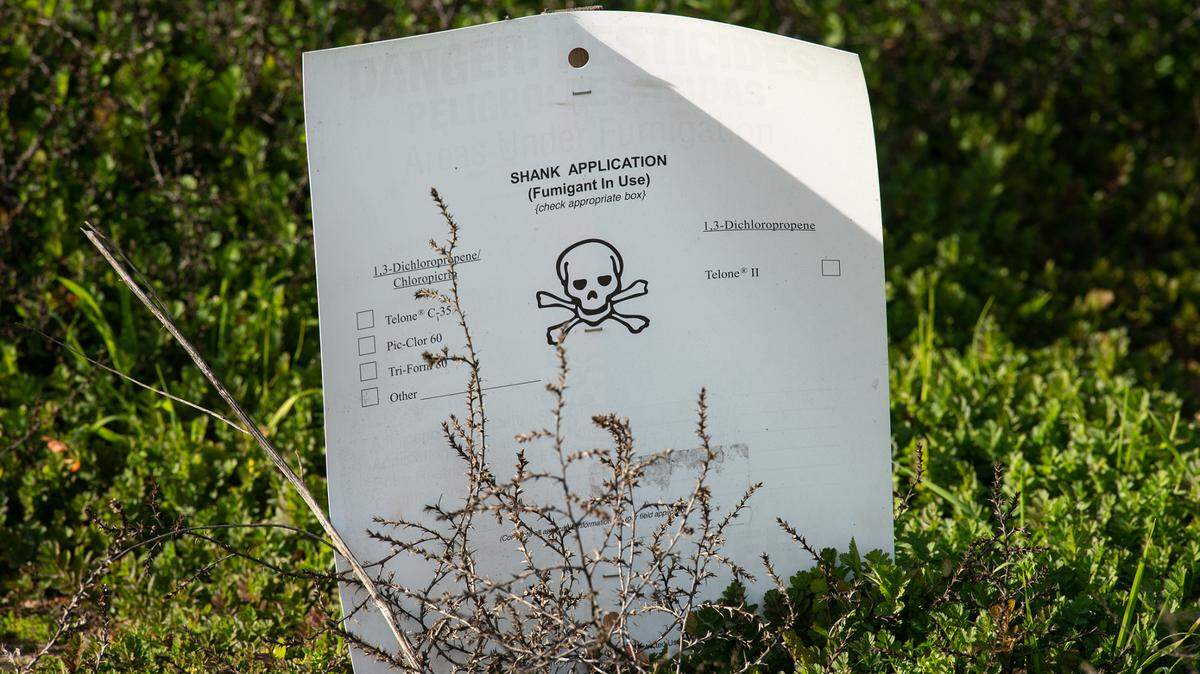
The most applied pesticide near schools in Stanislaus County is 1,3-Dichloropropene. Exposure to 1,3-D, including in the womb, has been linked to cancer, neurological and brain disorders, respiratory problems and kidney disease.
Stanislaus County ranks fourth in the state among counties with the highest use of 1,3-D, according to a DPR report.
Last month, a lawsuit was filed against DPR, alleging that its newly adopted regulations governing the use of 1,3-D violate requirements of the Administrative Procedure Act by failing to provide clarity and internal consistency. It also alleges that the regulations violate the California Food and Agricultural Code by allowing the public to be exposed to pesticide emissions at levels that cause harm to human health.
The first regulation, for people living near pesticide applications, took effect in 2024 and uses a regulatory target air level of 0.56 parts per billion per day over a 70-year lifetime. A second regulation took effect in January 2026, intended to protect people who work near 1,3-D applications. It uses a threshold of 0.21 ppb per 40 hours per week over 40 years.
“DPR cannot have regulations that contradict each other and allow different levels of exposure to 1,3-D at home or at work for the same people,” said Angel Garcia, co-director of the statewide coalition Californians for Pesticide Reform, in a press release. “The law requires clarity, consistency, and meaningful protection — none of which are present here.”
In a statement to The Bee, DPR said it does not comment on pending litigation, nor can it address specific allegations made in this case.
Between 2023 and 2024, 1,3-D emissions decreased by 29% due to the change in fumigation methods required by the 2024 regulation. DPR said its proposed regulations to add protections for occupational bystanders are expected to build on these decreases. A recent DPR report also found that 2024 air samples from California communities showed no pesticide detections, including 1,3-D, exceeding the agency’s health screening levels.