Modesto police chief addresses community concerns over immigration enforcement
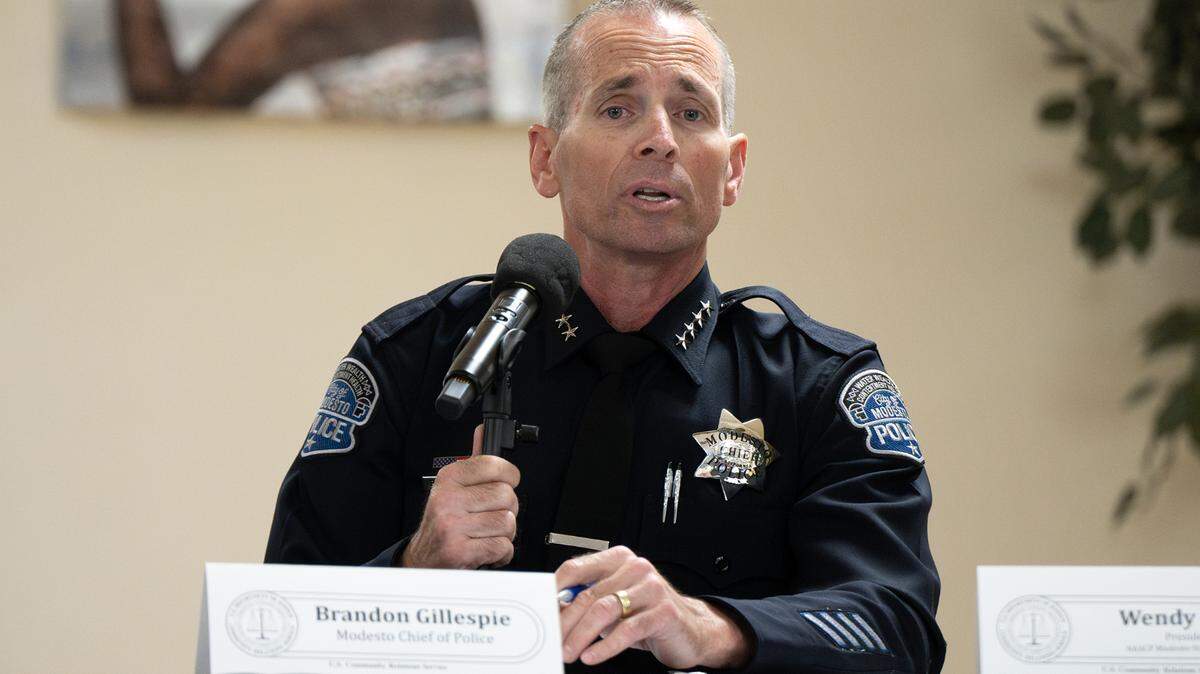
Amid community fears of mass deportations, Modesto Police Chief Brandon Gillespie on Wednesday addressed concerns about his department’s involvement in immigration enforcement.
He spoke Wednesday night at the Community Police Review Board meeting at the King-Kennedy Memorial Center in west Modesto.
“Immigration has been a hot topic, obviously since a new administration came into power, and I want to be very clear,” Gillespie said.
He cited California Senate Bill 54, which prohibits state and local law enforcement from using resources for federal immigration enforcement, and he emphasized that the department does not participate in general immigration enforcement.
The only exception, he explained, is if an individual has a judicial warrant or is wanted for a serious or violent crime. In such cases, the department would cooperate with federal immigration officials.
“I don’t care about somebody’s immigration status. If somebody is a danger to a community or wanted on serious or violent crime, my duty is to protect our community and make sure that those people are apprehended,” he said.
Gillespie said the MPD is not allowed to ask about someone’s immigration status or take action if officers learn an individual is undocumented.
He added that he recently spoke with Stanislaus County Sheriff Jeff Dirkse and other police chiefs in the county, all of whom affirmed that their departments do not participate in general immigration enforcement.
CPRB member Kenneth Bryant asked whether federal authorities have become more visible in Modesto since the start of President Donald Trump’s second administration.
Gillespie said that within the past month, MPD has been made aware of a few instances of immigration officials operating in the area but assured that the department has not assisted them. He said that while MPD occasionally collaborates with Homeland Security — which falls under Immigration and Customs Enforcement — those partnerships focus solely on narcotics trafficking and gang activity, not immigration enforcement.
Gillespie also addressed a recent rumor about immigration checkpoints in Stanislaus County that a community member had asked him about. He said there was no confirmation to support the claim and that MPD had no indication ICE was conducting such operations.
However, he noted that if immigration checkpoints were to occur, MPD would have no authority to prevent or control federal enforcement actions.
Gillespie later added that MPD would not notify the community in advance if it became aware of federal immigration activity, explaining that his department typically isn’t informed and wouldn’t want to interfere with federal investigations.
During public comment, Gina Vargas shared her family’s fears, noting that her husband is Hispanic and that the community has confusion about whether Trump will target only criminals, or anyone who is undocumented.
“They’re still scared because they’re thinking they’re going to pick up random people and take them back to Mexico,” Vargas said. “It’s not easy to get back from that, so how do we ease that fear?”
Gillespie said he does not want residents, regardless of their immigration status, to be afraid to interact with officers, whether during a traffic stop or if reporting a crime. Officers will not contact immigration officials, he said.
“We want cooperation. We don’t want somebody to be fearful to report a crime for fear that we would find out they were undocumented and something would happen to them,” he said.
Another person mentioned the Immigrant Legal Resource Center’s red cards, which were being distributed by community members at the meeting. The cards outline an individual’s rights and protections when approached by immigration officers.
Gillespie advised people to seek legal counsel to understand their rights and ensure the information on the red cards is accurate.
Anthony Drobnick, a teacher at Gregori High School, asked what steps MPD is taking to build trust with immigrant communities. “Right now, I feel that trust is lacking, and there’s certainly a lot of room for improvement there, because we’ve got a lot of folks that are really afraid to interact with the police, especially because of immigration status,” he said.
Gillespie shared that he recently met with several Spanish-speaking residents who expressed deep fears about what might happen to them and their families.
He added that discussions within Project Resolve have focused on finding ways to better inform the community about MPD’s policy of not working with ICE, aiming to ease fears among undocumented residents about engaging with local law enforcement.
Tom Helme, co-founder of the Modesto nonprofit Valley Improvement Projects and an ACLU NorCal volunteer, said the safest approach is to disclose immigration status only to an attorney.
He also referenced a 2022 ACLU report documenting how some Central Valley sheriff’s offices continued subtle coordination with ICE after the passage of SB 54, such as exchanging emails about an individual’s release time for potential pickup.
Gillespie said he’d have to think more about that but that MPD wouldn’t divulge any information about an individual’s immigration status.
When it comes to people in the jails, Gillespie said that they are in the custody of the Sheriff’s Office and it would be incumbent on that office and its guidelines for notifying ICE and, depending on the crime, to pick them up.
“The intent of SB 54 is to make sure that we understand that all of our community members are important, and that we want to make sure that people are safe, to help keep our community safe, to report crimes, and so I wouldn’t want to do anything that I thought would undermine that credibility as best I could,” he said.
This story was originally published February 20, 2025 at 12:32 PM.