Real reform for Modesto police and Stanislaus sheriff, or going through motions?
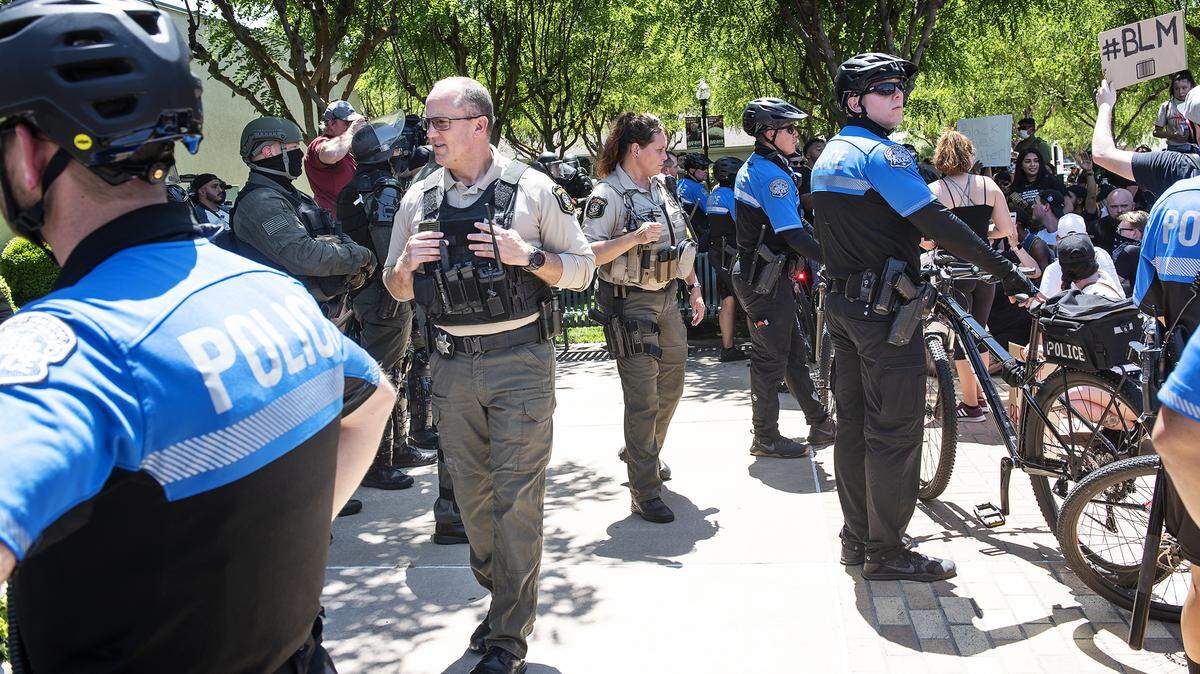
As our area’s two major law enforcement agencies — Modesto police and the Stanislaus County Sheriff’s Department — edge toward some version of change, it’s time to share some praise and concern.
Overall, both efforts are positive and give reason for hope. But they also have potential to go sideways, if the people in charge are more interested in rearranging the furniture than they are in meaningful reform.
These separate endeavors have origins in the national introspection on policing and use of force after the murder of George Floyd at the hands of Minneapolis police a year ago. That touched off protests in hundreds of cities across the United States, including here, and prompted serious pondering by two of our most powerful locally elected leaders: Modesto Mayor Sue Zwahlen (seated in February) and Stanislaus Sheriff Jeff Dirkse.
Both now aim to improve law enforcement in Modesto and throughout the county. This is a good thing.
Enhancing transparency is positive. Seeing how the women and men sworn to protect us go about their jobs, and helping them see things through our eyes, is a great idea. Increased understanding cultivates trust, the foundation upon which all relationships are built.
So let’s exercise patience as things take shape.
But let’s also make absolutely clear that we expect more than lip service.
So far, the city’s effort has been much more public than the sheriff’s, which finally is coming into focus after 11 months of behind-the-scenes work. Dirkse recently sat down with me to explain the direction his group has decided to go, knowing that I would relay the basics of his five-point action plan for the Sheriff’s Department, dubbed Project Resolve.
What Project Resolve is
In a nutshell:
Citizens Academies. Courses of 10 or so sessions where regular people learn how deputies are trained and why they do what they do.
Town halls. Neighborhood meetings in unincorporated towns and communities.
Weed and Seed. Renewed, robust partnerships between the Sheriff’s Department and specific neighborhoods to tackle tricky problems, such as getting rid of abandoned vehicles.
Youth outreach. Some type of program involving children and teens.
Project Resolve 2.0. A continuation of the private meetings that have led to this point.
Project Resolve team members can be expected to provide what-when-where-how details, and to answer the many questions all of us will have. They are invited to use this opinion page and other news sections of The Bee.
Kudos to Dirkse for pulling together an engaged, high-powered group of leaders from all over the county to collaborate on this action plan. I see a lot of good coming from it.
At the same time, I have concerns. Foremost is the lack of representation from regular people.
The sheriff’s Project Resolve includes police chiefs from all nine Stanislaus cities, the local California Highway Patrol, and representatives of the district attorney’s and probation offices. It’s quite law enforcement-heavy.
Other members are elected representatives from the county and its cities — people naturally inclined to support law enforcement in every way, including approving their budgets.
That this group of leaders — Dirkse referred to them as “the usual suspects” — decided against pursuing civilian oversight of the Sheriff’s Department came as no surprise to anyone. It’s not happening because Dirkse does not want to go there.
But he should. Civilian oversight is among the most common remedies when law agencies all over the country seriously think about improving. With more than 220,000 people, Modesto is the nation’s 107th largest city, according to World Population Review. Yet it is not one of the 144 American cities with civilian police review.
Does Modesto need a watchdog — or a lap dog?
When the Modesto City Council recently staged a listening session to hear concerns of regular people about police, audience speakers hammered on three themes: create a civilian review board, hire an independent police auditor, and introduce non-officer crisis intervention.
The latter means sending mental health experts and other outreach workers to nonemergency calls, freeing up cops to do real police work. I outlined Modesto’s emerging efforts, loosely based on the renowned CAHOOTS program in Oregon, in a separate Wednesday column.
Why did 11 months of Project Resolve leaders talking among themselves fail to produce any of the three main ideas demanded by Jane and Joe Sixpack? Because the view from the top is never the same as the view from the bottom. Life experiences of commoners and those in power aren’t even close, and regular people are far more likely than community elites to recommend change.
If your goal is to go through the motions to give the impression that you’re accomplishing something, the smart approach is loading your committee with people already on your side. The most likely result is a message much closer to “We told you we know what we’re doing” than “Please help us change.” That’s Project Resolve’s most significant challenge under its current structure.
Modesto’s effort initially seemed more promising. Right out of the gate, Zwahlen invited regular people to share thoughts and bare souls, and the listening session was a success.
But hope dimmed a bit Tuesday when city staff presented, and the City Council adopted, a list of names to serve on the committee tasked with shepherding Modesto’s Forward Together initiative — because the names and organizations look eerily similar to those serving on Dirkse’s Project Resolve.
In fact, at the last minute the city added Dirkse himself to Modesto’s committee.
Modesto’s endeavor still seems more promising because:
- Its committee features far more community groups, making it more likely that voices of regular people will be heard. They include the Black Student Union, MoPride, El Concilio, the Hispanic Chamber of Commerce, the Latino Community Roundtable, the NAACP and the National Alliance on Mental Illness — all representing populations disproportionately affected by police contact.
- Modesto’s committee meetings will be held in public, with agendas posted in advance and time set aside for public comment.
- The committee will add four at-large residents — regular people, as I’ve been calling them. I’m a little worried that these four could be intimidated by the 24 establishment “usual suspects.” But let’s give them a chance.
`Defund police’ isn’t on table
No-change advocates argue that the committee should not be stacked with anti-law enforcement advocates pursuing a “defund police” agenda. Several city councilors, including its most conservative members, assured the audience that no one wants that and it will not happen.
Although I had hoped for more voices of everyday residents, Modesto’s committee could end up suggesting that the city pursue independent oversight. The committee also could play a role in advancing the police department’s fledgling outreach programs to homeless and mentally ill people.
In our sit-down, the sheriff acknowledged that he might still be swayed on the idea of civilian oversight, saying Project Resolve 2.0 members could revisit the idea after all.
They should.
Both efforts represent progress, and should be commended and supported. But both agencies must remember that the goal is meaningful reform, not charades.