Why has Modesto area COVID rental program paid out $292K despite $20M in requests?
Since March, more than 2,700 low-income households in Stanislaus County who are behind in their rent and utilities because of COVID-19 have applied to a program for help.
These families have asked for more than $20 million to bring them current. (The payments go directly to the landlords and utilities providers, not the families.)
The program has nearly $36 million to help low-income renters. But according to information provided June 15, the program had paid out $292,390 to landlords and utilities providers. The program had an additional $721,639 in approved but pending payments. Of the roughly $1 million in payments and pending payments, about 80% is for rent.
Stanislaus Regional Housing Authority Executive Director Barbara Kauss said she knows renters and landlords are anxious. She said she expects the pace of processing applications and issuing payments soon will increase sharply because of an impending change in how the paperwork is processed.
“We want to get the money out of the door as soon as possible,” Kauss said, adding that it’s important not only for tenants but landlords. She said Stanislaus County has lots of small landlords who own a handful of rentals.
“We’re concerned for tenants who are afraid of getting evicted and for local landlords,” she said. “If we don’t have local landlords that hurts affordable housing. ... They need to pay their mortgage. They are very much in a crunch. And they are part of the local economy.”
The Housing Authority has partnered with Modesto, Stanislaus County and others to operate the Stanislaus Rental Assistance Program.
The city and county received $16.4 million from the U.S. Treasury’s $25 billion Emergency Rental Assistance Program to help tenants with past-due rent and utilities in Stanislaus County and its nine cities. Modesto and Stanislaus County also have $19.5 million from the state in federal Emergency Rental Assistance Program funding.
The Emergency Rental Assistance Program is part of a $900 billion pandemic relief package approved by Congress and signed by then President Donald Trump in December. There also is an additional $21.6 billion for emergency rental assistance in the $1.9 trillion American Rescue Plan that President Joe Biden signed in March.
New federal program moves slowly
Kauss said she understands why tenants and landlords are frustrated but said it’s important to understand the bigger picture.
This is a new effort to help low-income renters during the pandemic. That means the local agencies had to create their own programs. The programs also require lots of paperwork and documentation to ensure, among other concerns, there is no fraud and the people being helped are not getting help through other programs.
Kauss said much of the paperwork for the local program is being done by hand. But she said in about a week much of it will be automated as the program starts using a software program. She expects that will speed up the paperwork and payments by 50% to 75%.
“Cities and counties have never done something like this on this scale before,” said Georgi Banna, policy and program development director for the National Association of Housing and Redevelopment Officials. “... There are a lot of reporting requirements. For a federal program to start handing out funds within weeks is very difficult.”
The D.C.-based association represents more than 19,500 housing and community development providers that “create and manage affordable housing for low- and middle-income families,” according to its website.
Eviction ban about to expire
Banna said the Stanislaus Rental Assistance Program is operating on par with other programs across the nation. He said he expects the money from these programs will increase as the programs gain momentum.
Part of the urgency among local renters is that California’s eviction moratorium for tenants experiencing a COVID-19 financial hardship expires June 30. But Kauss said while there is no guarantee it will happen, state officials are working to extend the eviction ban for tenants behind in their rent because of the pandemic and for those with pending emergency rental assistance applications.
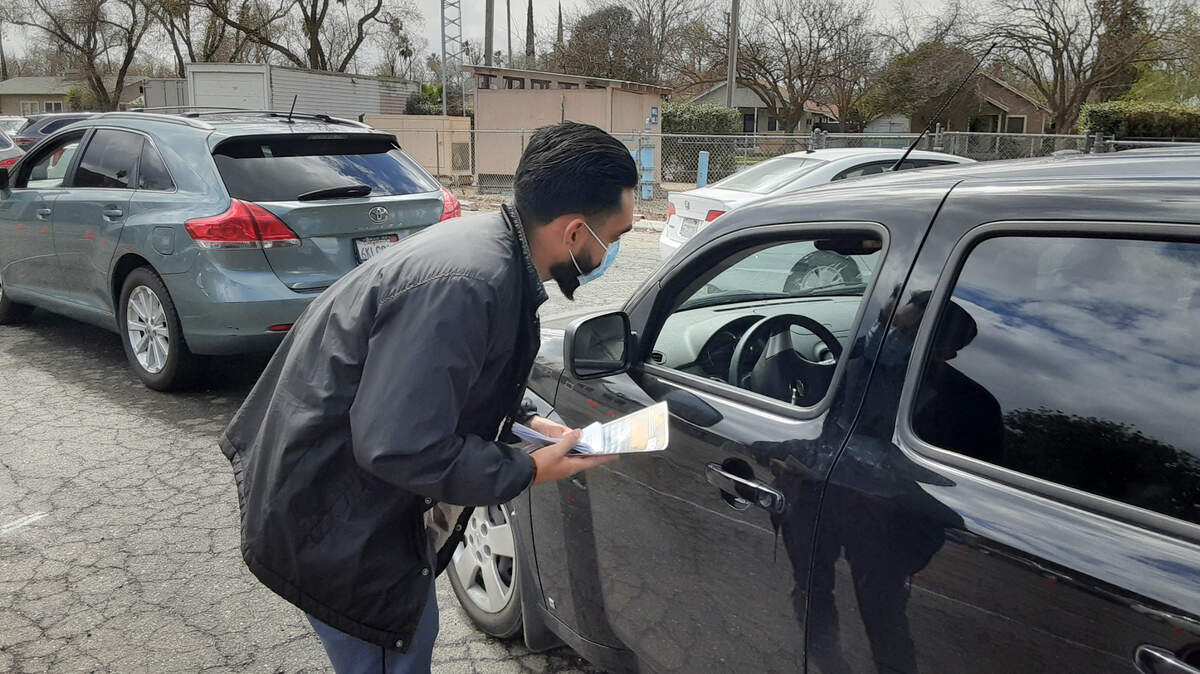
But that urgency was evident in mid March when a Stanislaus Rental Assistance outreach worker talked to people at a food giveaway in Patterson about the program. The worker was at The Gathering Covenant Church as people lined up in their cars and pickups in the parking lot for groceries from the Church Without Walls community food pantry.
Adriana was among those at the food pantry. The 31-year-old Patterson woman, who declined to give her last name, had just applied for help, saying she and her husband owed $4,400 in back rent and utilities bills.
Adriana said she was on unemployment and her husband had just returned to work after a layoff but at reduced hours. She said the layoffs and reduced hours were because of the pandemic.
“If I don’t get it,” Adriana said, “we will probably have to leave (our rental home). I feel we will be so in debt I won’t be able to pay him (her landlord). How will I catch up? We will probably have to move back with my dad and his family.”
Low income: $57,050 for family of four
Adriana said her dad has a family of six so with her and her husband and their three children that would mean 11 people living in a three-bedroom, two-bath home.
The rental assistance program is for households that make no more than 80% of the area median income and have had their incomes reduced because of the pandemic, such as a layoff, or face increased expenses because of the pandemic.
Some examples of household incomes that qualify for the program include no more than $39,950 for a single person, $45,650 for a family of two and $57,050 for a family of four.
Household income is determined by a household’s income for 2020 or its monthly income at the time it applies for help. Households qualifying based on their monthly income must have their eligibility checked every three months. So a high earning household could qualify for the program if the wage earners lost their jobs.
More information about the program is available at www.stanrentassist.com.
This story was originally published June 21, 2021 at 5:00 AM.