How will $36M help Stanislaus County tenants, landlords struggling in pandemic?
Doyle Conway has been supplementing his and his wife’s retirement pension for years by renting out local properties. As he’s gotten older — Conway is in his 80s — he’s gradually sold off houses, and is now left with just one in Turlock.
The tenants had been living in the house for a decade, always paying their rent on time.
But in December 2019, the husband lost his job. The wife, who had been battling cancer, had no income of her own. Since that month, Conway said, he hasn’t gotten a rental payment from his tenants.
The COVID-19 pandemic, which upended everyone’s lives last March, made it nearly impossible for his tenants to find jobs, and their unemployment benefits were wearing thin. Conway and his wife, who live in Modesto, were able to get by on their pensions, but the financial impact of the pandemic began to take effect.
“I haven’t asked him to move and I don’t want to ask him to move,” Conway said. “I’m hoping things will get better, because they were so faithful.”
Then, just last month, tragedy struck for the tenants, whom The Bee is not identifying for privacy reasons. The wife died from cancer, and the husband was left with her medical bills and no income of his own.
Conway said he and his tenant had no solution in sight, until Conway turned on the news and found out about the new COVID-19 Tenant Relief Act. The program will provide rental assistance to tenants across the county, using federal and state funding.
“I wouldn’t want it on my conscience that I put somebody out,” Conway said. “I was hoping that maybe this program, it’ll help that couple, it’ll help us.”
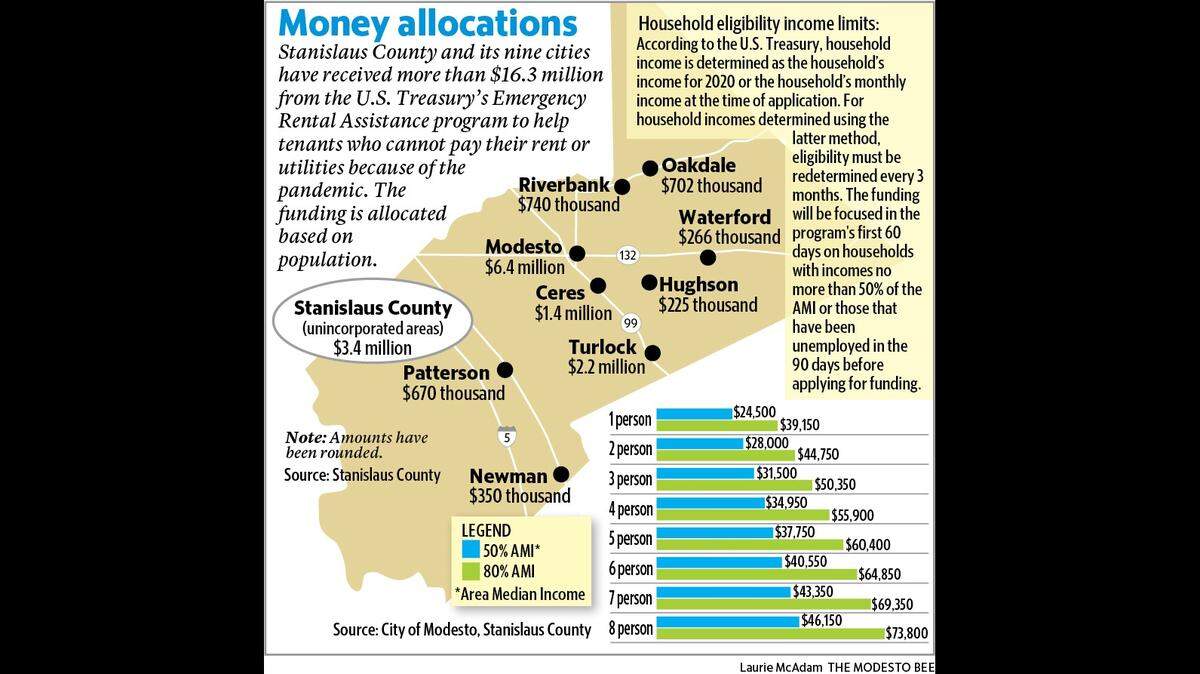
In total, Stanislaus County and its nine cities will have access to about $36 million in funding directly from the federal government and federal funding via the state.
Congress in December passed legislation that allocated $25 billion to the U.S. Treasury Department for the Emergency Rental Assistance Program to help households that cannot pay their rent or utilities because of a pandemic-related economic hardship, such as a layoff or reduced work hours.
California received $2.6 billion in federal funding, with $1.1 billion going directly to jurisdictions with 200,000 or more residents, which includes Modesto and Stanislaus County.
The federal funding amounts to about $6.4 million for Modesto and about $10 million for Stanislaus County. The county is dividing its funding among its unincorporated areas and eight other cities based on population.
Additionally, Stanislaus County and Modesto received $19.5 million in federal funding through the state.
This latest funding is among the tens of millions of dollars in federal stimulus funding that has poured into Stanislaus County and its cities to help small businesses, the unemployed, renters, the homeless and others in the pandemic.
The county Board of Supervisors and Modesto City Council on Tuesday approved an identical set of guidelines and delivery model for the program, which will be executed through a collaboration with a number of local credit unions and organizations, including the Stanislaus Regional Housing Authority.
There are differences between the federal and state programs, however. The Treasury Department’s funds can be used to cover 100% of rental and utility costs incurred by tenants, whereas the state’s program has limitations.
State program pays 80% of rent
If landlords agree, the state money will pay them 80% of their tenants’ unpaid rent from April 2020 to March 2021. Landlords would waive the remaining 20%. If landlords don’t agree, their tenants can apply for funding to pay 25% of their unpaid rent.
Tenants who pay at least 25% avoid being evicted during the state’s eviction moratorium, which remains in place through June. But the tenants would owe any unpaid rent once the moratorium is lifted.
The funding in Stanislaus County will be distributed in two phases: Phase 1 will encompass the federal money, which covers 100% of rental and utility arrears. Once those funds are exhausted, the county and city said, they will begin to disburse the state funds during Phase 2, covering 80% of the back rent.
For the first 60 days, the program will prioritize households earning at or below 50% of the area median income or those who have faced unemployment for 90 days prior to applying. After that period, the focus will shift to households earning at or below 80% of area median income.
Additionally, households can qualify if the renter has experienced a reduction of income or experienced financial hardship due to COVID-19 and has a proven risk of housing instability or homelessness. Those interested in applying for the program can do so at the stanrentassist.com.
County and city leaders said their distribution model was designed with Stanislaus County landlords in mind, who, like Conway, often own only a few units. For them, taking a 20% cut to their payments is much more difficult than for a larger corporate landlord with dozens or hundreds of units.
‘They’re not moneybags’
Greg Terzakis, a senior vice president at the California Apartment Association, a membership organization for landlords, said he and his organization recognize that the state program specifically has its limitations, “but we also understand that 80% of something is better than 100% of nothing” and will provide immediate relief, especially for smaller scale landlords.
“They’re really getting squeezed, because a lot of these people have gotten into the rental market, they bought a home or two as a way to fund their retirement, as a way to send their kids or grandkids to college,” he said. “They’re not moneybags, they’re not really well-off people, and they’ve been having to dip into their savings or 401k accounts for a significant amount of time.”
Terzakis said the COVID-19 pandemic hit landlords hard. While there’s little definitive data, he said CAA members have expressed their struggles with tenants who are unable to pay their rent.
California has been under an eviction moratorium since the beginning of the pandemic. Gov. Gavin Newsom recently extended it through June. The moratorium has empowered certain tenants who can pay their rent to skip payments, without fear of retribution.
People like that exacerbate the problems faced by landlords big and small, Terzakis said. He added he would welcome any oversight that could separate rent-dodgers from those who are suffering genuine financial loss, so assistance goes to those who truly need it.
Income crashes for Lyft driver
One Modesto renter said she and her husband are paying what they can but are struggling because her husband’s income as a Lyft driver in the Bay Area has dried up in the pandemic.
The woman, who asked that her name not be used, said she and her husband turned to another rental assistance program last month to catch up on two months of rent. She and her husband paid half of their $1,250 rent for their three-bedroom apartment for this month but have no idea how they will pay the balance and future months.
But the woman said she believes their landlord talked to her husband about the new rental assistance program, and he applied Wednesday. The woman said she fears losing their apartment if they owe months in back rent once the moratorium ends.
“It’s a good thing they can’t evict us now,” she said. “I worry that once they lift it, we will be out on the streets with no place to go.” The couple have a preschool-age son as well as children from previous relationships who live with them part time.
Roop Purewal, who owns three Modesto apartment complexes that have more than 100 combined units, also worries about tenants who are behind in their rent once the moratorium is over. He hopes the rental assistance program will prevent that.
“We know if tenants are four months behind in their rent that is an insurmountable amount,” he said. “We honestly think this is the right way to go, to get people back to some sort of equilibrium point.”
Purewal said the vast majority of his tenants are paying their rent on time. He said nearly all of those who aren’t are working with his property managers to keep them informed on their finances, making payment plans, and availing themselves of assistance programs.
Tenants owe about $40,000 in back rent
But he said his Modesto tenants still owe him about $35,000 to $40,000 in back rent. He said that is a huge amount, considering how his and other landlords’ expenses for such costs as insurances and water, sewer and trash services continue to increase. He said landlords also have their own mortgages to pay.
“When you start looking at the totality of all of the operating costs,” he said, “there are a lot of expenses.”
Terzakis said rent relief needs to be much higher on Congress’ priorities list.
“We need rental assistance to be a significant factor in the next stimulus and economic recovery plan from the Biden administration and Congress,” he said. “For us, this isn’t a partisan issue this is, ‘Do people stay in their homes, and are the people who provide rental housing able to stay in business?’ ”
This story was produced with financial support from the Stanislaus Community Foundation, along with the GroundTruth Project’s Report for America initiative. The Modesto Bee maintains full editorial control of this work.
To help fund The Bee’s economic development and children’s health reporters with Report for America, go to https://bit.ly/ModestoBeeRFA
This story was originally published February 28, 2021 at 5:00 AM.