
A quick, relatively easy way to get many homeless people off Modesto streets
After almost a decade of working closely with homeless people and all aspects of our systems of care, I’ve come to a few fundamental conclusions about homelessness. A lot of my early assumptions about homelessness were proven wrong after working closely with homeless people themselves, literally hundreds of them.
Most people would agree our systems of care are overwhelmed, so I’m not going to spend time discussing that. The evidence is on our streets, in our parks, and along our rivers and freeways. There are homeless people everywhere.
A conclusion that took a long time to realize is that we need to stop thinking about rehabilitation and start thinking about harm reduction. The traditional shelter system was meant to get people who were temporarily out of work or experiencing hard times back on their feet, and ultimately back to work. Modesto’s low-barrier shelter represents a key change to how shelters should operate, but it does not necessarily lead to the workplace.
A large percentage of our homeless population is medically, mentally or developmentally disabled, or lacking in skills enough to earn a living wage. Given today’s high costs of living, especially housing, no wonder they are homeless. The first step is to reduce further harm by getting them shelter and supportive services through bridge housing, also known as tiered or graduated housing options.
When we start thinking in terms of harm reduction, we realize that getting people off the streets and into bridge housing means an immediate reduction in quality-of-life crimes associated with homelessness. It means fewer hospital visits, easier access for volunteers and professionals, fewer homeless people around our small businesses, homes and parks, and easier assessment of people’s needs.
Understanding housing in terms of tiered or graduated housing options makes it easier to respond immediately. With our current acute housing shortages forecast to last many years, we must have a near-term option that provides bridge housing quickly and inexpensively.
Our experience with the Modesto Outdoor Emergency Shelter was very instructive. Even though MOES got too large and outgrew its infrastructure, it still showed us we can reduce much of the harm homelessness causes in our community while also providing easier access to services for homeless people. MOES showed us that even tents can serve as bridge housing, and that community is a key to progress through harm reduction.
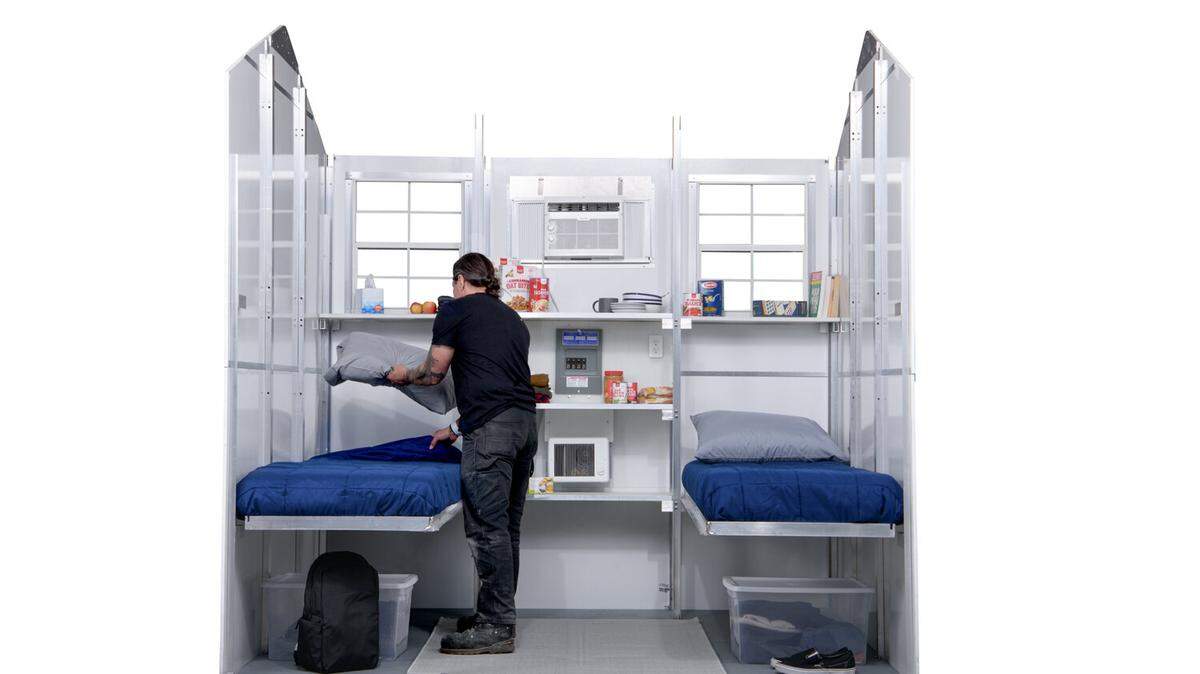
My research has shown that the next stage above tents is pods, small metal shelters built by Pallet Shelter of Everett, Washington. The units are sturdy, can be set up in half an hour, and can be shipped immediately. With beginning costs of around $7,000 per unit, they are far less expensive than traditional housing. After site prep, a community could be established in days, not months or years.
Many of our homeless have some type of minimal long-term income from agencies such as Social Security. A community of elderly people with incomes could be set up quickly and they could pay a fee for their pods. This community could become relatively self-sufficient.
Ideally, pods would be placed near mental health services and existing shelters, in easily accessible vacant spaces. These new micro-communities would function and be served much like other communities throughout town in terms of law enforcement and public services like trash and garbage pickup.
These micro-communities would not only improve the quality of life for their residents but for the rest of us as well.
Our local leaders have said repeatedly that money is not the problem when dealing with homelessness. If not, then let’s start a program of bridge housing options now. We have a growing homeless crisis, and it’s time to act.
This story was originally published February 26, 2021 at 4:00 AM.