
Strengthening Modesto and Stanislaus connections despite COVID-19
The worldwide COVID-19 coronavirus pandemic is the catalyst causing an oil crisis — or rather a reverse crisis, with too much oil. Production is now coming off the market, some permanently perhaps. This could upend long-term global economic growth, as oil is the highly efficient lubricant upon which globalization is built.
With less total oil around now, what do we do?
Primarily, we can be connected with each other — locally.
Some historical context and a shared philosophical foundation can keep us positively tied together. Generically, we need local decency.
Changing back to localism — or globalization in reverse — is not all immediately pleasant, but we have much going for us in the greater Modesto-Stanislaus region, longer-term. Now is the time to recognize it.
Centrally, why are we here? Modesto, the largest city in the region, was founded as a stop along the railway. Rather humble. Modest, in fact.
Yet, it has achieved staying power, and in a modest way.
We have food-growing land with an accommodating climate, plentiful sunshine, and valuable water supply. That fateful railway stop happened to grow Modesto into the economic market-center of an agriculture commodity-based industrial region: I think of it as greater Stanislaus County.
We grow food here, with actual roots: grapes, fruit, olive, and nut trees, and seed and row crops. Other important land-use ag includes dairy, beef, and poultry. Food is essential.
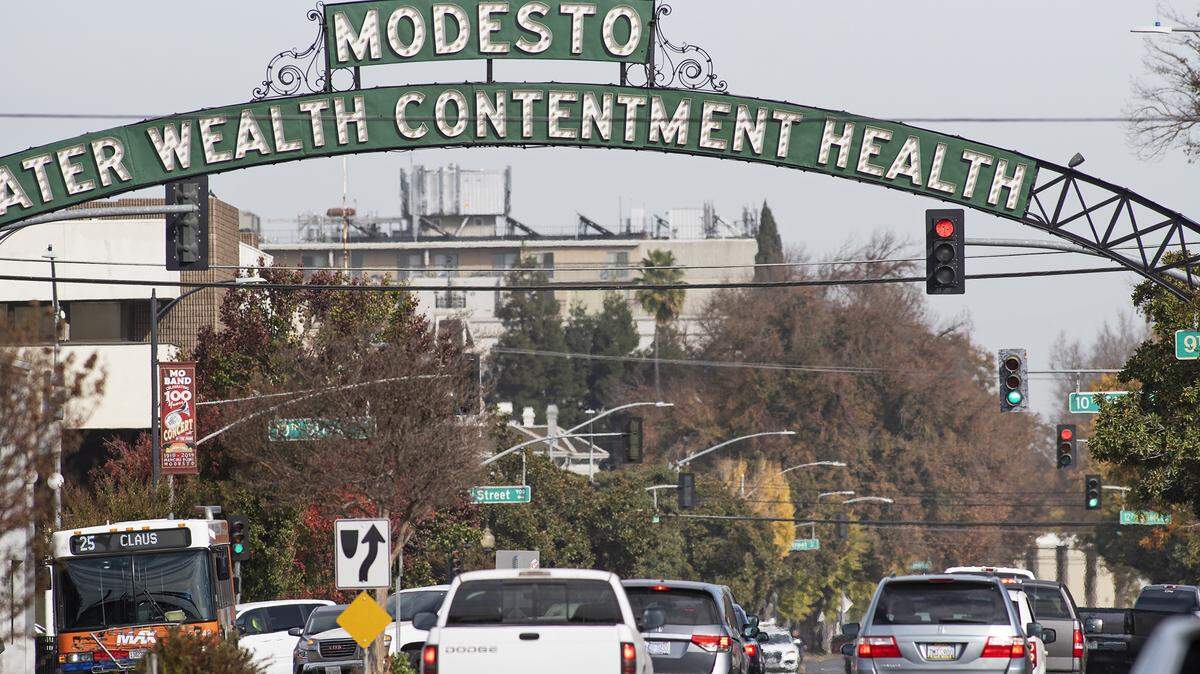
Emblazoned on the Modesto Arch is Water Wealth, Contentment, Health. It’s the water wealth, a phrase not separated by a comma, that provides the rest.
The arch was formerly sketched as the city of Modesto’s logo; it’s a monument of a reminder of what fundamentally sustains us. Water is essential.
Pragmatically, our political leanings are balanced. Uncommonly, we’re nearly 50-50 split conservative-liberal. Practically, we skew to the center. It’s Midwestern-like, and it’s a real strength.
We’re also connected in ways that we don’t even realize.
The name Modesto came from William “Chap” Ralston, who was known for exuding an aura of “nothing is impossible” and was apparently too modest to have a town named for him. It’s profoundly Modesto-like!
Ralston’s legacy was in founding the Bank of California. A branch (now called MUFG Union Bank) still operates downtown, near the old El Viejo post office.
Where is Ralston’s other legacy bank branch in Modesto? Inside a Save Mart store on Pelandale Avenue. It’s literally housed in a store which is part of one of our homegrown supermarket chains.
Why such minutiae?
To underscore how connected we are, even for ways we don’t realize. Our strong bonds are something mega-populated places like the Bay Area and Southern California largely lack.
Older, small towns have the deepest bonds. I see it when visiting cousins in Oakdale and Sonora. It’s structurally intact in the Ceres, Manteca, and Turlock areas, too. Long-time residents there basically all know each other; it’s meaningful. Same goes for Atwater, Merced, and the Valley’s West Side towns.
All that food we grow? It happens that the Hebrew Biblical “seven species of Israel” — wheat, barley, grape, fig, pomegranate, olive, and date — all grow in the Valley. Devoutly or metaphorically, this is a land of milk and honey. This is our promised land. We make it so.
I often think in music — and with classical music the greatest of all time, I would contend — it seems like our region is relatively close to Maurice Ravel’s Daybreak, the “sunrise song.” Look it up for a listen. You may get the emotionally healing feeling needed to gain clarity in times like this.
Broadly, this could be a new sunrise for us locally.
With plenty holding us together — temporary physical social distancing aside — this multi-pronged crisis can actually serve to strengthen our connections. We’ll all benefit if it does.