Stapley: What we should glean from first public meeting on Modesto police reform
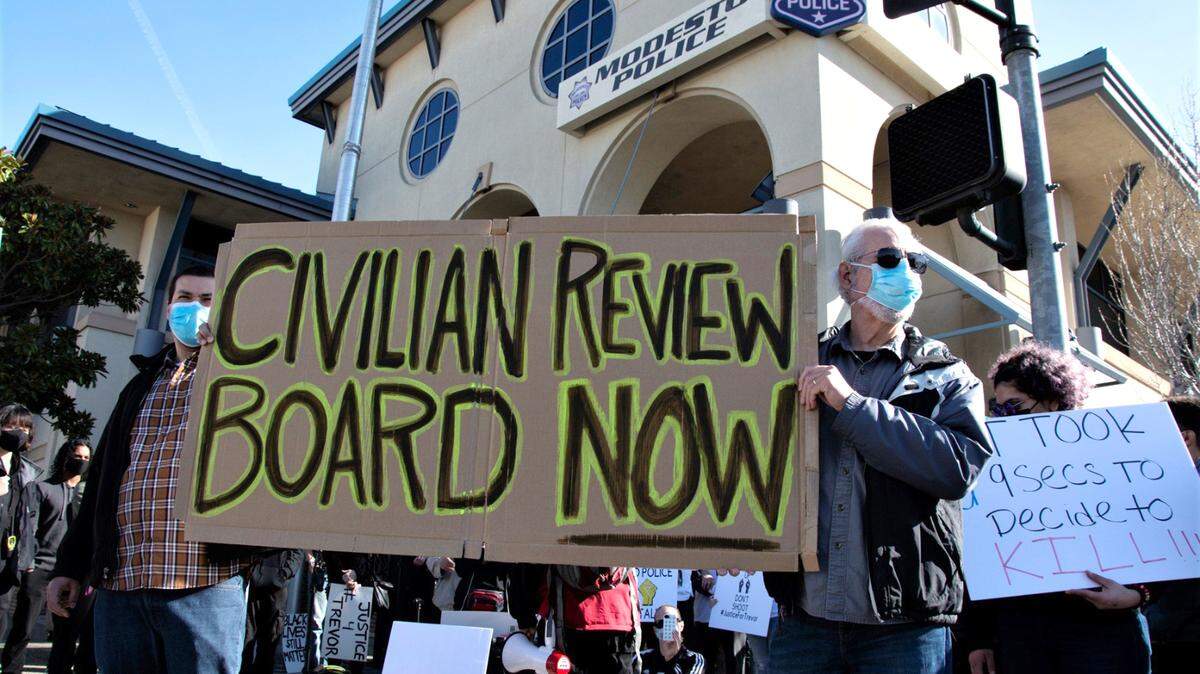
Some takeaways from Saturday’s inaugural listening session of the Modesto City Council on police reform:
- Many of 40-plus speakers from in-person and Zoom audiences zeroed in on establishing a civilian review board and hiring an independent police auditor. Both were key recommendations from a consortium of local nonprofits, and issued independently, from The Modesto Editorial Board. This tells us people are paying attention.
The idea that any group has the innate ability to police itself is ludicrous. Speaker after speaker drove home this point.
Civilian review working hand-in-glove with an independent auditor to review police policies, procedures and critical incidents, and to suggest changes, is the obvious and proven answer. A soon-to-be-formed committee tasked with formulating recommendations won’t be able to ignore all of the voices raised Saturday in support of these fundamental pillars.
The Rev. Michael Schiefelbein of Modesto’s College Avenue United Church of Christ provided a real-life example of such accountability. His church has a pastoral relations committee, he said, whose duties include acting as a check on his far-reaching power. That sort of thing just makes sense.
- We love our cops. This admittedly is a generalization, meaning many people — not all — expressed the value that police bring in protecting our community, usually with dignity and respect.
“This is not a challenge to police,” speaker John Lucas wisely reminded everyone.
The listening session was designed to gauge and record attitudes. It was never meant solely for police bashing, and anyone hoping to hear a litany of horror stories would have been disappointed.
- At least a couple speakers, however, noted that people traumatized by police encounters might be the last expected to offer testimony in such an intimidating forum — standing alone in a public spotlight facing a semicircle of stern authority figures. I hope dozens watching from home heard the much-repeated invitation to submit comments privately by leaving voicemail at 209-577-6400 or email at forwardtogether@modestogov.com. Following progress at modestogov.com/forwardtogether is a good idea, too.
- The CAHOOTS model is worth trying. As I explained in Sunday’s column, this is the name of a successful crisis intervention program in Eugene, Oregon, that sends a mental health worker and a medic to nonemergency calls involving mental illness, addiction or homelessness. These two-person teams save lives and taxpayer money, and similar efforts are popping up all over the United States.
Chronology: I wrote that column Friday, the listening session was Saturday and the column was posted and printed Sunday. Which means that all speakers mentioning CAHOOTS Saturday had done their homework and were not simply parroting the newspaper.
People recognize that huge challenges facing police don’t always require a police response. Locally styling a CAHOOTS-type effort should be a top consideration.
Interim Police Chief Brandon Gillespie told me that three homeless outreach workers recently were hired, and another is to be added soon. We’re anxious to learn more.
- City Council members don’t always follow instructions. Near the close of Saturday’s meeting, facilitator Kate Trompetter asked them to pick out themes of what they’d just spent four hours hearing. The first three to weigh in — Jenny Kenoyer, Bill Zoslocki and David Wright — ignored that direction and spoke mostly in platitudes.
Chris Ricci, Rosa Escutia-Braaton and Tony Madrigal did better. They’re open to the idea of a shift in police culture, in some fashion.
- To achieve the “meaningful, meaningful change” that Escutia-Braaton spoke of, we can’t afford to tap out. It will be tempting, once the committee begins its work, to unplug and sit back.
Wendy Byrd, president of the NAACP’s local chapter — a moving force behind the idea of Modesto police reform since George Floyd’s murder at the hands of Minneapolis police a year ago — had the best advice: “Stay engaged.”