Saving lives and money — what’s not to like about CAHOOTS? Give it a try, Modesto
When talk turns to police reform in Modesto, periodically someone will say something about CAHOOTS. I don’t recall hearing a decent explanation of what that is. So here goes.
Thirty-two years ago, Eugene, Oregon, began sending a mental health caseworker and a medic instead of police to nonemergency calls involving mental crises, addiction and lack of housing. These responders work for a contracting company called Crisis Assistance Helping Out on the Streets, or CAHOOTS.
The innovation has saved a lot of lives and money, and others have taken notice. Since George Floyd’s murder at the hands of Minneapolis police last year, 400 cities and counties have contacted CAHOOTS for advice in setting up something similar.
Modesto and Stanislaus County ought to, too.
Both right now are exploring how to improve law enforcement. The Modesto City Council launched its Forward Together listening session on Saturday, to be followed by a committee whose future recommendations could include some fashion of civilian oversight, and eventually maybe something like CAHOOTS. We should know more about Stanislaus Sheriff Jeff Dirkse’s Project Resolve in a few weeks.
Our Modesto Bee Editorial Board has issued recommendations on civilian oversight. CAHOOTS represents something more, an entirely different approach for service calls that don’t require sirens, a gun or a badge and that police probably would rather not deal with.
Any sheriff or police chief will tell you that officers daily confront myriad problems of addiction and mental health. They chew up 21% of an officer’s time on the street, concluded a 2019 report from the Treatment Advocacy Center in Arlington, Virginia, along with the National Sheriffs’ Association.
It’s partly why Modesto recently hired two full-time and two part-time homeless outreach workers who will respond to nonemergency calls, Interim Chief Brandon Gillespie told me Friday evening.
Policy changes in recent decades have taken responsibility for front-line contact with the mentally ill from the medical community and placed it with the criminal justice system. That’s not fair to police and sheriffs, another study found after polling 2,406 senior law enforcement officials in Management of the Severely Mentally Ill.
By diverting 20% of police cases, CAHOOTS is saving Eugene taxpayers $8.5 million a year, and it also serves nearby Springfield and Lane County. Hopefully, Modesto can save some money, too, with its fledgling homeless outreach program.
But the case for saving lives is even more compelling.
The Treatment Advocacy Center says people with untreated mental illness are 16 times more likely to be killed by law enforcement. A 2016 study found that up to half of people killed by police had a mental illness.
Bullets don’t always solve the problem
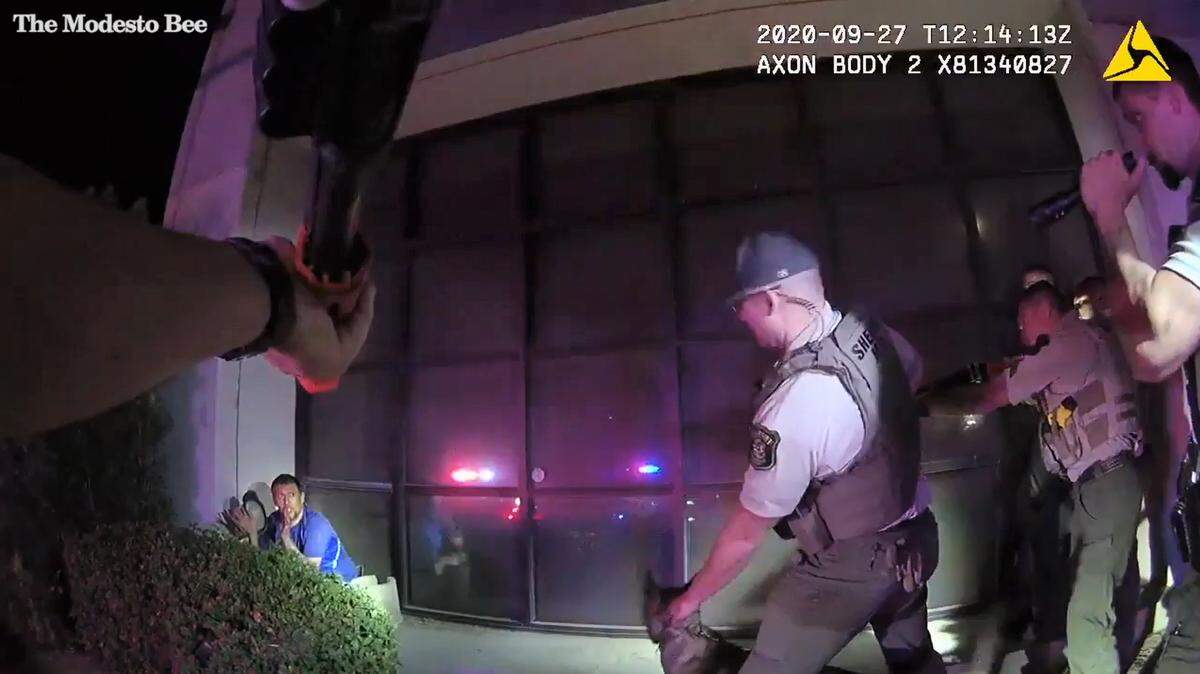
Modesto’s Evin Yadegar might be alive today if someone treating mental problems had showed up rather than deputy sheriffs when a Salida hotel clerk called in a disturbance in 2017. Officers chased Yadegar at 35 mph to Ripon, where one shot and killed her. A wrongful death settlement cost taxpayers $7 million, and a deputy still faces a criminal manslaughter charge.
One wonders how many officers who have killed people now wish that someone with mental health expertise had been sent, rather than them.
Stories of sick locals needing help, not bullets or attacking canines, are too many to recount in this space. But the list of names includes Eloy Gonzalez, Kim Jackson, Brian Reed, Richard Phillip Robles Jr., Armando Olvera, Francisco Moran, Jesse Montelongo and Garrett Schmidt.
It’s not clear whether a CAHOOTS-type team might have saved them and many more from injury or death, because some had weapons, requiring a law enforcement response.
What is clear is that too many pay with their lives when overly aggressive warriors show up and see a criminal to neutralize rather than someone in need.
Knowing they could be putting a loved one in the way of an officer’s bullet, family members hesitate to call until a problem gets out of hand. They would be more inclined to call if they knew that a mental health worker and a nurse or EMT would be first on the scene.
CAHOOTS teams are used to help solve disputes, find disoriented seniors and others who wander away, provide first aid, give suicide and grief counseling, and much more. If encounters go sideways, CAHOOTS retreats and sends in the cops. In a recent one-year period, CAHOOTS requested police backup 150 times among 24,000 total calls.
Consider crisis intervention in Modesto
Does this not sound like something worth trying?
Don’t we in Modesto and Stanislaus County deserve the best protection possible?
By the way, what works in Eugene, population 176,000, may not work in Modesto with our 222,000. Other places trying something, but not exactly like CAHOOTS, include San Francisco, Chicago, New York City and more. Los Angeles County came up with its “Care First, Jails Last” plan with the same goals in mind.
An Oregon senator in Washington, D.C. in February introduced legislation providing funding for cities everywhere to set up nonpolice response teams, and the American Rescue Plan stimulus package offers matching money for similar intervention efforts.
I know this is a lot to take in, at a time when Modesto and Stanislaus County are just coming to grips with the idea that our policing could be better.
I also know the men and women leading our city, our county and our law enforcement agencies. I’m convinced they want what’s best for us, and they grieve with us when a cop needlessly takes a life.
A nonpolice CAHOOTS-type response could provide a solution that’s helpful to all.
This story was originally published May 23, 2021 at 5:00 AM.