
Modesto and Stanislaus County must not be left holding bag for downtown stadium
It’s too early to predict if a downtown stadium would be as good for Modesto as it would be for the Seattle Mariners, who own the Modesto Nuts minor league baseball team.
It’s not too early to warn as city and Stanislaus County leaders examine the ambitious Great Valley Coliseum proposal, because it would cost a whole lot of public money.
Much about the grand plan, without doubt, is exciting.
Those who love Modesto and want to see it thrive love the idea of a large downtown venue hosting concerts, professional soccer matches and of course, baseball games. For any city, civic amenities matter. They can be selling points to attract new residents or to help keep our children from leaving for greener pastures.
But it would be irresponsible and possibly ruinous to encumber the people of this community with unreasonable debt to satisfy a starry-eyed edifice complex.
The Modesto Bee is concerned about statistics in a stadium feasibility study. Mind you, these worrying numbers weren’t produced by opponents of the stadium. They were produced by supporters. In addition, Modesto residents should be aware of the many other publicly subsidized sports projects that failed to live up to rosy promises made to municipal leaders and their citizens.
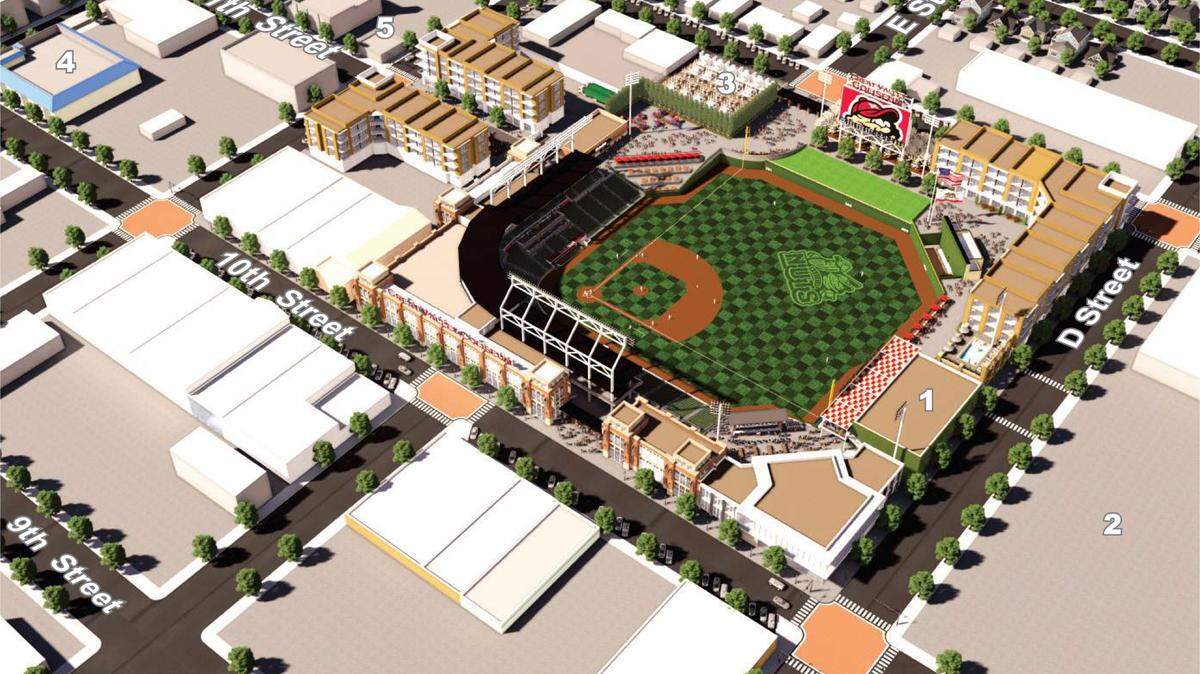
The Great Valley Coliseum would occupy much of a four-block area between 10th and 12 streets and D and F streets. Impressive computer-generated renderings showcase a facility capable of being configured for baseball, soccer and even football games. The pictures show people milling about terraces and a party deck, and a grass berm section for picnickers. They even call for a small almond grove just outside the stadium in a nod to our agricultural heritage.
The estimated cost is between $85 million and $122 million. It’s disappointing that local taxpayers would be expected to cover all but $5 million to $10 million of the stadium cost. In fact, disappointing doesn’t begin to describe this aspect of the stadium plan.
Since new ballpark rumors began to surface last summer, The Modesto Bee has been clear that a proposal must not gouge taxpayers. Expecting as little as 4% from private investors — and as much as 96% in municipal bonding — is gouging taxpayers.
Proponents contend that the arena would pay for itself, with enough left over eventually to return money to city and county coffers. In other words, this will end up being a revenue source instead of a drain, according to a preliminary funding and economic benefit analysis by Kosmont Companies.
Others have fallen for the same bill of goods, or similar, with disastrous results.
Modesto must learn from mistakes
In 2005, Stockton sunk millions in public money toward a sports complex it could not afford, including a $22 million ballpark for its Stockton Ports — same instructional league as the Nuts — and a few years later the city declared bankruptcy.
Two decades ago, Fresno built a two-deck, 10,000-seat stadium in its downtown for their minor league team, the Grizzlies, costing $46 million. Like the Nuts — whose ties to the Oakland A’s changed to the Colorado Rockies and then to the Mariners — the Grizzlies have switched affiliations with major league teams over the years. Each time, lease revenue for Fresno was negotiated downward; what was $1.5 million a year went to $1 million, then $500,000, and now it’s $100,000. “Each time, city leaders go along citing the need to keep the team afloat and the peripheral effects the stadium has on downtown,” wrote Fresno Bee columnist Marek Warszawski.
Twenty years later, Fresno taxpayers continue making $3.2 million annual payments on construction bonds, prompting Fresno City Council President Miguel Arias to call the stadium “the city’s most expensive impulse buy.” And professional soccer, once a stadium lessee, didn’t save the day for Fresno.
We must avoid that sort of deal in Modesto.
Our own history should give us pause. Our convention center — Modesto Centre Plaza — has served us well, hosting innumerable events over the years. But its construction included a bad deal with the adjacent Red Lion Hotel (which later became the DoubleTree), and the land our city owned underneath was forced into foreclosure. The city paid $1.4 million for the land it lost with hopes of reaping $4.2 million in future lease payments. And the convention center continues to be a drag on the city’s General Fund, this year requiring a General Fund subsidy of nearly $900,000.
So no, taxpayers don’t always win when elected leaders gamble with their money.
“From a return-on-investment standpoint, economists and researchers almost universally agree that stadiums are unlikely to generate anywhere near the level of tax revenue needed to offset the public subsidies tied to their construction,” wrote the Investigative Post, an award-winning journalism nonprofit based in Buffalo, a few weeks ago.
Books have been written about risky stadium deals, including “Field of Schemes,” whose Nebraska-based authors maintain a website tracking public subsidies of sports venues. In a Dec. 29 post, author Neil DeMausse ridiculed Modesto for even considering what he thinks is an outlandish ask by the Mariners. DeMausse compared the local proposal to “the reigning minor-league stadium subsidy record of $150 million for the Worcester (Massachusetts) Red Sox, but at least that’s a Triple-A stadium.” In baseball parlance, Triple-A is the rung on the developmental ladder just underneath the big leagues while Modesto’s single-A team is for low-level players just starting out.
The authors of another book, “Public Dollars, Private Stadiums,” found that team owners love it when local business leaders cheerlead public subsidies, taking the heat off sports franchises from critics crying corporate welfare.
Unacceptable local risk
Modesto’s stadium proponents — a notable bevy of local business people — are right to say Modesto will stagnate without visionary thinking, and ultimately, risk. They assert that cities like Modesto must assume some risk to prosper.
The trouble here is expecting the city and county to assume almost all of the financial risk.
What risk will be assumed by the Mariners, who own the Nuts and want to manage the Great Valley Coliseum? It appears to be small.
That arrangement — high reward for team owners, high risk to local taxpayers — is a classic recipe for disaster, numerous urban planners and economists have warned.
City and county finance experts are now crunching numbers and may produce independent analyses in March. All await those reports, which will inform deliberations by the City Council and county Board of Supervisors.
Modesto City Manager Joe Lopez isn’t brimming with enthusiasm. A stadium “would be a tremendous asset,” he said in a December interview with Bee editors, “but we’re very fiscally challenged. We can barely provide the core services the community expects of us.”
And county leaders have indicated reluctance to champion yet another downtown amenity when City Hall would not. That’s a reference to the $47 million Gallo Arts Center, which Modesto leaders refused to help build. The city did waive building permits worth $161,000, while the county donated the land, a $15 million value when it was built in 2007.
The Modesto Bee recommends...
If coliseum proponents hope to meet with success, they should find a way to:
Learn from mistakes of other municipalities, including Stockton and Fresno.
Commit to raising more than $10 million in local private investment.
Get Seattle to put some serious skin in the game.
Find other ways to dramatically reduce taxpayer risk.
Lastly, proponents should not berate anyone for looking at their idea with a critical eye. Any proposal of such magnitude — with so much at stake for all of us — must withstand intense scrutiny if it hopes to gain widespread support.
If this project guaranteed a return on investment, it wouldn’t need public money because private investors would be lined up to support it. Our leaders should remember that when they’re asked to gamble with our money.
BEHIND THE STORY
MOREWhat are editorials, and who writes them?
Editorials represent the collective opinion of the The Modesto Bee Editorial Board. They do not reflect the individual opinions of board members, or the views of Bee reporters in the news division. Bee reporters do not participate in editorial board deliberations or weigh in on board decisions.
The board includes McClatchy Central Valley Executive Editor Don Blount, Senior Editor Carlos Virgen, Opinions Editor Juan Esparza Loera and California Opinion Editor Marcos Breton.
We base our opinions on reporting by our colleagues in the news section, and our own reporting and interviews. Our members observe public meetings, call people and follow-up on story ideas from readers just as news reporters do. Unlike reporters, we share our judgments and state what we think should happen based on our knowledge.
Read more by clicking the arrow in the upper right.
Tell us what you think
You may or may not agree with our perspective. We believe disagreement is healthy and necessary for a functioning democracy. If you would like to share your own views on issues or events important to the Modesto region, you may write a letter to the editor (200 words or less) using this form, or email to letters@modbee.com.
Support The Modesto Bee
These conversations are important for our community. Keep the conversation going by supporting The Modesto Bee. Subscribe here.