Why Stanislaus school districts struggle to fill positions, lack fully qualified educators
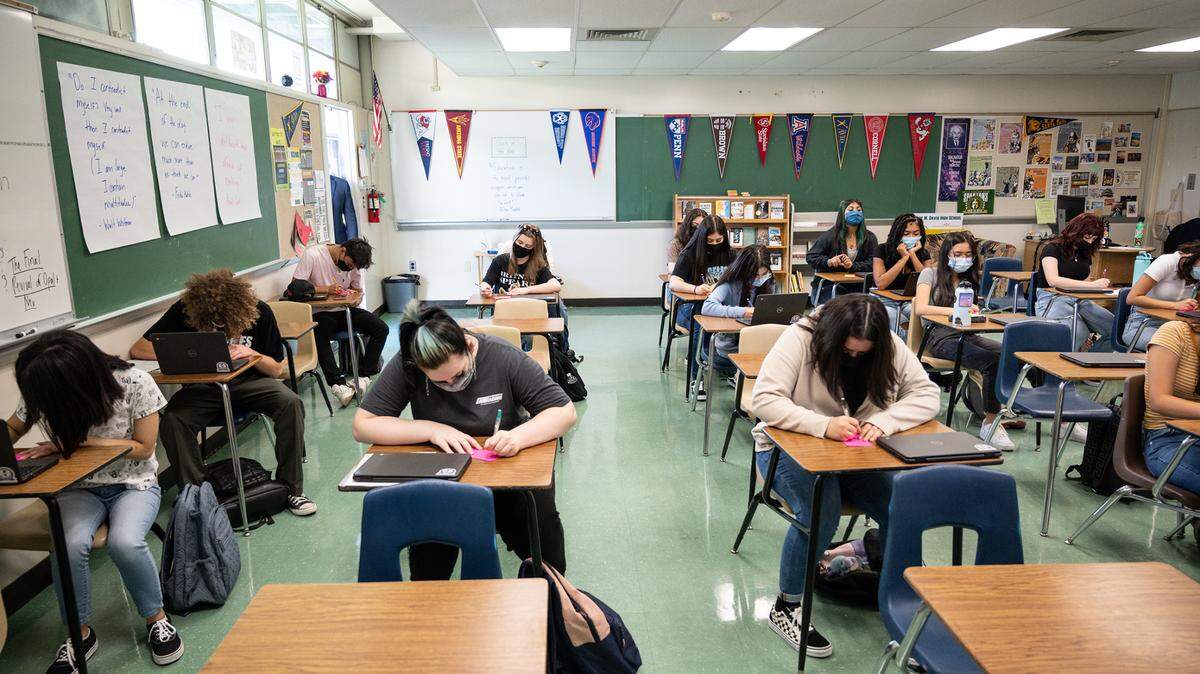
Modesto’s Stanislaus Union School District confronts a peculiar situation this year: School leaders have money to hire staff to help accelerate student learning, but no applicants to fill the positions.
The K-8 school district hoped to bring on classified staff to address academic and social emotional needs, Superintendent Shannon Sanford said. These paraprofessionals, or instructional aides, would provide targeted assistance to English language learners and students in special education, for example.
“It slows that process down in getting them the assistance that they need to be more successful,” Sanford said.
For more than a decade, California has felt a shortage of qualified teachers, substitutes and school support staff. Smaller districts like Stanislaus Union are particularly hard-hit.
The pandemic brought distinct circumstances that exacerbated shortages for districts across California. A spike in teacher retirements, new positions from COVID funding and people needed to run independent study programs led to Stanislaus County school districts starting the school year with unfilled positions and hiring educators with substandard qualifications.
“The teacher shortage is real for all of us,” said Mike Berhorst, assistant superintendent of human resources for the Stanislaus County Office of Education. “We’re all feeling it.”
Substitutes hard to find
School leaders are scooping up qualified teachers to fill permanent openings, leaving substitute lists dwindling.
Stanislaus Union developed a roster of three substitute teachers specific to the district’s five elementary schools and one junior high last year, Sanford said. School leaders needed to move those three substitutes to oversee their new independent study program this year, which California schools learned they needed to offer in July. About 100 of Stanislaus Union’s more than 3,000 students opted into online independent study.
That brought the district-specific sub list back to zero.
School leaders covered classrooms before other jobs, relying on a “very frequently” used flowchart outlining who should supervise classes, Sanford said. Intervention specialists, instructional coaches, principals, administrators and even Sanford herself stepped in last year.
That meant aides weren’t always available to give students the targeted academic support they needed.
Stanislaus Union raised the daily pay rate for substitutes from $120 before the pandemic to $225 for this school year. Other local districts, including Turlock Unified and Sylvan Union, raised substitute pay this year to $200 per day.
Sanford hopes vaccinations will lead to fewer teachers staying home sick, and less need for substitutes. Vaccines are required for all California school employees.
“The vaccine would cut a lot of those pieces out where we were needing subs before,” Sanford said.
Oakdale program delayed
Oakdale Joint Unified School District delayed the start date of its junior high after-school program until people can be found to lead it.
“We did our best, but when kids came back, we just couldn’t do it,” Superintendent Dave Kline said.
The district prioritized staffing after-school programs at all elementary schools for consistency’s sake, Kline said. The 2020-21 school year aside, this is the first year the after-school junior high program isn’t open.
Districts lack fully qualified educators
Where districts don’t struggle to fill positions, some jobs are filled by people who don’t have complete qualifications.
School districts can submit an annual “Declaration of Need for Fully Qualified Educators.” This serves as a request for limited assignment permits, granting districts the ability to hire interns, educators credentialed outside of California and teachers who have a subject credential different than the one they’re asked to instruct.
Although districts may submit this declaration yearly, teachers hired with substandard credentials are “a strong indicator of teacher shortages because districts can receive authorization to hire such teachers only when fully prepared and credentialed teachers are not available,” according to research from the Learning Policy Institute.
A Stanislaus State University professor who studies teacher recruitment and retention said educators on substandard credentials lack subject matter knowledge and specific pedagogical approaches, and instruction suffers as a result.
“I think the theory is that you’re competent enough,” professor Derek Riddle said.
Modesto City Schools filed for 60 limited-assignment permits this year, meaning 60 of the district’s 1,500 teachers had substandard credentials when hired, according to the agenda from a July school board meeting.
This amount is “typical,” said Mike Henderson, associate superintendent for human resources. However, he added, “I wouldn’t say it doesn’t indicate an area of concern.”
The declaration of need provides the district some flexibility, he said, and allows the district to hire interns.
Modesto City Schools typically looks to hire interns in special education, math and the sciences. High demand has led the district to consider interns in other subjects, too.
Professional development helps
Interns might spend up to two years after their time of hire to earn a full qualification, Henderson said. Modesto City Schools tries to offset interns’ potential for lower quality of instruction through professional development, he said.
“Ideally, you would have everyone you hire completely have every authorization for which you would hope to assign them,” Henderson said. “But that’s not always the case.”
The district saw more openings than usual this year, caused by a spike in early retirements combined with new positions added through pandemic relief funding. About a dozen jobs were not filled when school started, Henderson said.
“It’s actually pretty successful that we went out and filled as many positions as we did,” he said.
Some classroom teachers were hired as instructional coaches for this school year, but until the district finds replacements for their teaching jobs, they’ll continue in their former positions, MCS spokeswoman Becky Fortuna said.
Modesto City Schools’ business services division determined the district could benefit financially from offering certificated staff an early retirement incentive last year, Henderson said. He said he could not recall the last time the district offered a similar incentive. More than 90 people accepted, retiring a year or two earlier than planned.
Modesto Teachers Association President Doug Burton said this was a cost-saving measure, but primarily, the incentive stemmed from “realizing that there were a lot of people towards the end of their career that were struggling in the technology world of distance-only learning.”
Shortages date back over a decade
Special education, secondary math, physical sciences and bilingual education are the most challenging areas to fill, said Christine Sisco, assistant superintendent for instructional support services at the Stanislaus County Office of Education.
“There’s no shortcut to getting highly qualified staff and teachers into these positions,” she said.
Riddle said staff shortages stem back to the 2008 recession. “I feel like we’ve been playing catch-up for about a decade,” he said.
Messaging plays an important role in attracting more teachers to the profession. “I think the message needs to be stronger that teaching is actually a financially stable and sustainable field,” he said.
Teaching candidates often have negative perceptions of some Central Valley school districts, he said. Larger districts like Modesto, Ceres and Turlock tend to compete for the same pool of applicants, and smaller, rural districts are left waiting until the last moment to fill vacancies, he said.
“It’s just a matter of really getting people to understand, you know, where the needs are,” he said.
Once someone is hired to a smaller, rural district, professional environments play a big factor in keeping them there, Riddle said.
Sisco, who oversees curriculum and instruction at the county office of education, said she’s encouraged to see so many school leaders expanding support for staff mental health and wellness during the pandemic. This can help with teacher retention, she said.
“I think that our districts and our county office all are very focused and understand that if our school staff don’t take care of themselves, then they aren’t able to take care of their students,” she said. “That’s not something that has been traditionally done in education.”
Riddle said all teaching candidates at Stanislaus State are being hired, suggesting “there are probably still more that need to be hired, and we’re just not producing enough.”
“It’s complicated, and it’s a multifaceted issue,” Riddle said. “If it wasn’t, we would have solved it by now.”
This story was originally published August 26, 2021 at 6:00 AM.