How do Stanislaus school districts look to use Rescue Plan funds? Here are some answers
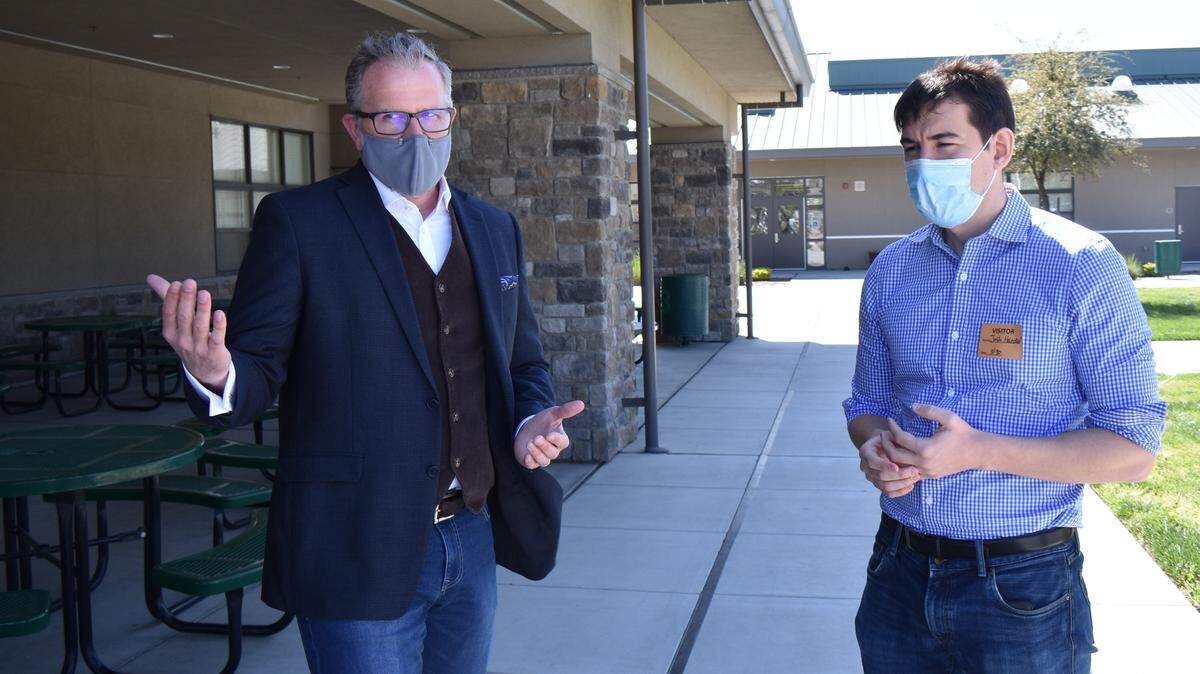
The well-being and mental health of students and employees are top-of-mind for at least some Stanislaus County education leaders as they look at ways to spend federal COVID-19 pandemic recovery money.
Talking recently with U.S. Rep. Josh Harder about plans for education funds coming from the $1.9 trillion American Rescue Plan Act of 2021, county schools Superintendent Scott Kuykendall stressed the importance of addressing the wellness of not just schoolkids but their teachers and other staff.
“It’s almost kind of like when you’re getting on a plane and you get instructed, ‘OK, you need to put your oxygen mask on first, then take care of the kids you’re with,’” he said to the congressman as they visited a county Office of Education alternative-education middle school late last month.
Keeping the wheels of education turning during the pandemic has created an “extreme amount” of staff burnout, Kuykendall said, and historic high percentages of teacher and administrator retirements. To retain employees, he said, districts must ensure they’re “in a good place, ... squared away and taken care of.”
Modesto City Schools leaders are of the same mind. District communications chief Krista Noonan said in an email to The Bee that an important area of fund investment is “building the professional capacity of all our teachers and staff.”
Support and resources would be to help them not just professionally, but also with their social-emotional wellness. “We recognize that by investing in our teachers and staff, we not only help support and build/uplift them as individuals, but this will also enable Modesto City Schools to more effectively meet the needs of our students.”
Riverbank Unified Superintendent Christine Facella, too, said that among the numerous spending options her district is looking at is “a strong system of supports for mental health that include increased time in our contracts with the Center for Human Services and an additional mental health therapist.”
And Ceres Unified School District’s draft spending plan includes a contract with Hazel Health, which provides virtual health services for students and families, Assistant Superintendent Amy Peterman said.
Historic investment in schools
Reportedly, about $322 million for education is coming to Harder’s 10th Congressional District as part of the American Rescue Plan, which President Joe Biden signed into law on March 11. The congressman, whose district includes Stanislaus County and southern San Joaquin County, said he believes it’s the largest single investment ever in Central Valley schools.
Of the $322 million, more than $234 million will come to Stanislaus.
The money can be used by districts for a wide variety of needs, including safe reopening of schools (personal protective equipment, cleaning and sanitizing materials, etc.), social-emotional learning and mental health, hiring or avoiding layoffs, buying learning devices and instructional tools, funding activities that support remote learning for all students, especially disadvantaged or at-risk students, and their teachers, and more.
The day after Kuykendall and Harder toured John B. Allard School/Tactical Character Academy in Ceres, the Democratic representative and California School Boards Association legislative advocate Erika Hoffman spoke at a virtual workshop attended by school district superintendents and board of education members within the 10th Congressional District.
Hoffman said the American Rescue Plan includes $122 billion for education, under what’s called the Elementary and Secondary School Emergency Relief (ESSER) fund. The forthcoming funding is referred to as ESSER III. Lesser amounts, ESSER I and ESSER II funds, were included in the Coronavirus Aid, Relief and Economic Security (CARES) Act, enacted March 27, 2020, and the Coronavirus Response and Relief Supplemental Appropriations (CRRSA) Act, enacted Dec. 27, 2020, respectively.
Modesto City not sure what it’s getting
Modesto City Schools received $41.2 million in ESSER I money, which included state funding sources, Noonan said. The money went to such things as computer devices for all students, assistance for families without internet, software, learning aids, winter/spring intersession classes, tutoring, increased substitute rates, child nutrition services, COVID testing, health clerks and safe-reopening needs (PPE, disinfecting supplies, plexiglass barriers and HEPA air purification systems).
The district’s ESSER II funding was $35.4 million, all federal. Last month, MCS told The Bee that spending considerations included school facility repairs and improvements to reduce the risk of COVID transmission and exposure. That would include work on heating/ventilation/air conditioning systems, filtering, purification and window and door repair/replacement.
Modesto City Schools, composed of an elementary district and a high school district with a common Board of Education and administration, isn’t sure how much it will get in ESSER III money. Harder’s office says the elementary district is to receive $54 million and the secondary district $37.8 million, for a combined $91.8 million.
“But then a different update was communicated to us from School Services, indicating a lower amount ($78.8 million), so that’s why we are still working to clarify everything,” Noonan said Wednesday. “We are unsure why there is a difference, but as with any expenditure, we want to ensure we are being fiscally responsible and doing our due diligence to verify the funding amounts before we proceed.”
Some funds mandated for learning loss
Of the ESSER III money, Hoffman said, 90% goes to local educational agencies, aka school districts, and 20% of that must be spent on evidence-based interventions on learning loss, like summer school, extended-year and extended-day programs, and after-school and summer-enrichment programs.
Riverbank Superintendent Facella said her district is developing a plan “to support academic gaps resulting from the pandemic” that includes intervention teachers, paraprofessionals and additional support for English learners. “We have held parent meetings and LCAP (Local Control and Accountability Plan) stakeholder meetings to get input from the community as we put together our plan for utilizing the resources,” she said via email.
Ceres’ Peterman said the conversation in her district is about how to “accelerate the learning” of students during the transition back to full-time in-person learning. The goal is more than one year’s growth in one year’s time, she said.
“There is a lot of talk out there about ‘learning loss,’ which carries a very negative connotation for our students and teachers,” Peterman said by email. “We prefer to talk about how we can assess the learning needs of all students and identify strategies that will accelerate learning through the next several years, so that when we look back on this five years from now, we can say that we were able to provide the right supports ... for our students.”
In addition to the Hazel Health contract, she shared other points of Ceres Unified’s spending plan:
- 13 elementary intervention teachers (one per school) to focus on providing supplemental math support for students. This is in addition to the 13 current intervention teachers who focus mostly on literacy.
- 13 additional support paraprofessionals (one per elementary school) to support classroom teachers. “We are looking to target first grade, as we are anticipating having a number of new students who will go straight to first grade without having attended kindergarten in 20-21.”
- Three additional learning directors (one per junior high) to support social-emotional learning and academic needs. They will join the two learning directors each junior high already has.
- Continue additional custodial and technology support staff at each school site through 2021-22. “We hired additional staff this year to support through the COVID school closures and believe these positions will continue to be necessary in 21-22,” Peterman said.
She added that Ceres Unified has ideas for other expenditures around internet access, lowering class sizes and additional technology support but hasn’t pinned those down yet.
As for Modesto City Schools, Noonan said Wednesday that the district still is assessing how it will spend the money. “Like with most federal and state COVID relief, we will work with our stakeholders in our planning process to identify and strategize for addressing specific health, safety, and learning needs.”
More time sought to obligate funds
One plea Kuykendall made with Harder is that school districts could use more time to make wise spending decisions. Deadlines are staggered for the ESSER I-III funds to be spent, the first being this Sept. 30, Hoffman said. The ESSER III money has to be obligated by Sept. 30, 2023, she said.
The county superintendent told The Bee that in his talk with Harder, “I wanted to stress the point that it’s extremely difficult for districts to spend down these large sums of one-time dollars within a restrictive time frame. Because of their one-time nature, it’s nearly impossible from a sustainability perspective to add personnel for long-term solutions (i.e. additional counselors, teachers for smaller class sizes or after school programs).”
He told the congressman he has concerns that some districts are going to be either forced to make budget decisions that perhaps aren’t the most responsible or effective, or send the money back.
Ideally, Kuykendall said, districts would be able to set aside some funding as a safety net. “We’re all anticipating that some time there’s going to be another recession, and districts are going to want to be able to leverage some of these dollars out in the future,” he said.
As for short-term spending, he added, “I do want to see districts really leverage this as far as student wellness and student mental health. I think that’s huge.”
This story was originally published April 8, 2021 at 4:00 AM.