Modesto students were failing under home study. How in-person learning hubs brought them back
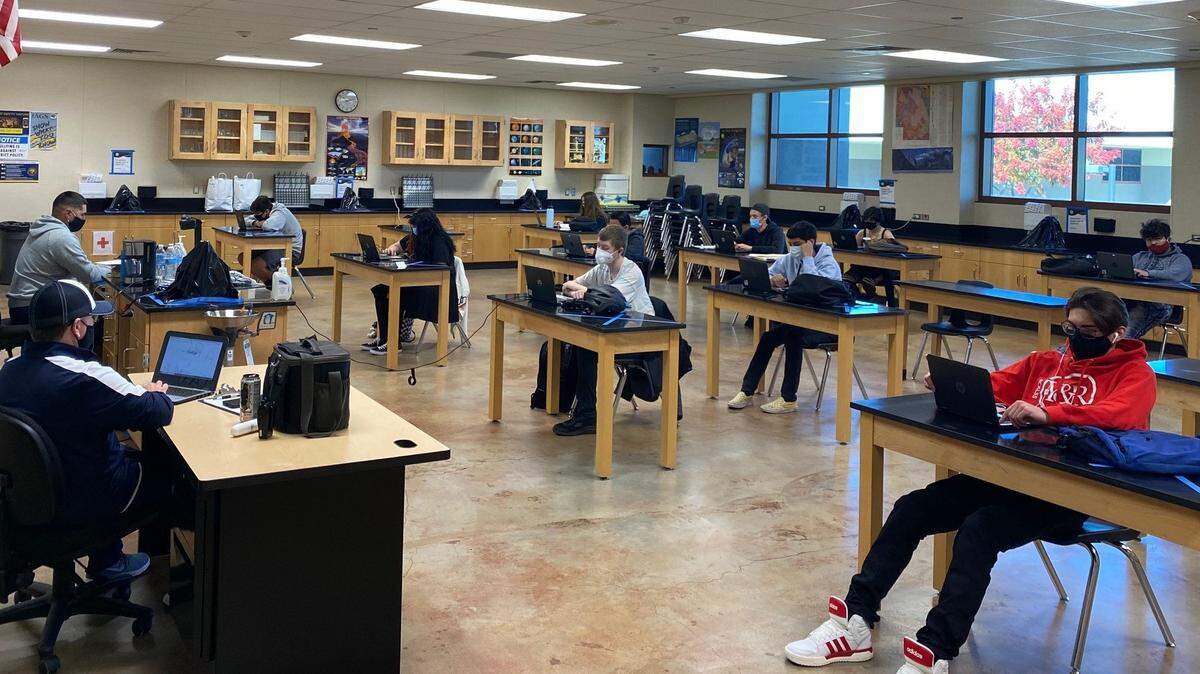
Preston Lee and Melissa Mullings, both juniors at Gregori High School, had similar experiences when the COVID-19 pandemic forced schools to begin distance learning. Logging into school to study from home just wasn’t working for them. Easily distracted and lacking the structure of a traditional school day, they pretty much gave up on learning and saw their grades plummet, they said in phone interviews last week.
Early on, Melissa realized that she wasn’t grasping information delivered remotely. She needs face-to-face instruction in a classroom setting, she said. So Melissa began signing in but leaving her computer. “I’d just go somewhere else or go to sleep, or not focus. ... And that caused my grades to go down a lot,” she said. Prior to distance learning, her marks included A’s and B’s, Melissa said, but they fell to all F’s with distance learning.
Preston said that pre-pandemic, he was doing pretty well in school, by his own standards. “My grades were a lot better than they were ever in middle school. And also, I was on the basketball team, and that was some of the most fun I’ve had.”
The switch to home study “completely took me out of my routine,” he said. He struggled with not having interaction with classmates and teammates and with not having face-to-face instruction. “All my grades dropped. I think I was failing almost all my classes.”
Davis High sophomore Zohal Aman also struggled with no longer having in-person instruction by her teachers, and with Internet connectivity from her home, she said. But as an immigrant from Afghanistan who’s an English learner in the Language Institute at Davis, her challenges were multiplied manyfold.
She’s learning not just English and the other subjects being taught in her classes, but what it means to be American, and specifically an American teen. With the help of a translator, the Farsi-speaking Zohal said it’s important for her growth that she learns the culture by interacting with classmates, teachers and all the others who make up her school and community.
Learning hubs began in September
Since mid-September, Melissa, Preston and Zohal have been in learning hubs set up by Modesto City Schools. The hubs, at both elementary and secondary sites, serve the district’s most at-risk students, including homeless and foster youth, English learners, those who don’t have reliable Internet connectivity at home, some who have no parental supervision, students with disabilities and some in special circumstances.
The hubs provide these at-risk kids with a structured classroom setting in a stable cohort of no more than 14 students and two supervising paraprofessionals. Their teachers are remote, providing synchronous instruction to those in the hubs and their classmates studying from home.
The creation of the learning hubs by the district answered an issue of fairness, said Steven Hurst, the school district’s director of student support services. When guidance from the state allowed the formation of small, stable learning cohorts, “parents who had the wherewithal to support their students started creating some of these, where they would hire a tutor, essentially, to sit with their kids all day.”
Modesto City Schools’ aim was to target students in need whose families didn’t have the ability to provide that adult tutoring or supervision “and definitely from an equity standpoint were falling behind.”
Across the school district, about 95 learning hubs were rolled out, serving just over 1,100 students, Hurst said. Every school has had at least one hub, and some have had a general-education hub and a special-education one, he said.
A few hubs have been sent into quarantine since they started, district spokeswoman Krista Noonan said in a text message Friday. Staff infections were reported at three school sites, leading to one hub at each school going into quarantine. No students were infected.
“We had one student that (tested positive for COVID-19) at Modesto High in mid-November, but the exposure was very limited and isolated so the quarantine already expired,” Noonan said. “In each instance, we implemented the quarantine out of regard to student and staff health/safety as well as after receiving guidance from Public Health.
“We also notified the families that may have had students who were exposed as well as the applicable staff to have them quarantine.”
With transitional-kindergarten through second-grade students back on campus a couple of days a week in the district’s hybrid learning model, the numbers of children in hubs has diminished, Hurst said, but 110 junior high and 260 high school students remain in them.
The district still sees the need for elementary-grade learning hubs on students’ at-home days, especially Wednesdays, when all are distance-learning, he said. “We know we have some support that we can provide on that day to still try to continue some of these hubs for those kids that are really at risk.”
Measuring the success of the learning hubs
How well are the hubs working? Very, said the students who spoke with The Bee.
“Everything went up, everything got way better. It’s helped me a lot,” Preston said. “It got me back into a routine. And even though my grades haven’t skyrocketed,” he added, he’s attending, focusing and doing his assignments.
“My grades are looking way better than they were before,” Melissa said with a happy laugh.
When at home, she had no idea what was going on in her math class, she said, but now she can follow along, pay attention and answer questions. “I’m starting to learn.”
Melissa looks forward to things improving further when she can fully return to classrooms. Hub supervisors and friends provide help she wasn’t getting at home, “but I still need my teacher there (in person) to help me out.”
Zohal said she gets more educational support in the hub than she could at home, no longer has connectivity and technical troubles and benefits from being able to do group work with classmates, all of whom also are English learners.
The importance of friends, as Melissa noted, is one of the factors district and school administrators kept in mind when forming learning hubs. “We tried our best to partner up kids with their friends ... because we know kids are going to be more likely to come to school if they know somebody in their pod,” Gregori Assistant Principal Justin Woodbridge said. “We did some digging to put them in the best condition while they’re here in the pods. Do they have other athletes that they play sports with? Do they have any friends who will be in hubs? That sort of thing.”
Kids are attending, work is getting done
Preston noted that his grades didn’t “skyrocket.” Hurst said a better measure of how the hubs are doing is that students who weren’t consistently engaging in distance learning, if they were doing so at all, are attending and completing assignments.
Most of the students now in hubs were barely passing, or weren’t passing, in distance learning, he said. “As we start to see some of the grades, I’m not going to say that they’re going to be off the chart,” he said, “but what we’re noticing is that work that wasn’t getting done is getting turned in, which means the students have a much better ability to pass or increase their grades.”
Associate Superintendent Mark Herbst said Modesto City Schools always has had numerous supports available to students, but nothing pre-pandemic that has been like the learning hubs, running concurrently with instruction by teachers.
A big piece of the success is simply having an adult presence. In many home situations, he said, there’s not an adult at home during the day to make sure the student is paying attention to time and is attentive to the instruction. The paraprofessionals supervising the hubs also offer an extra layer of assistance, Herbst said.
The Modesto City Schools Board of Education will receive an update on learning hubs at its meeting Monday. “We’re going to talk through what we’ve been doing of late and what our plans are for our next steps now that we’ve got TK-2 students back then grades three through six opening up.”
The meeting will be live-streamed and recorded and can be viewed on the MCS Board of Education channel on YouTube.
This story was originally published November 28, 2020 at 5:00 AM.