How Modesto helps homeless earn a paycheck, find purpose cleaning city streets
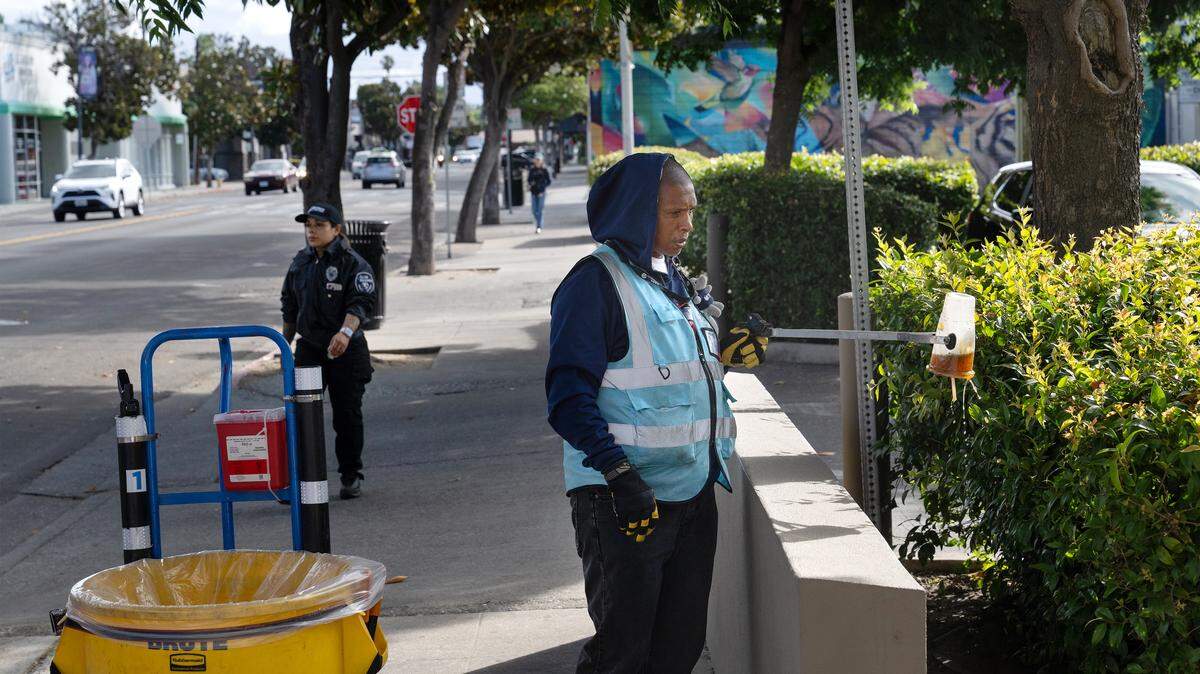
A group of seven people, fitted with blue vests, buckets and grabbers, stepped into a van Tuesday morning and headed to downtown Modesto for their first shift of the week.
Once there, the crew quickly split up to opposite sides of J Street, picking up trash with each step. One of them wheeled a bin for the others to periodically dump their buckets in, though the sidewalks were already pretty clean.
“I know it’s not a lot,” one worker said.
About an hour and a half later, they made their way to their next destination.
Since its launch in the beginning of the year, the Hope Works program has removed 20 tons of trash from the streets of Modesto. More importantly, it has secured a weekly paycheck for 40 unhoused individuals.
“Trash pickup is cool and all, but it’s about that person and getting them back and feeling like they’re a productive member of the community,” Modesto Gospel Mission Chief Executive Officer Jason Conway said during the Stronger Together conference on May 20. “That’s what the program’s about.”
The workforce development program replaced Downtown Streets Team after the organization shuttered at the end of October. Modesto scrambled to put together a replacement, Hope Works, by partnering with United Way of Stanislaus County and the Gospel Mission.
The program is funded through city support, grants, community partnerships and public donations. Clients are onboarded over three weeks through two temporary employment agencies, which allows participants to get paid minimum wage while the agencies carry the workers compensation liability.
Hope Works has a program manager, two case managers and a driver who leads the cleanups. Because there’s only one driver, space for more participants is limited. A donation of a second van is in the works.
The city provides participants with a map to clean neighborhoods and public spaces, pull out weeds and respond to illegal dumpings.
There are currently five teams work about 50 hours a month. Participants range from ages 19 to 62.
They must be unhoused, but they don’t have to be clean and sober. Conway said they should, however, be ready to rebuild their lives.
“You can take a horse and lead them to water, but you can’t make them drink,” he said. Prior to coming to the Gospel Mission, Conway himself was homeless and struggled with addiction. He said he knew what it was like to not be ready.
One concern, Conway said, was that some participants would jump ship after getting their first paycheck. That has not been the case. There is a waitlist of about 50 people.
Besides providing workforce experience, the program helps individuals gather essential documents and polish resumes.
The goal is to get the participants back into the workforce once the six-month program ends. As of May, 14 job applications have been submitted and nine clients have attended job interviews. The temp agencies assist with connecting individuals to jobs, like working in a warehouse or washing dishes at a restaurant — anywhere they could clock in at least 30 hours a week.
Conway said cycles of layoffs and hires of human resources directors have made it a challenge to maintain standing relationships at certain places.
“Some of them have no work history … some of them have legal issues,” said Conway. “All different spectrums that we’re dealing with to say, ‘Hey, we’re going to give you that first shot back into getting into the workforce.’”
A first step
Before coming to the Gospel Mission, Will Oberg, 45, was living with his mom. After she passed away, he lost his job and was evicted. His car broke down, too. Though he had some money saved up, it wasn’t enough, so he spent the last year at the shelter.
Since joining Hope Works’ inaugural cohort, he said it feels good to be productive again.
“It’s a good first step for no matter what you’re trying to do,” Oberg said.
About a month ago, he and his wife found housing, thanks to his new income. His goal now is to find a full-time job to sustain their living situation for when the program ends. Hope Works already has helped him reformat his resume.
“It’s so nice to have our own place again,” Oberg said. “After not having it for so long, you take things for granted.”
Deborah Gomez, 62, has been homeless since December 2024. She was part of the Downtown Streets Team for almost a year before it ended.
In comparison, Hope Works has fewer meetings, and the workers get cash instead of gift cards, she said.
She said it feels good to clean up the city where she was born and raised. “A lot of people, you know, they root for us, so it feels good … to be doing something,” she said.
Gomez’s partner of 18 years, Anthony, is also in the Hope Works program. The two sleep in her car because the Gospel Mission doesn’t allow men and women to stay together.
In addition to Hope Works, she is a delivery driver for Walmart and Amazon. Her partner had been out of the workforce for a while, so their goal is for him to secure a job after the program.
“Hopefully, the wages is what’s going to help us get on to a place,” Gomez said. “Living out of our car is not fun. It’s scary and dangerous, and it’s just hard.”
There are eight former Downtown Streets Team members in the Hope Works program.
Greg Meyer, program manager for Hope Works, said efforts were made to recruit former members into the new program, but some phone numbers were disconnected or lost.