Modesto police chief defends arrests during protests amid mask ordinance debate
AI-generated summary reviewed by our newsroom.
- Modesto police arrested six at June 14 protests, citing mask ordinance violations.
- Police Chief Gillespie defended the arrests as legal and part of public safety strategy.
- Community members questioned surveillance, unequal enforcement, and ordinance scope.
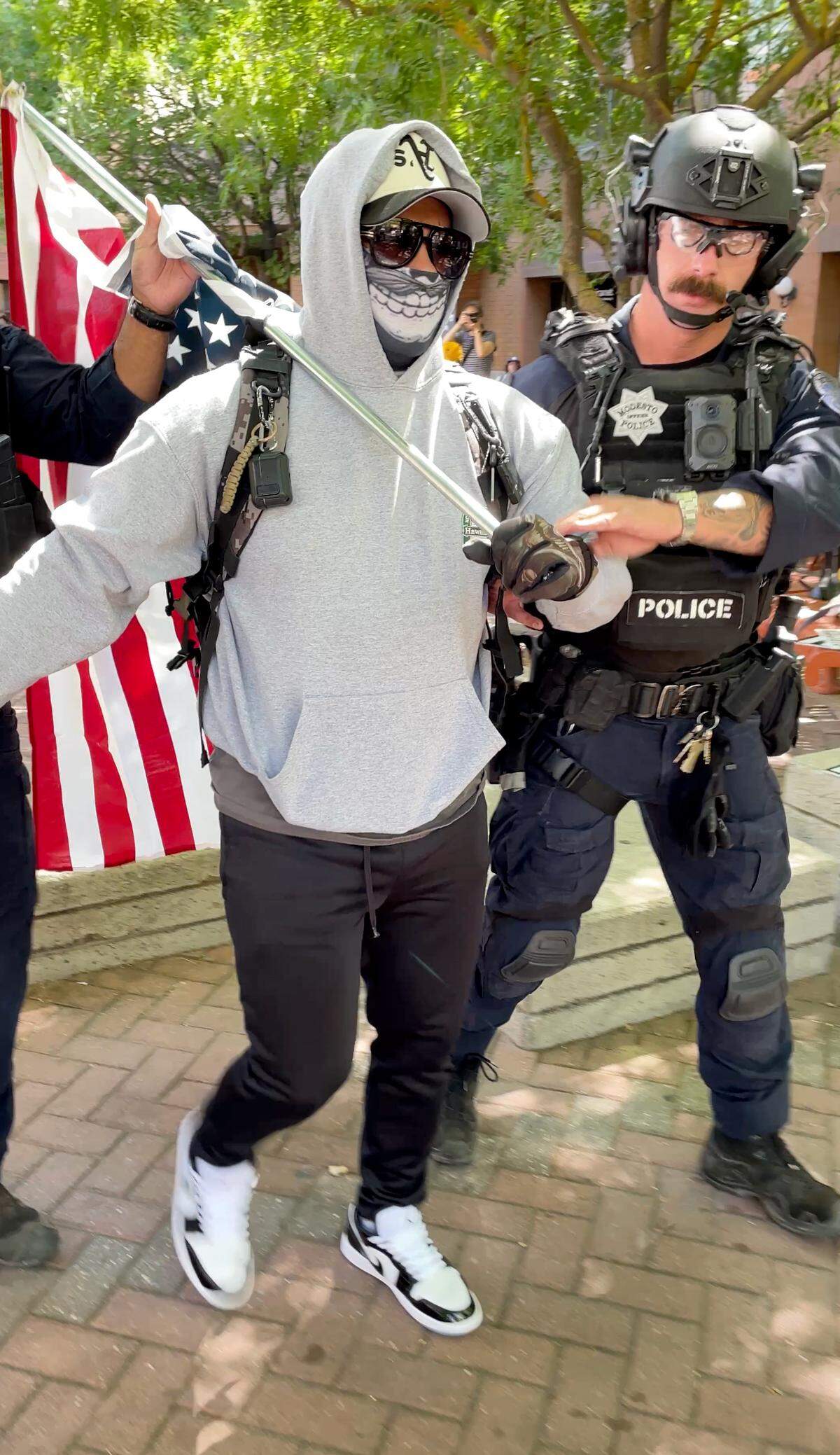
The Modesto Police Department’s goal for the June 14 protests was for peaceful events with no arrests. Protesters say they upheld their end but the police did not, by enforcing a controversial city mask ordinance.
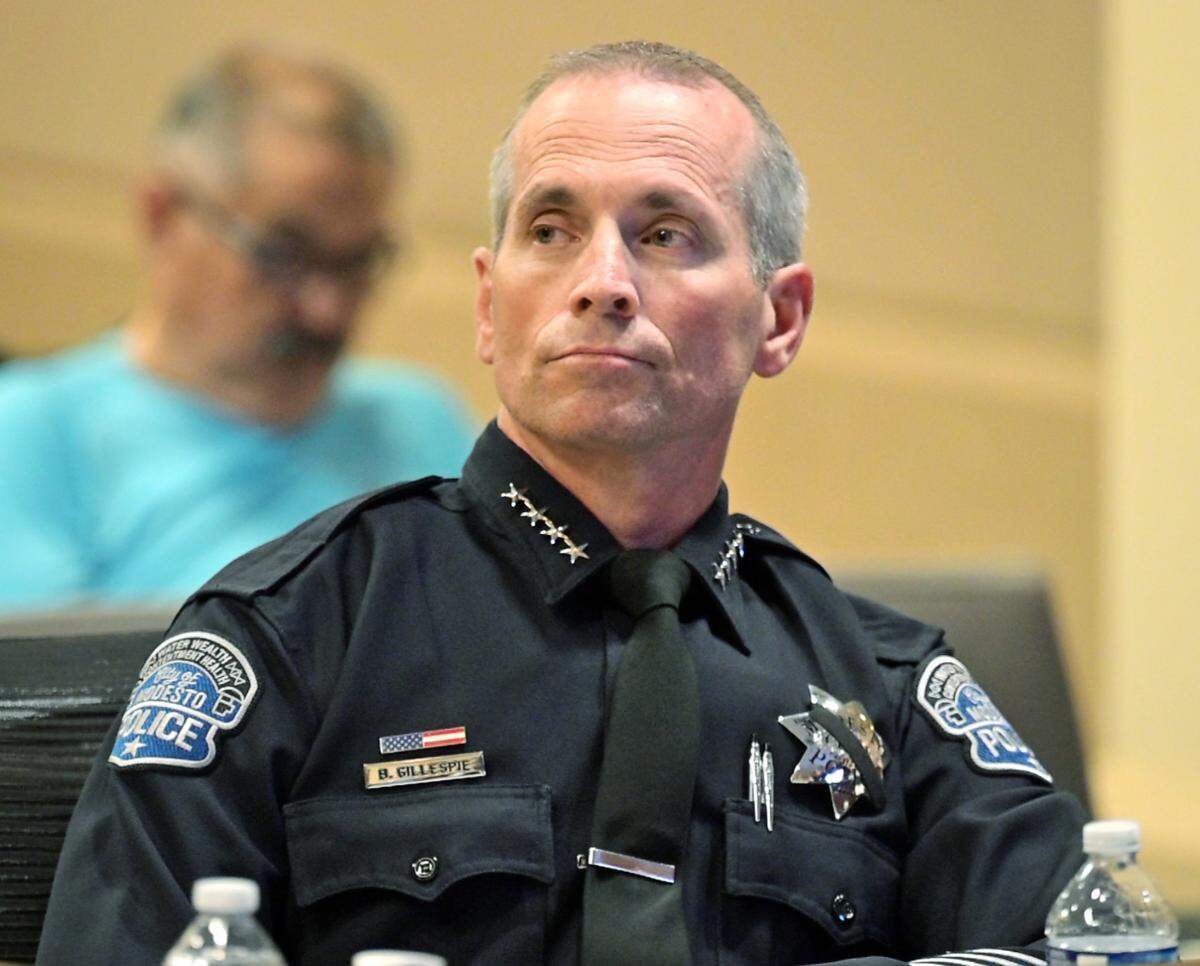
At Wednesday’s Community Police Review Board meeting, Police Chief Brandon Gillespie presented his department’s actions during the No Kings and ICE Out protests, where six people were arrested. The discussion lasted about two hours and drew a larger crowd than usual for a CPRB meeting.
Mask ordinance
Some board members suggested revisiting the mask ordinance to consider whether to recommend changes to the City Council, while several members of the public called for its repeal.
Board member Frank Damrell questioned whether enforcing the ordinance was worth it if arrests ended up escalating tensions, asking how it balanced against maintaining peace.
Gillespie said he doesn’t want protesters to exploit medical or religious exemptions as loopholes. He defended the ordinance as highly effective during the six years it has been in place.
He added that the department focused on what he called “egregious violators” who were “clearly trying to conceal their identity” and did not target those wearing medical masks.
“I’m not the one who decides. They’ll have to convince a judge or a jury that, ultimately, that they were wearing [a mask] for one of the essential reasons,” Gillespie said.
“At the end of the day, this is a bad law, in my opinion,” said Tom Helme during public comment. “It’s unconstitutional, it’s vague, it’s over broad, it’s almost impossible to enforce, which is why it led to being enforced in what the chief just admitted a discretionary way.”
Nora Garcia asked why protesters weren’t given the chance to remove their masks before being arrested. She also noted that many were likely wearing masks to protect themselves from being doxxed or out of fear of becoming a target for ICE. She also questioned whether mask-wearing truly made it significantly harder for MPD to identify legitimate threats.
“The possible benefits of the mask ban must be compared as a possible damage to the community,” Garcia said.
Board member Wendy Byrd said her subcommittee recommended that the board send a letter to the City Council urging an amendment to the mask ordinance. She also expressed support for dropping the charges against all those arrested.
“The ordinance is so misunderstood … it’s too broad, it’s not enforceable,” Byrd said. “This whole thing has been very damaging to the relationship between law enforcement and the community.”
She said it’s too difficult to enforce the ordinance by simply assuming someone isn’t wearing a mask for legitimate medical or religious reasons. She added that it’s not worth someone receiving a misdemeanor charge over.
Enforcement strategy
Gillespie said about 35 to 40 officers were deployed that day. He called the event a success, noting that 99% of participants were peaceful and that officers did not have to declare an unlawful assembly.
He also defended the department’s enforcement of a Modesto municipal code that prohibits the use of certain items during protests, including umbrellas, glass bottles and masks.
He explained that the ordinance was created because past protests, both locally and across the country, have shown that people engaging in violence, destruction and other unlawful acts often wear masks to incite chaos, intimidate others and damage property. The mask ban, he said, is meant to deter violence and keep people safe.
“The ordinance is not about targeting ideologies, messages. It’s about public safety,” Gillespie said.
He said that before the protests, the department received messages from concerned community members, including downtown business owners, who feared violence, citing recent demonstrations in Los Angeles, San Francisco and other cities.
In Los Angeles, about 560 people were arrested and the LAPD chief admitted officers were “overwhelmed” by the level of violence and vandalism. In San Francisco, more than 140 arrests were made.
Some community members questioned why MPD was overprepared for the protest, noting that those larger cities are much different than Modesto.
Gillespie responded that it would have been irresponsible not to prepare thoroughly simply because Modesto is smaller. “I don’t look for correlations. I look for what’s going on,” he said.
The chief added that this was one of the largest protests Modesto has seen in recent years. The last one, in 2020, was largely peaceful but was declared an unlawful assembly after small group of people advanced upon officers and began to throw water bottles and other objects at them.
Based on social media activity in the days leading up to the June 14 event, Gillespie said he anticipated a large turnout. He also heard rumors from various sources about the possible presence of Proud Boys and other counterprotesters, and noted that some social media posts were advocating violence and destruction.
He said the department’s strategy included issuing early warnings — such as PA announcements about the ordinance in both English and Spanish — and taking a zero-tolerance approach to violations. Officers were deployed in a mix of marked and unmarked vehicles, as well as in plain clothes, to prevent suspects from slipping back into the crowd and to minimize confrontations.
Gillespie added that the department used the city’s real-time crime center and surveillance cameras in parks and downtown to monitor the event. During his presentation, he showed photos of arrested individuals, captured by those cameras, wearing masks. Some members of the public seemed disturbed over the level of surveillance, arguing it was yet another reason people wanted to cover their faces in the first place.
“The individuals arrested wore masks clearly to conceal their identity, and in violation of our city ordinance,” Gillespie said.
In total, five people were arrested for violating the mask ordinance and one for obstructing officers. Police also issued a noise citation, 18 traffic tickets for unsafe behavior such as hanging out of car windows, and towed five vehicles — two of them for reckless driving.
Gillespie pushed back against public claims that the arrests were “snatch-and-grab operations,” saying officers had lawful cause, issued warnings and “acted with a deliberate strategy to prevent escalation and protect both protesters and officers.”
He also denied that the department was using “ICE tactics.” He said officers employed effective tactics law enforcement has used for decades.
“Contrasting protest approaches”
Gillespie said the two protests that day took different approaches.
At the No Kings protest in Graceada Park, he said, organizers communicated clearly with attendees, promoted lawful behavior and even assisted with crowd control to help people cross the street safely.
In contrast, at the 10th Street Plaza protest, he said, organizers handed out literature encouraging face coverings and chanted loudly during an officer’s PA announcement about the ordinance.
He highlighted a flyer from the Modesto Progressive Democrats — who helped organize the Graceada Park protest — which outlined rules for a peaceful protest, including not wearing masks and obeying traffic laws. By contrast, a flyer from the Central Valley Black Indigenous People of Color Coalition, distributed at the ICE Out protest, urged protesters to “stay anonymous” by covering their faces and to watch out for “cops and other white supremacists.”
“In my opinion, not very good advice to tell people to violate our ordinance,” Gillespie said.
Some public commenters argued that the two protests were policed differently based on their perceived “mindset,” accusing officers of bias against the protest organized by CVBIPOCC.
Helme said he saw many masked attendees at Graceada Park who were not arrested and criticized the department for inconsistent enforcement of the mask ordinance between the two events.
Another commenter noted that there seemed to be more officers present at the smaller ICE Out protest than at the larger No Kings one.
Challenges
Gillespie acknowledged the department faced some challenges during the No Kings protest. Cellular congestion disrupted camera functionality at Graceada Park, limiting the real-time crime center’s visibility north of Mancini Bowl.
Looking ahead, he said the department plans to improve signage and ensure the accuracy of its social media posts. He admitted that a Facebook post published the day of the protest omitted the section about masks in the city ordinances — an error he said he didn’t notice until reading about it in The Bee.
Gillespie also said his department will work on clearer, two-way communication between the real-time crime center and officers in the field. He addressed complaints that arrestees weren’t told why they were being detained, explaining that the real-time crime center often identifies individuals to arrest but the officers on the ground may not immediately know the specific charge.
He added that the department will ensure officers themselves don’t wear face coverings at protests and will focus on building relationships with protest organizers to answer questions, clarify rules, and address safety concerns — though he admitted they can’t force organizers to talk to them.
“As a learning organization, we’re always committed to continuously improving our practices and our services to our community, and our review of this event, I believe, reflects that,” Gillespie said.
This story was originally published July 17, 2025 at 5:20 PM.