MAX buses make fewer trips because workers out with COVID-19, for other reasons
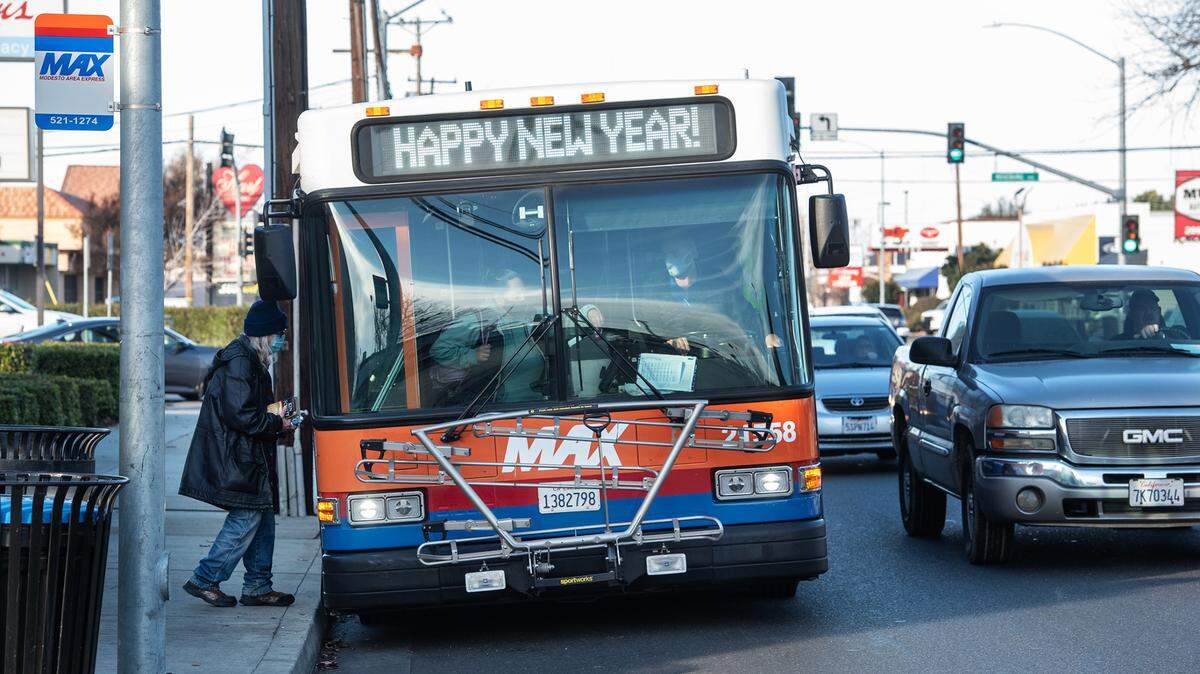
Modesto Area Express has reduced how often its buses run by about 25 percent in response to having fewer workers on the job because of COVID-19 and for other reasons.
The revised schedule fits the number of available workers and increases MAX’s reliability for its passengers, Modesto Transit Manager Adam Barth said last week.
The new schedule — called Saturday Plus — started last week and comes after MAX had seen an increase in the past few weeks in the number of daily trips that were being missed because fewer workers were on the job. Barth has said MAX buses typically run about 1,000 trips a day among 17 routes and three commuter runs.
Barth said about 50 trips were being missed daily before the new schedule. That’s roughly 50 buses that did not arrive when passengers were expecting them. He said no trips have been missed in the week since the new schedule started.
Modesto contracts with National Express Transit to operate the city’s bus system, and the MAX employees work for National Express. Barth said National Express budgets for about 150 employees, primarily drivers, for the MAX system.
Seven workers with COVID-19
Barth said Monday through a city spokesman that National Express was reporting seven employees were not at work because they had COVID-19, two were awaiting test results and one was in self quarantine. An additional 31 employees were not at work for other reasons.
Barth also reported that 19 employees who had tested positive for COVID-19 had returned to work after being symptom free and completing their quarantine.
MAX has had an increase in COVID-19 among employees in the last few weeks. Before this, Barth said National Express had reported an occasional case of COVID-19 during the pandemic.
Barth has said National Express has stepped up its safety protocols, including testing employees weekly. The city also announced last week that hand sanitizer stations had been installed on MAX buses for passengers and drivers as well as clear, plastic barriers to protect drivers from the virus.
MAX continues to operate all of its routes and three commuter runs under the new schedule, but Barth said the wait time for buses on some routes has increased as buses make fewer trips. So a bus on one of those routes that arrives at a stop every 15 minutes now arrives every 30 minutes, and a bus on one of those routes that arrives every half hour now arrives every hour.
MAX driver files complaint
But Barth said MAX continues to operate under its old, full schedule 6 to 8 a.m. weekdays to accommodate people who rely on the bus to get to work. He said the reduced schedule will stay in place until there are enough workers on the job.
“The modified schedule is good, if they do it right,” said Loveasia Jones, who has been a MAX driver for about five years, in an interview last week.
Jones said she is off work because the schools for her three children are closed because of the pandemic and she is looking after them, including making sure they stay up with their schoolwork. She said last week that her husband, Howard, also is a MAX driver and had returned to work after missing about three weeks after contracting COVID-19.
Jones said National Express did not take the pandemic seriously enough to protect its workers until the recent increase in COVID-19 among workers. She said that includes not cleaning buses and MAX facilities enough and notifying employees when a co-worker tests positive for COVID-19. She has filed a complaint with Cal-OSHA. A Cal-OSHA spokesman confirmed the agency is investigating the complaint.
A National Express Transit spokesman has said the company has followed Cal-OSHA and federal Centers for Disease Control and Prevention protocols since March, when the first stay-at-home order was issued, to keep employees and passengers safe, and notifies workers when someone is sick and clean buses and facilities regularly.
Barth said this is second time MAX has gone to an abbreviated schedule in the pandemic. He said MAX operated under a similar schedule in April and part of May when it did not have enough face masks and other safety measures in place to keep drivers safe and ridership was down by about half.
Ridership remains down by about half, which Barth has said is typical for public transit systems across the United States in the pandemic.
This story was originally published January 12, 2021 at 8:27 AM.