Modesto hospitals prepare for coronavirus outbreak. Data from other countries is scary
In Stanislaus County, everyone from hospital administrators to county residents continue to brace for the novel coronavirus and cope with the emerging health crisis.
Modesto’s three hospitals will provide care for people who come down with severe symptoms requiring hospitalization. Based on data from other countries that were hit with COVID-19, about 80 percent of people who test positive won’t have symptoms that require hospital care, according to the California Department of Public Health.
That leaves the troubling statistic: About 20 percent, or 1 in 5 people infected, will be sick enough to need hospital care.
Hospitals said they are preparing for a surge in patients who are seriously ill from coronavirus. It is hoped the social distancing, canceled events, school closures and other measures to limit the spread of illness will keep hospitals from being overwhelmed.
Hypothetically, it would take 5,000 cases of COVID-19 to fill the nearly 1,000 beds at Modesto hospitals with patients stricken by the virus. But less dramatic numbers could severely impact the hospitals, which need capacity for births, trauma and surgical patients and people with many other kinds of medical needs.
Those severely affected by COVID-19, typically older people and adults with underlying health conditions, may develop pneumonia and acute respiratory distress, creating demand for ventilators and other breathing supports in hospitals. In addition, patients hospitalized for coronavirus are supposed to be isolated in their own hospital rooms.
Doctors Medical Center
Doctors Medical Center, which has 398 acute care beds, is equipped with 100 adult or infant ventilators in addition to other breathing devices that help patients while recovering from serious illness, spokeswoman Krista Deans said.
Early in the global health crisis, the hospital identified an inventory of equipment and supplies needed for dealing with COVID-19. “Our inventory includes personal protection equipment such as N95 masks, gowns, sanitizers and filtration systems,’ Deans said by email. “We are not experiencing any supply chain management issues. We are monitoring this carefully on a daily basis.”
Doctors has a plan for expanding capacity as needed for treating an increase in patients. People with a serious case of COVID-19 are mostly given supportive care in hospitals. There is no magic pill for treating the viral illness.
The Modesto hospital can also work with partners in its network — Emanuel Medical Center in Turlock and Doctors Hospital in Manteca — to manage a surge in patients. Deans said a conference center near the emergency department at Doctors in Modesto is being used for patient triage as necessary.
The hospital also has tighter restrictions on visitation.
“Right now, there is no shortage of personal protective equipment or intensive care beds,” said Dr. Mark Fahlen, chief of the medical staff at Doctors. “That could change rapidly.”
Fahlen acknowledged the stress on hospitals in other hard-hit countries, such as Italy, is something that needs to be avoided here. “The hospital is having daily briefings and I am getting two or three updates a day,” Fahlen said. “We could probably handle 50 or 60 ventilated patients.”
Memorial Medical Center
Officials with the 423-bed Memorial Medical Center and Modesto’s Kaiser hospital, which has 152 beds, did not have a count on ventilators at their hospitals. In issuing new guidelines Sunday, Gov. Gavin Newsom said the state is purchasing more ventilators and has access to 900 additional ventilators through partners, which adds to the 7,587 ventilators at the 416 hospitals in California.
Hospitals in the state have capacity for 11,500 intensive care patients and have 74,000 regular beds. An executive order from Newsom’s office gave the state authority to commandeer property for quarantining, isolating or treating coronavirus-stricken patients.
Sutter Health, which operates Memorial in Modesto, said it is postponing all elective procedures that can be safely rescheduled, effective Tuesday. Sutter said that is part of an effort to “preserve capacity to address critical needs as they arise.”
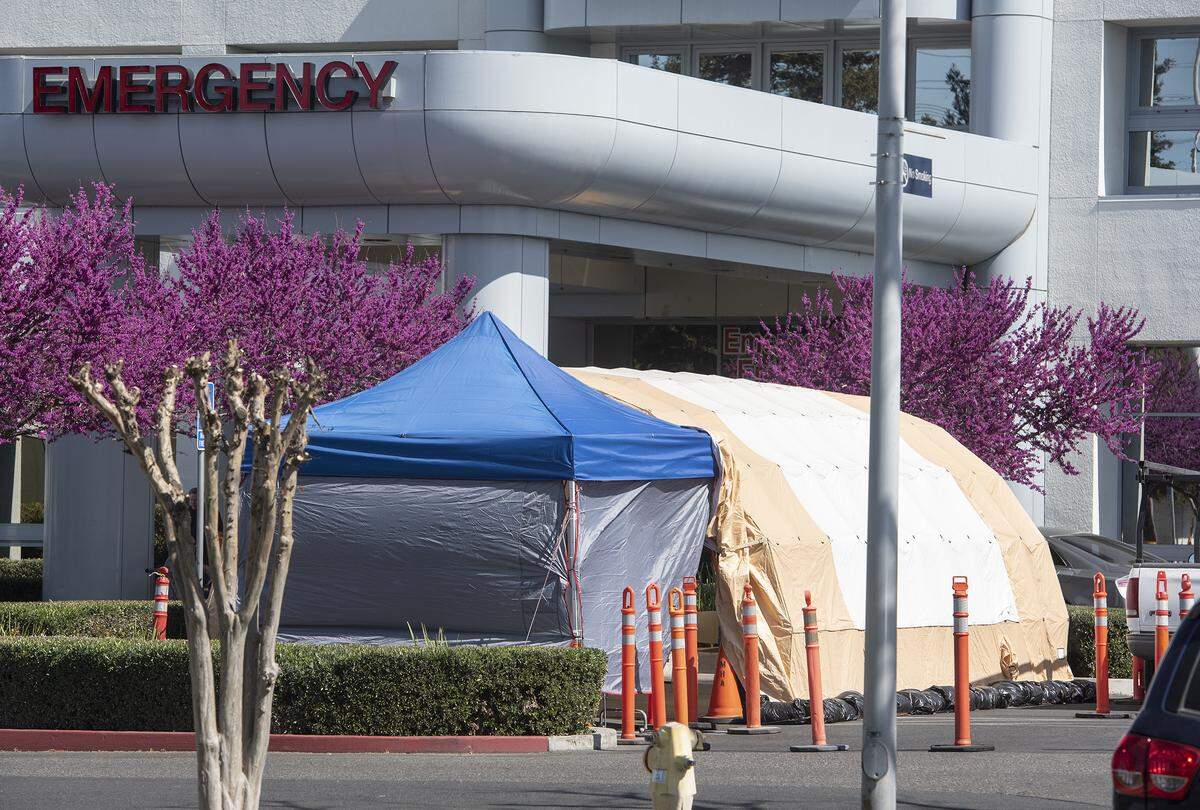
Memorial placed a surge tent outside its emergency department for handling an increase in traffic. Surge tents are approved by the state to help keep infectious illness from spreading to other patients or hospital visitors.
Sutter Gould Medical Foundation is making patients aware of video visits with a physician if they have coronavirus-like symptoms, which include fever, sore throat and shortness of breath. Video visits can inform Sutter Gould patients if they meet the criteria for testing, a spokesperson said.
“If their symptoms are mild or moderate, they do not need testing,” Liz Madison of Sutter Health said via email. “We ask they please stay home to prevent further exposure and take care of themselves.”
Health agencies advise people who think they have the illness to first call their physician or the local health department before making an appointment. That way, arrangements can be made so other patients and staff are not exposed at the medical office.
Kaiser Permanente did not respond to specific questions about local readiness but released general information from its national infectious disease director.
Tips for families
As the number of cases rises in the Northern San Joaquin Valley, households in the region were advised to have a home plan for COVID-19.
Families should choose a room in the home for isolation and care of a family member who comes down with coronavirus illness. The Centers for Disease Control and Prevention also suggests that the person who is sick use a separate bathroom.
The infected person should wear a facemask when sharing a room with other family members; likewise, a family member who enters the person’s room should wear a mask. Other guidelines for infected individuals and families include:
▪ Cover your mouth and nose with a tissue when you cough and then throw the tissue in a lined trash can.
▪ Wash your hands often and avoid sharing dishes, drinking glasses, eating utensils, towels or bedding with others in the home.
▪ The family should regularly clean surfaces such as counters, doorknobs and bathroom fixtures.
▪ Seek medical attention if the illness is worsening.
People with confirmed COVID-19 infection should remain in home isolation until risk of transmission is low. The general rule has been 72 hours after symptoms are gone.
Gov. Newsom’s call for voluntary home isolation of seniors 65 and older, to keep them from getting infected, prompted some changes for senior meal programs locally.
At most senior centers in Stanislaus County this week, seniors in congregate programs started picking up their hot meals at centers and taking them home to eat.
Jill Erickson, a manager for county Aging & Veterans Services, said that change is only for this week. Starting next week, seniors will pick up a box of frozen meals one day per week at the centers in Modesto, Oakdale and other communities.
The centers in Turlock and Newman will continue with Monday through Friday service. There are no changes for meals delivered to home-bound seniors.
The county agency was considering other supports for seniors who are isolated at home. “We are planning on a 30- to 60-day basis because so much is unknown,” Erickson said. “Hopefully, this will all pass over and we can get back to normal business.”
Erickson was at home in Lodi with a stuffy nose on Monday. She said she has no fever and it seems like a cold. Even so, an email from her doctor told her to stay home for 72 hours after the symptoms are gone.
“They told me don’t come in (for an appointment),” Erickson said. “If it gets worse, they will call me on video.”
This story was originally published March 17, 2020 at 9:00 AM.