Update: They’re here! Pfizer COVID vaccines arrive in Stanislaus County
Pfizer BioNTech COVID-19 vaccines arrived in Stanislaus County on Thursday morning with the possibility they could be administered as early as Friday to healthcare workers.
The shipment of boxes arrived to an undisclosed location via a UPS truck a little before 9:30 a.m.
The county’s allotment of 3,900 doses of the state’s initial 327,000 doses were expected on Tuesday, but the arrival was delayed due to shipping challenges.
The county’s Health Services Agency will allocate this first round of vaccines to the five acute care hospitals in proportion to the number of health care workers on their staff.
Spokespersons from Doctors Medical Center, Memorial Medical Center, Emmanuel Medical Center, Kaiser Modesto and Oak Valley Hospital said they have plans in place to begin immunizing their top priority staff as soon as they receive the vaccines.
First in line among health care workers are the more than 5,000 who work in high-risk settings, including ICUs, emergency rooms or directly caring for known or suspected COVID-19 patients, consistent with the prioritization from the Centers for Disease Control and Prevention and the California Department of Public Health.
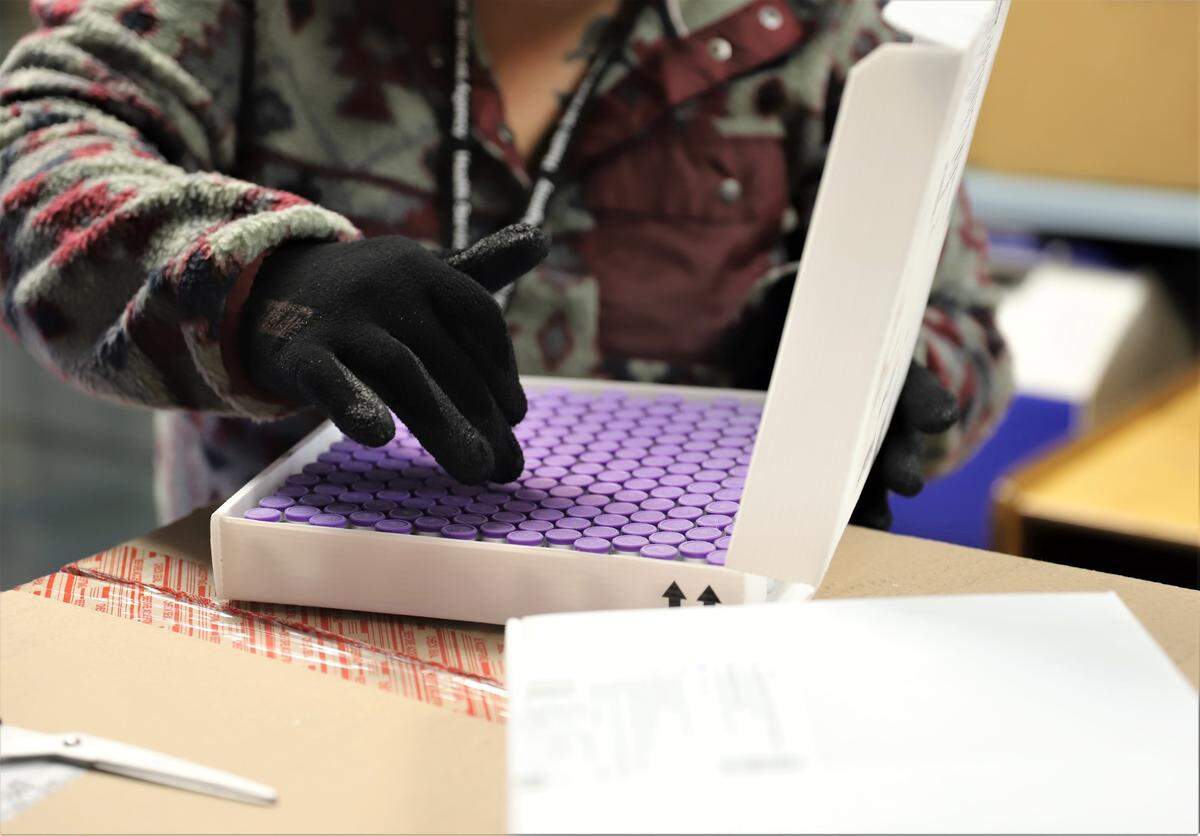
Each “pizza box” shaped container of 975 vaccine doses that arrived Thursday has been maintained at ultra-cold temperatures since its departure from the Pfizer distribution center in Michigan last Sunday.
Upon arrival into the county, the boxes were loaded into the two minus-70 degree Celsius freezers on loan from the Biology Department at Stanislaus State University.
The temperatures of freezers and refrigerators used to store vaccines are monitored continuously to ensure integrity of the immunizations.
“Like all vaccines that we receive, we monitor them 24 hours a day, seven days a week,” said Dr. Julie Vaishampayan, public health officer for Stanislaus County. The freezers have temperature monitors that trigger an alarm if the temperature goes out of the safe range.
The HSA has decades of experience with tracking and delivery of vaccines from the Vaccines For Children program. A new, though similar computer-based system, is being implemented for monitoring the COVID-19 vaccines.
The Pfizer vaccine demonstrated 95% efficacy in clinical trials and once thawed, can be kept at refrigerated temperatures for five days.
“We maintain the cold chain of refrigerated temperatures,” Vaishampayan said, “That’s why they (local hospitals) have to be ready to use it within five days of their receipt from our ultra-cold freezers.”
On Thursday, the U.S. Food and Drug Administration’s advisory panel deliberated providing emergency use authorization for the Moderna COVID-19 vaccine. That vaccine is prepared with the same active component of genetic material, the messenger RNA, as the Pfizer vaccine, though the formulations are different.
The Moderna vaccine can be shipped and stored at more commonly used temperatures for vaccines found in refrigerator freezers. In addition, the vaccine is packaged in 100-dose allotments, which also help facilitate distribution, especially to smaller hospitals with fewer staff members.
County HSA said in a press release that they expect to place requests for vaccine allocations to CDPH every week, and upon receipt they will then distribute following prioritization from the CDPH. They anticipate that it will be a few months before the vaccine is available to everyone.
Public health officials ask that everyone continue to practice COVID-19 mitigation efforts, including staying home as much as possible, wearing a mask, physical distancing, and frequent hand hygiene.
“The vaccine is here, and we have freezers from our wonderful partners at Stan State,” said Vaishampayan, “It’s a very exciting time of starting to give vaccines.”
This story was produced with financial support from The Stanislaus County Office of Education and the Stanislaus Community Foundation, along with the GroundTruth Project’s Report for America initiative. The Modesto Bee maintains full editorial control of this work.
To help fund The Bee’s children’s health and economic development reporters with Report for America, go to bitly.com/ModbeeRFA
This story was originally published December 17, 2020 at 12:05 PM.