Stanislaus has high unemployment. Here’s what one economist says about our recovery
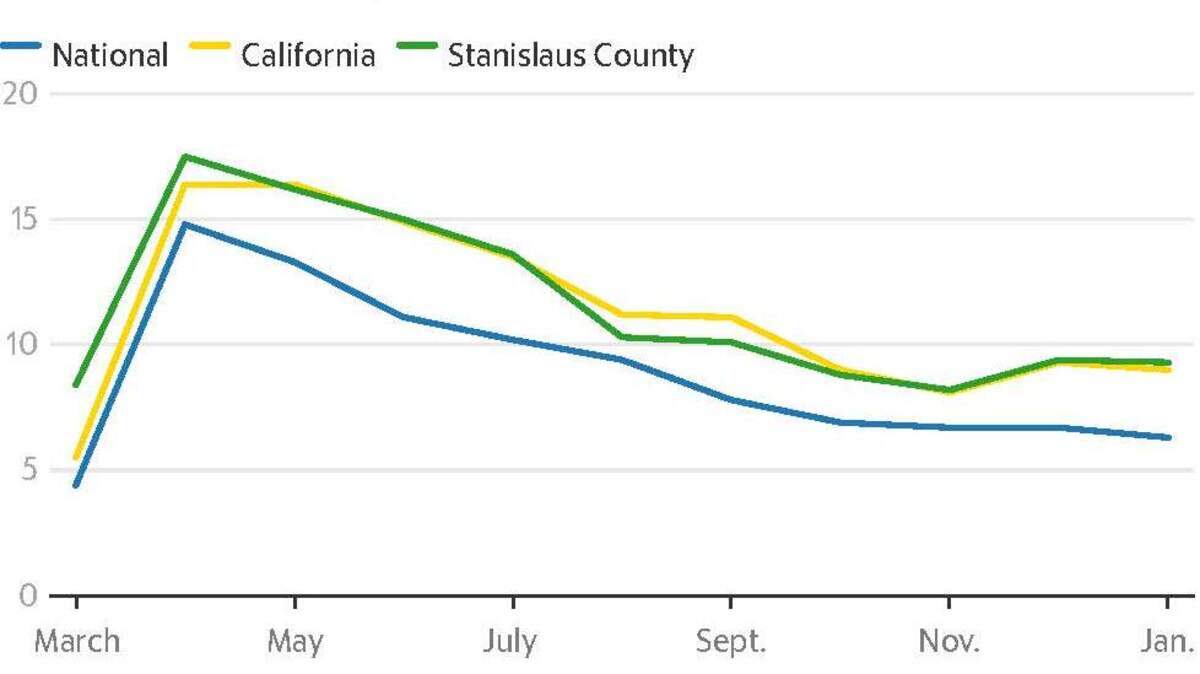
Stanislaus County saw only a modest decline in unemployment in January, but new federal stimulus dollars and increased vaccine availability point to stronger recovery in the coming months.
The county’s unemployment rate was 9.3% in January, down from a revised 9.4% in December 2020, according to data released by California’s Employment Development Department. County-level data is not seasonally adjusted.
Likewise, unemployment also declined marginally at the state level. California posted a 9% unemployment rate in January, down from 9.3% in December. Nationally, the jobless rate dropped to 6.3%, down from 6.7% the month before, according to data from the Bureau of Labor Statistics.
Stanislaus County’s unemployment rate has often been close to the state level during the pandemic, which Jeff Michael, the director of the Center for Business and Policy Research at the University of the Pacific, said is uncommon for the region.
Typically, the local jobless rate is significantly higher than the state’s, but Stanislaus County’s high percentage of essential industries – like agriculture, food processing and manufacturing – and comparatively little tourism activity, have helped the county weather the economic impact of COVID-19.
“It hasn’t had the double hit of the travel tourism industry shutting down like we’ve seen in some other areas, so that’s been a benefit,” he said.
In January 2020, pre-pandemic, the county’s unemployment rate was 6.8%, compared with 3.9% statewide and 3.5% at a national level.
Surge of cases in Stanislaus County around holidays
Michael said the fractional change in unemployment between December and January can be attributed largely to a surge of cases around the holiday season, exacerbated by strict stay-at-home measures and colder temperatures.
Michael said he’s optimistic for a strong recovery surge in the second half of 2021, followed by further growth in 2022. To help kickstart that recovery, President Joe Biden on Thursday signed a $1.9 trillion stimulus package into law, and the president said he expects all adults to be eligible for vaccines by May.
California will get more than $150 billion from the stimulus, according to the state’s finance department, with nearly half going directly to individuals by way of $1,400 checks and expanded unemployment benefits.
Michael said the administration’s efforts reinforce his expectations of growth.
“It might accelerate the timeline a little bit as people are getting more optimistic about vaccine distribution, and then we’re having another injection of money into the households as well as the local governments,” he said. “There’s going to be more spending power out there, and (eventually) things reopening and we expect a pretty vigorous response.”
People are already more optimistic, Michael said, and news of incoming vaccines is likely to make the economic surge that typically accompanies spring weather “much stronger than usual.”
Still, he said, the pandemic will cause lasting changes in the economy as a result of altered consumer behavior. A new reliance on e-commerce for everything from groceries to office supplies as millions of Americans transitioned to working from home, and a boom for home improvement stores and similar retailers will shape the market for years to come.
“Everybody is going to have a few things that they’ve adopted during the pandemic as consumers, or in the workplace, that will persist even as the restrictions go away,” he said.
This story was produced with financial support from the Stanislaus Community Foundation, along with the GroundTruth Project’s Report for America initiative. The Modesto Bee maintains full editorial control of this work.
To help fund The Bee’s economic development and children’s health reporters with Report for America, go to https://bit.ly/ModestoBeeRFA