
From the Archives: Billy Graham's Modesto Manifesto revisited
Editor's Note: This story about the "Modesto Manifesto" and Billy Graham's time in Modesto in 1948, by former Bee reporter Dennis Roberts, appeared in The Bee on Nov. 30, 1993. Graham died in North Carolina on Wednesday, Feb. 21, 2018.
–––––––––––––––––––––––––
The Modesto Manifesto.
It was the pact that set the standard for Billy Graham's scandal-free ministry.
And one of the young men who helped establish it – then went on to become the world's best-known Christian songleader – was Ceres' own Cliff Barrows.
Nearing the 50th anniversary of his association with Billy Graham (who just turned 75), Barrows recalled the circumstances that led to the Manifesto, and reminisced about those early days of the ministry.
November, 1948 – In a rock-facade motel on South Ninth Street in Modesto, members of Billy Graham's fledgling evangelistic team met to hash over the potential pitfalls of their profession.
Attending that meeting were Graham, his assistant evangelist Grady Wilson, singer George Beverly Shea, and songleader Cliff Barrows. Barrows, born and raised in Ceres, and ordained at First Baptist Church in 1944, had met Graham "by divine coincidence" in 1945 while honeymooning with his bride, Billie.
"We had scheduled a honeymoon up in Wisconsin, and the weather was so cold we decided to come south," Barrows said. By a combination of train, bus and hitchhiking, the newlyweds ended up in Asheville, N.C., where they stayed with friends.
The friends invited them to attend a Youth For Christ rally where another young evangelist named Billy Graham was preaching. "We got to the conference center and the director said, "We've got a little problem,'" Barrows recalled. ""We don't have anybody to lead the singing.' "And our host said, "Well I can help you there. I've got a young couple staying at our home. He leads the singing and she plays the piano. Cliff, you'll be happy to help, won't you?'
"Bill (Graham) looked at me and smiled and said, "Come on Cliff. We won't be choosy.'
"I was 22 and he was 26. And we've been together since that time." Graham and Barrows had covered a lot of territory by the time of the Modesto crusade, first with YFC and then as independent evangelists.
They discovered the campaign trail to be mainly an uphill route. Tent evangelism had developed a reputation as a huckster's playground. Lone wolf preachers hustled from one town to the next, accountable to no church or denomination.
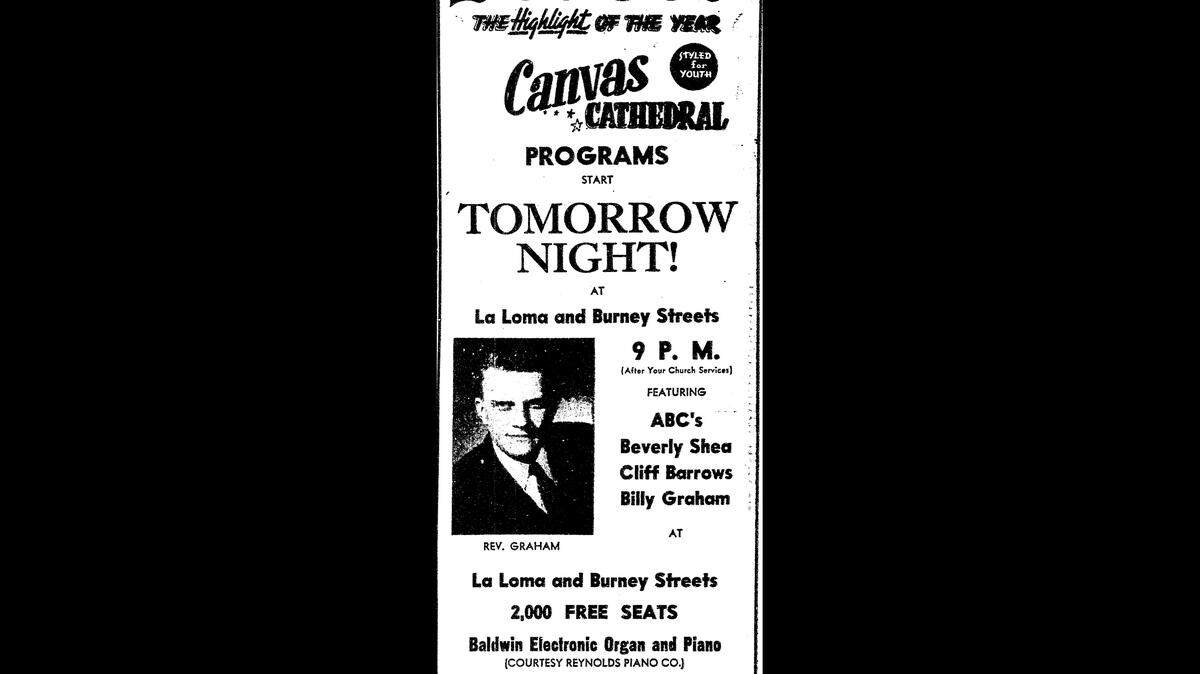
Graham, in mid-crusade with a "Canvas Cathedral" erected at La Loma Drive and Burney Street, saw the need to draw up a set of standards that would keep his team on higher ground.
"Bill and Grady stayed in ... a motel out on 99 South," Barrows recalled. "It was made out of river rock. That was where we met that day.
"As we were meeting together for a time of reflection, Bible study and prayer for the meetings, Bill said, "Let's talk a little bit about pitfalls that evangelists have been plagued with.
""We'll go back to our rooms and pray about it and write them down and commit them to the Lord. We'll ask God to keep us from them, if possible, and help us to be on guard.'"
The four companions came together an hour later. Their combined lists amounted to about 15 items. High on all their lists were four main concerns:
– Sexual immorality. Scarcely a single major ministry, from that day to this, has escaped the taint of sexual scandal. However, Graham and his team have maintained a clean reputation.
In a 1966 biography of Billy Graham, author John Pollock described how the ministers kept themselves out of temptation's path.
"They avoided situations that would put them alone with a woman -- lunch, a counseling session, even a ride to an auditorium or an airport. On the road, they roomed in close proximity to each other as an added margin of social control. And always, they prayed for supernatural assistance in keeping them "clean.'"
"(We asked) the Lord to keep our lives pure and faithful to our wives," Barrows said, "and God has enabled us to do this. We're just verythankful, and we must attribute thelongevity of our (team's) relationship ingreat part to the commitment our wives have made ... to the ministry and to their husbands."
– Misuse of offering money. Traveling evangelists were notorious for milking audiences for extra offerings, then simply pocketing the money to use however they pleased. Graham wanted to dissociate his team from that image.
"(But) we didn't know how to support ourselves other than (with) ... love offerings," Barrows said. "They'd take offerings for the expenses, then . .. love offerings for the evangelist and the team.
"Sometimes the people loved us a lot, sometimes they didn't love us very much."
Barrows said when he tried to buy his first home, he had difficulty explaining the concept of love offerings as collateral.
A concerned businessman suggested the team form a non-profit corporation and each draw a fair salary determined by a board of directors. That led to the establishment of the Billy Graham Evangelistic Association in 1950.
Before that time, though, the Modesto Manifesto helped guide the team's financial philosophy. They pledged not to emphasize offerings in their meetings, and to have each crusade's sponsoring committee handle the income and expenses.
Through the years, careful accounting and modest salaries have given the organization an exceptional reputation for financial integrity, even among Graham's critics.
– Exaggerated claims of crowd size and "souls won." "It had to do with reporting of facts and figures," Barrows explained. "Sometimes the phrase "evangelistically speaking' was used. We determined we would be as accurate as possible. That's why we started to count those who responded."
Unlike some other tent preachers, Graham wanted to make sure no one included altar counselors in the count – accidentally or otherwise – to inflate the tally.
– Criticism of local churches. Traveling evangelists often belittled other preachers, calling them spiritually cold and blaming them for the sorry religious conditions that made revival meetings necessary.
"(It was) determined to always lift high the heart and the hand of the pastor," Barrows said. "And Mr. Graham has never, privately or publicly, spoken disparagingly of any pastor or clergyman, whether he agreed with them ... or not."
The four teammates also listed several lesser transgressions to avoid, such as sensationalism, anti-intellectualism, and the temptation to place too much emphasis on Bible prophecy.
None of the four could know they were creating a template for behavior that would serve them through a half century of international ministry.
"We've been reminded of these (standards) many, many times," said Barrows, who first coined the term Modesto Manifesto. "They've been some of the hallmarks of the ministry which we still have to keep safeguarding. You can see why that (pact) was very special to us."
Evangelistically speaking, the Modesto crusade was a huge success. Even non-evangelistically speaking, it was at least moderately successful by campaign standards of the day. A Nov. 13, 1948, story in The Modesto Bee reported 26,250 people attending and 290 making decisions for Christ.
But the team experienced mixed results in its crusades until newspaper legend William Randolph Hearst saw Graham preach in Los Angeles in 1949. Hearst issued a terse command to his papers: "Puff Graham." That seemed to mark a turning point for the Graham evangelistic team, providing the kind of free publicity every traveling preacher prayed for.
Just prior to that turning point, Barrows said, he came to one of those monumental crossroads of life when he had to decide whether to go on to seminary and perhaps become a pastor, or stay in music and programming.
"My wife and I prayed about it for a good long while, and the Lord spoke to us very definitely about it," Barrows recalled. "He said, "You be content to lead the music for Mr. Graham, and I'll take care of the rest.'
"I've never once doubted it since then, and (as a result) I've had more opportunities to preach in other parts of the world than I would ever have had, and I'm very grateful for it."
Reflecting on nearly 50 years of ministry, Barrows counts himself uniquely favored.
"I don't have any regrets. I would try to spend more time at home with the family if I could, though those early days in the ministry dictated that we would be away. I don't know how I would change that, but the time we would be home, I would have devoted more time with them, perhaps."
Barrows said he is especially grateful for each day he can spend with his wife. Billie survived a battle with cancer several years ago, but two weeks ago was told the cancer is again beginning to spread.
"We're facing the uncertainty of her situation. They didn't give her more than six or eight months to live three years ago. So every day is a precious day for us.
"We're trusting the Lord. We wouldn't have chosen it, but we wouldn't take anything for what we have experienced together."
Barrows rarely returns to the Modesto area these days, though his brother Rick and sister Judy still live here, and his sister Shirley lives in Fresno.
But he said he visits often in his mind, remembering the old home on Service Road, the bike rides to the Big Orange stand, working in the peach orchards in the summertime.
And, of course, the extraordinary meeting in Modesto that set the tone for 50 years of ministry.
This story was originally published February 21, 2018 at 11:53 AM with the headline "From the Archives: Billy Graham's Modesto Manifesto revisited."