
Being deaf doesn’t slow Downey High football players
If you were to stumble upon a Downey High football practice, the first thing you’d likely notice is music blaring from the sound system perched on a ribbon of concrete that winds along the outskirts of the field.
“We started (playing music) in the 2010 season,” said head coach Jeremy Plaa, who is 51-33 in eight seasons as the Knights’ head coach and will lead them into the first round of the Sac-Joaquin Section playoffs Friday against Antelope. “Our coaching staff took a road trip before that season to the University of Oregon and watched spring practice. We were blown away, literally, by the loud music during their practice.”
Soon after encountering the music, you’d notice other things, such as three members of the squad who seem oblivious to the music. In fact, they don’t seem to be paying too much attention at all to what’s happening on the field. Their attention is turned toward the sideline.
Actually, the trio is probably more focused on what’s happening than any other member of the team. They are junior defensive backs Jed McGuire, Alejandro Lobato and Omar Ruiz. And they are deaf.
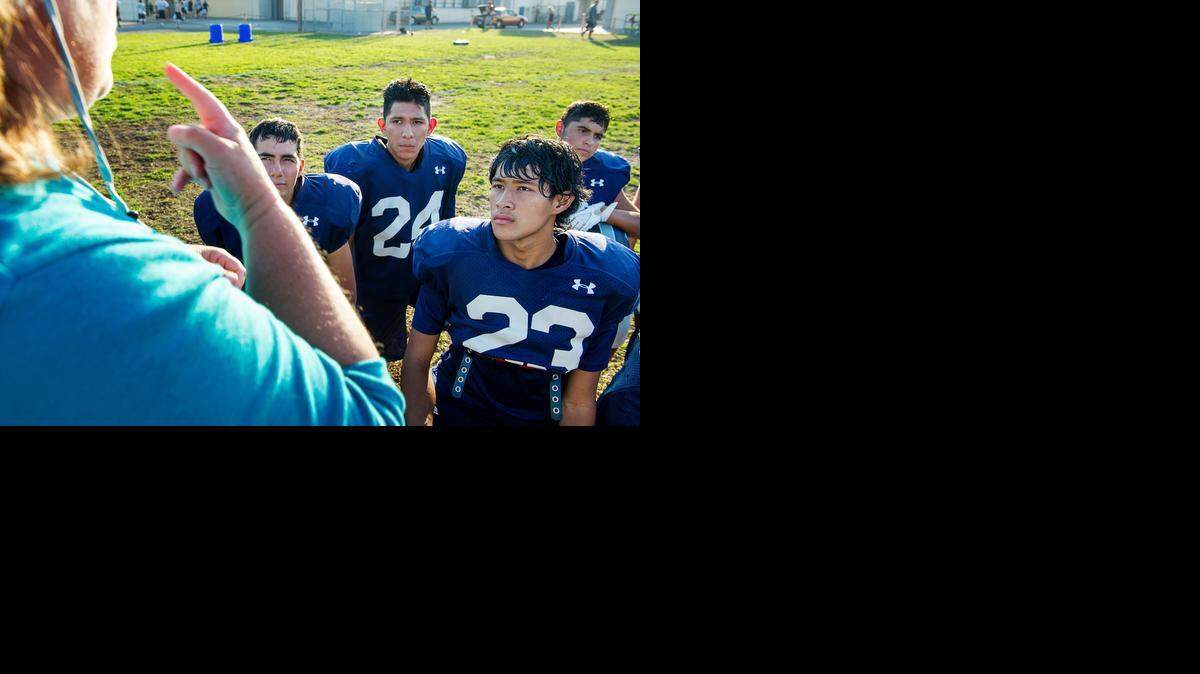
There’s an old maxim that advises athletes in contact sports to play with their head on a swivel, lest they unsuspectingly be blindsided by a lurking behemoth. McGuire, Lobato and Ruiz must adhere to this maxim all the time. Their heads constantly are in motion so they can not only follow the action on the field but pick up signs from their interpreter, Cathy Johnson.
It was the need for an interpreter that most concerned Plaa when he first had a deaf player on his squad a few years back.
“Initially I worried because you’d think having an interpreter signing in front of the team could be a distraction,” he said. “But Cathy is so good working with the players; she understands how we practice and how we manage the sideline in the game, and she works very efficiently with the players.”
Johnson, an interpreter for Modesto City Schools, has worked at the Downey campus since 1989.
“I do less and less each day as they’ve learned the routine and all the plays,” said Johnson, who is the players’ main conduit to the hearing world. As such, she is required to sign for them everything she hears. Everything.
“It makes for some interesting bus trips,” Johnson said. “But I guess I blend in so well now that the other players are comfortable to just say whatever.”
All three players read lips and all three players admit that they’ve been admonished by coaches who thought they weren’t paying attention.
Lobato and Ruiz use hearing aids – though not during competition “It would ruin the device,” said Johnson – and McGuire and Ruiz both were born deaf. An accident when Lobato was about 5 years old resulted in his loss of hearing.
While being deaf comes with obvious challenges, it hasn’t slowed them.
“It’s fun to see them do what they want to do and not have that wall of being deaf stop them,” quarterback P.J. Wilson said. “It really shows their character.”
Though the three players live mostly in a world of silence during practices and games, they don’t feel isolated from their teammates.
“It feels good to be out here with the other players and make a connection with them,” said Ruiz, who, along with Lobato, was talked into coming out for the team by McGuire. “I’m teaching them (American Sign Language) and we’re developing a camaraderie.”
Developing a bond with new teammates can be a challenge, even when communication isn’t an issue.
“Yes, it’s very hard to communicate with my teammates,” McGuire said. In addition to playing JV football last year, he also ran track for the Knights. “But it really motivates me to work with them and to try to teach the hearing how to sign.”
Playing in actual games is probably the biggest challenge of all.
Typically, during practice, Johnson is never more than a few yards from the trio so she can relay the coaches’ instructions to them. On Fridays, however, she is confined to the sideline. The deaf players must be diligent in keeping their heads on that swivel to pick up signs and adjustments from the sideline and from teammates.
And since they can’t hear the whistle – they sometimes can hear it a little bit – they have to be ultra-aware of when a play is over.
Or when one isn’t.
“One time I was so focused on trying to hear the whistle that I didn’t make the tackle,” Lobato said. “But there was a penalty on the play anyway, so it was OK.”
Toward the end of a recent practice, junior Joe Franco walked up to each of his deaf teammates, tapped them on the shoulder and began signing the phrase, “Hello, my name is Joe.”
His deaf teammates nodded to indicate that Franco’s message was understood.
“I just thought it would be cool to try to communicate and to talk with them,” said Franco, a 6-foot-2, 280-pound defensive lineman. “They’re a part of our team and they’re just like everybody else. The fact that they can’t hear doesn’t mean anything.”
Bee staff writer Joe Cortez can be reached at jcortez@modbee.com or (209) 578-2380. Follow him on Twitter @ModBeePreps.
This story was originally published November 12, 2014 at 11:20 PM with the headline "Being deaf doesn’t slow Downey High football players."