
Critical Race Theory isn’t so scary, Modesto, once you understand it
While the opinion piece titled “A new history curriculum or anti-America propaganda?” (May 24, 6A) masquerades as a fair piece of commentary, the text amounts to little more than grandstanding and fear-mongering that holds to the Trump party line.
As someone born and raised in Modesto, I found this vile cesspool of misinformation disturbing, and an intent to stifle conversation. I offer these clarifications to allow the people of Modesto to make an informed decision on these important political matters.
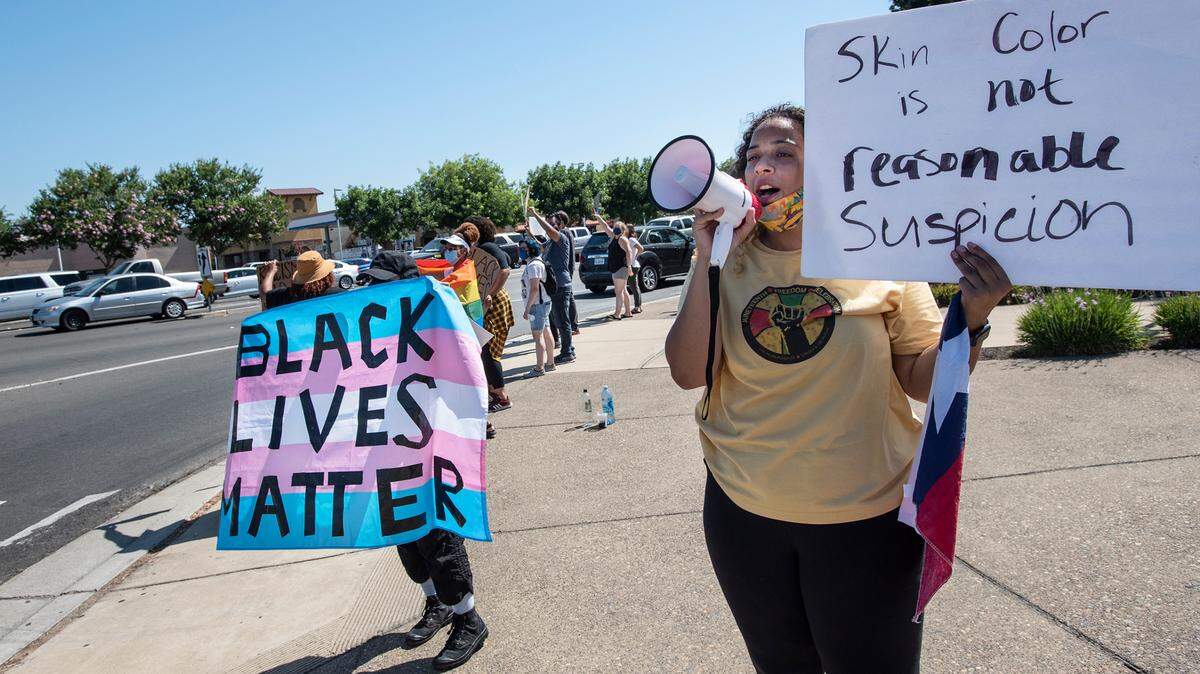
Critical Race Theory (CRT) became one of the favorite rallying cries of the Trump camp in September 2020, when he signed an executive order banning public funding to schools that teach it. It sounds scary, especially to people who were taught to fear the slogan Black Lives Matter. Few people actually know what CRT is, which contributes to the fear it evokes.
CRT is an academic approach that hails from law departments. As a legal conceptual apparatus, it focuses on the way that racial politics are embedded in the American legal system. It takes an activist stance, wanting to change the way that these racial categories hold sway in the organization of American law.
CRT scholars use narrative forms of argumentation and maintain a hypercritical viewpoint on established social and juridical opinions. Perhaps the best definition of CRT is that it is a critical way of examining legal and political systems with the hope of creating a better future.
To an already entrenched system of power, such approaches are a threat because they question ideological and monetary foundations. It is funny that these reactionary opinions do not consider if they are barking up the wrong tree. CRT is not directly concerned, as an academic object, with changing history. Rather, it refocuses history on something traditionally ignored.
This misalignment is all over the Heritage Foundation’s opinion piece.
Ibram X. Kendi, for example, is called a “CRT trainer.” Kendi is a historian and political activist, not a CRT scholar even though he does deal with American legal frameworks. Heritage Foundation authors poorly cite him; his quote is nothing more than a justification of affirmative action as a temporary move toward greater equity, with an acknowledgment that affirmative action is itself racist and simply the lesser of two evils.
Throwing around “Marxist” and “ideology”
I am equally fascinated by their use of the term “Marxist.” Of course, we cannot forget the Cold War and the unimaginable violence perpetrated by people waving around The Communist Manifesto. But the works of Karl Marx have inspired a lot more than the deaths of millions, and in an academic context, it means something entirely different.
“Ideology” is a Marxist term. Originally, the word just meant the study of ideas. Napoleon is often cited as the originator of it as a negative term, but the idea that ideology is a system of thought that upholds a false relation to reality is thoroughly Marxist.
The notion of an ahistorical ideology, which the article uses, was popularized by the work of Louis Althusser, an influential French Marxist philosopher of the 1960s which proliferated in the United States during the 1970s and 1980s. Humorously, the Heritage Foundation’s column is founded in Marxism.
So please, if you are going to use the accusation “Marxist,” define your terms. Marxism has developed as an activist stance that tries to think through the economic origins of inequality, but it is nearly impossible to think about modern politics without resorting to some facet of Marx’s thought.
The 1619 Project, supposedly endorsed by Joe Biden, was set up by The New York Times in August 2019 as a collection of articles by journalists and academics that attempt to place race as a focal point in American History. The vast majority of criticism is focused on journalist Nikole Hannah-Jones’s article “America wasn’t a democracy until Black Americans made it one,” which does indeed propose that the Revolutionary War was fought to preserve slavery.
The far right-wing assumption that everyone in academia believes this to be fact is a myth. There are plenty of professors who have objected to that as false history. Furthermore, the argument that 1619 is the first date of slavery in the colonies has been disproved by many scholars of Black studies. Any politician who tries to use the 1619 Project specifically as a foundation for a curriculum would be seriously mistaken.
History is always politics
It should be taken, rather, to say that history might not always be what it appears. Anyone who has studied Nazi Germany, Bolshevik Russia, or Maoist China knows that history is always politics; totalitarian countries simply radicalize and make obvious something that is always present.
I happily join assertions that history should be taken seriously, and that the 1619 Project is flawed. For me though, the 1619 Project signals a possibility of looking for what is at stake in history.
The goal of the Heritage Foundation column is to confuse and frighten the reader, nothing more. The real effect of this is the confusion of terms and the proliferation of false equivalences in order to make sure that conversation is impossible. If you are using the same terms to different effect, everyone will continue to talk past each other.
If all conversation but the voice of Trump and some disparate Democratic Party is silenced, then everything is preserved. This is precisely what established politicians want, because with it, nothing will ever change.
This story was originally published May 30, 2021 at 4:00 AM.