Heading from Modesto to the snow? What to know about chain controls, closures and more
As rain and snow continue to pummel Northern California, travelers headed toward the Sierra Nevada and Tahoe regions should take extra precautions as chain controls and closures are underway.
Caltrans has issued a notice recommending people avoid traveling during the current storm system. But if you have to head up to the snow anytime soon, officials suggest checking the weather and road information and making sure you are prepared for the conditions.
Wednesday morning, the California Highway Patrol in Sonora also issued a warning about the storm and its accompanying heavy rain, snow and high winds.
“Please use extreme caution when driving in these conditions. Watch out for flooding and hazards in the roadway (down trees, wires, etc.). If you don’t need to drive in it, please consider postponing your trip. Slow down, be patient and wear your seatbelt,” the warning said.
Chain controls are in effect in large portions of the Sierra and Lake Tahoe areas. Caltrans and the CHP set the requirements for chain controls, which vary depending on the conditions.
Currently, chains are required along portions of Interstate 80 near Lake Tahoe, as well as State Routes 88, 89 and 28. Farther south from Tahoe, chain controls begin at Poison Springs on Highway 4 and just before Sonora Junction on Highway 108.
Closures already are underway in the Tahoe region, including Old 40, State Road 89 at Emerald Bay and Monitor Pass, and State Road 4 at Ebbetts Pass.
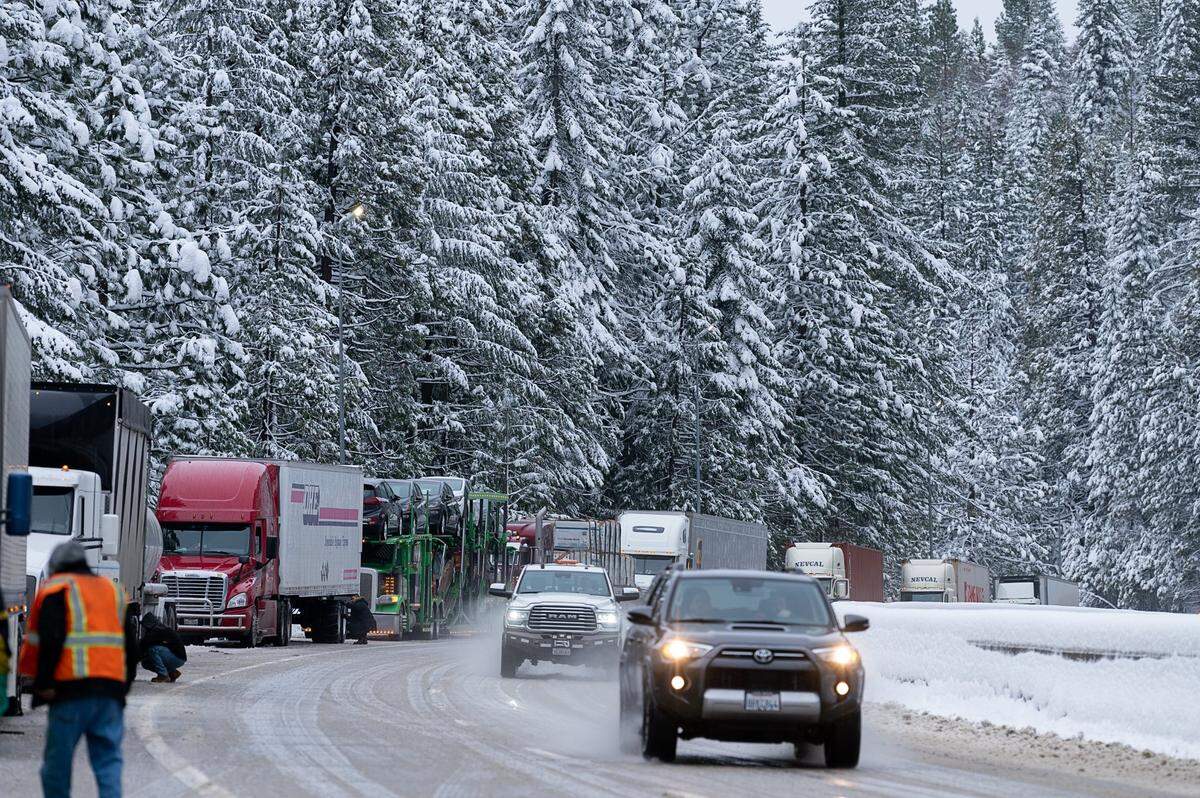
For those intrepid travelers still making the trip to the snow, here is what to know about chain controls.
- Chain control orders come in three categories: R1 (chains are required on all vehicles except passenger vehicles and light-duty trucks under 6,000 pounds gross weight and equipped with snow tires on at least two-wheel-drive wheels), R2 (chains required for all vehicles except four-wheel/all-wheel drive vehicles with snow-tread tires on all four wheels), and R3 (chains or traction devices are required on all vehicles, no exceptions)
- Carry chains with you when headed into areas with controls, and make sure they match the measurements of your tires (listed along tire edge).
- Chain installation must done once “Chains Required” signs appear. Drivers typically have about a mile until hitting a chain checkpoint. Those without chains can be cited by CHP.
- Chain installers may be present and you can purchase their services, but they are not Caltrans employees and work independently. Chain installers are not allowed to sell or rent chains.
- When installing and uninstalling chains, be sure to pull off entirely to the side of the road and do not block traffic.
- Where chains are required, the speed limit is 25 to 30 mph.
Before heading out during any winter storm, check the Caltrans Highway Information Network at 800-427-7623.
This story was originally published January 4, 2023 at 2:00 PM.