Ballot counting begins in Stanislaus County, where do ballots go once they’re dropped in the box?
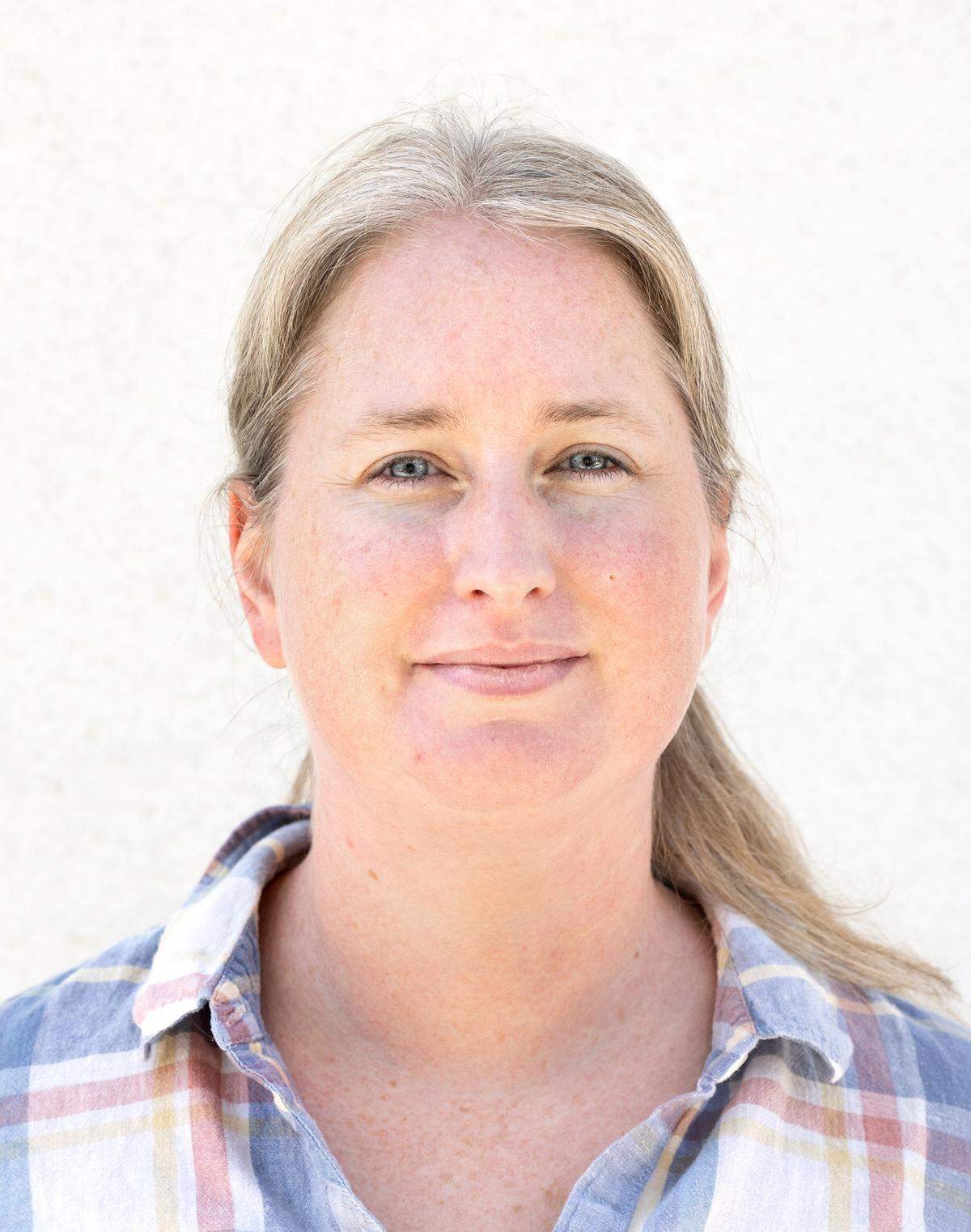
Ballot counting for the Nov. 5 election has begun in Stanislaus County, starting with vote-by-mail ballots. The Bee asked Registrar of Voters Donna Linder to give us an inside look into the process.
First things first, we were escorted by a staff member to an elevator, where we were checked for weapons. We got “wanded” by a security officer, signed in with date and time, and were given badges.
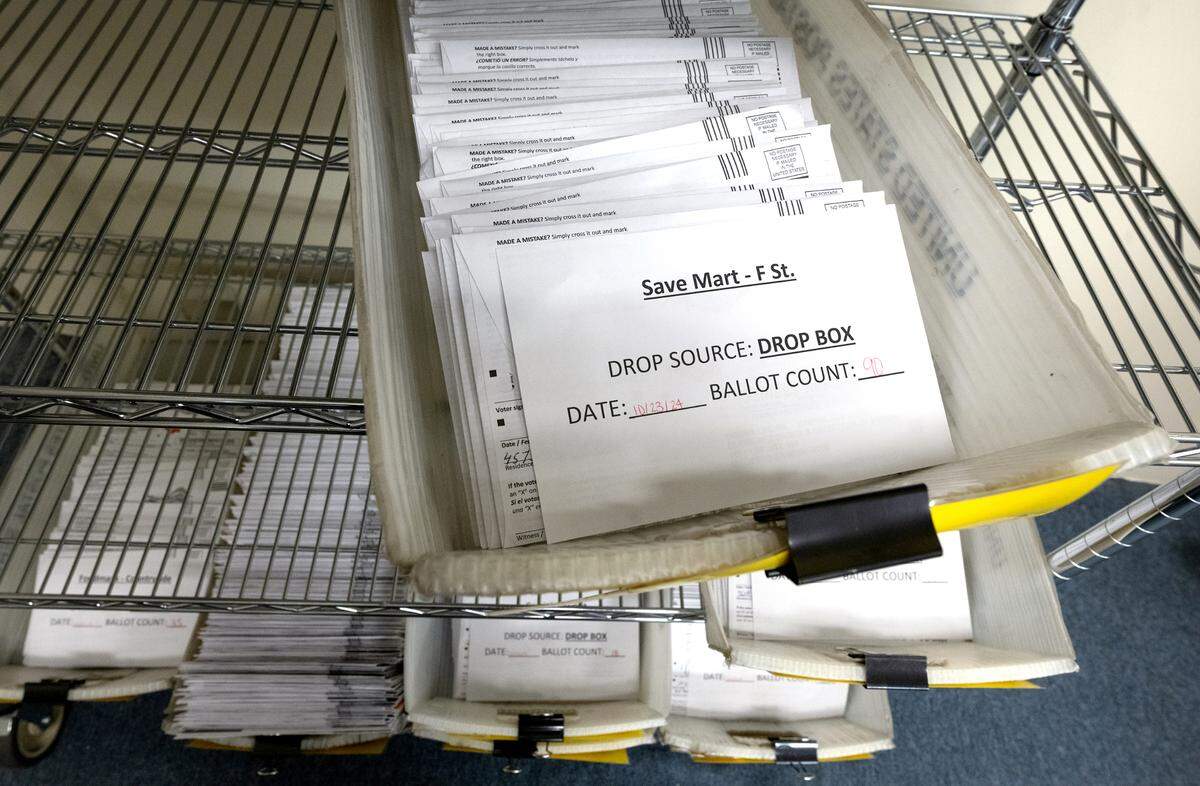
On Wednesday, ballots were received either through the mail or one of the many drop boxes located in high-traffic areas throughout the county.
Almost all of the processes at the county registrar’s office are performed by staff members in pairs. “We’re very, ‘get your buddy system going,’” Linder said.
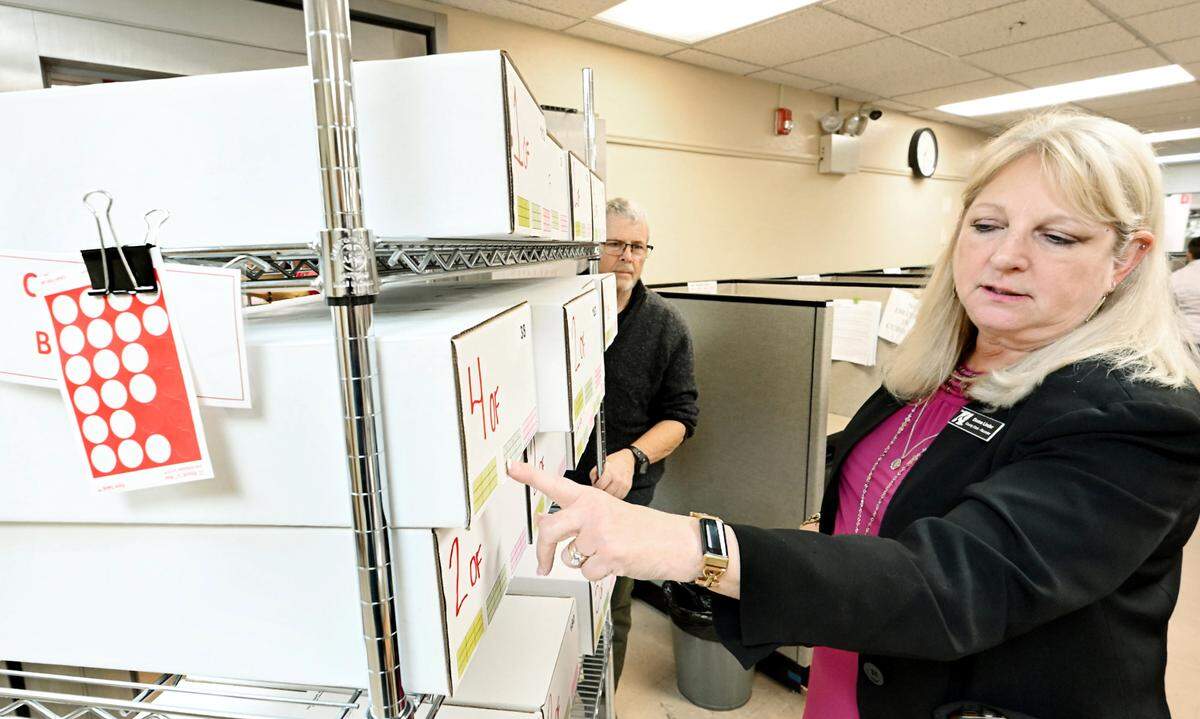
First step: weighing
Ballots from drop boxes are delivered in bags. Each bag has a label that shows the time it was delivered and the ballot box it came from. Workers check that the seal number matches and that the time frame for when the bag came in isn’t way off.
“If you went to Oakdale to pick it up, it would take awhile to get back,” Linder said. “But if you’re two blocks away, you should be back in a few minutes.”
The bags are sorted to ensure they contain no mail other than ballots, and then are weighed. Afterward, the bags are zipped shut and sealed. The seal number on the bag has to match the seal form received from the ballot box.
These bags are weighed by a machine to get an estimate of the number of ballots in each. This is largely for reference when deciding where to place drop boxes for future elections.
“Say we had a drop box at Safeway on McHenry — we don’t, but just saying — and it has 10 ballots, but Save Mart on Standiford has 150 ballots,” Linder said. “I know that is not a good location, we need to find something [better] for future elections.”
Second step: sorting ‘Ready to be sorted’
Next,the bags go onto a cart. The carts are labeled by status, and the one we’re tracking reads “Ready to be sorted” and is taken upstairs.
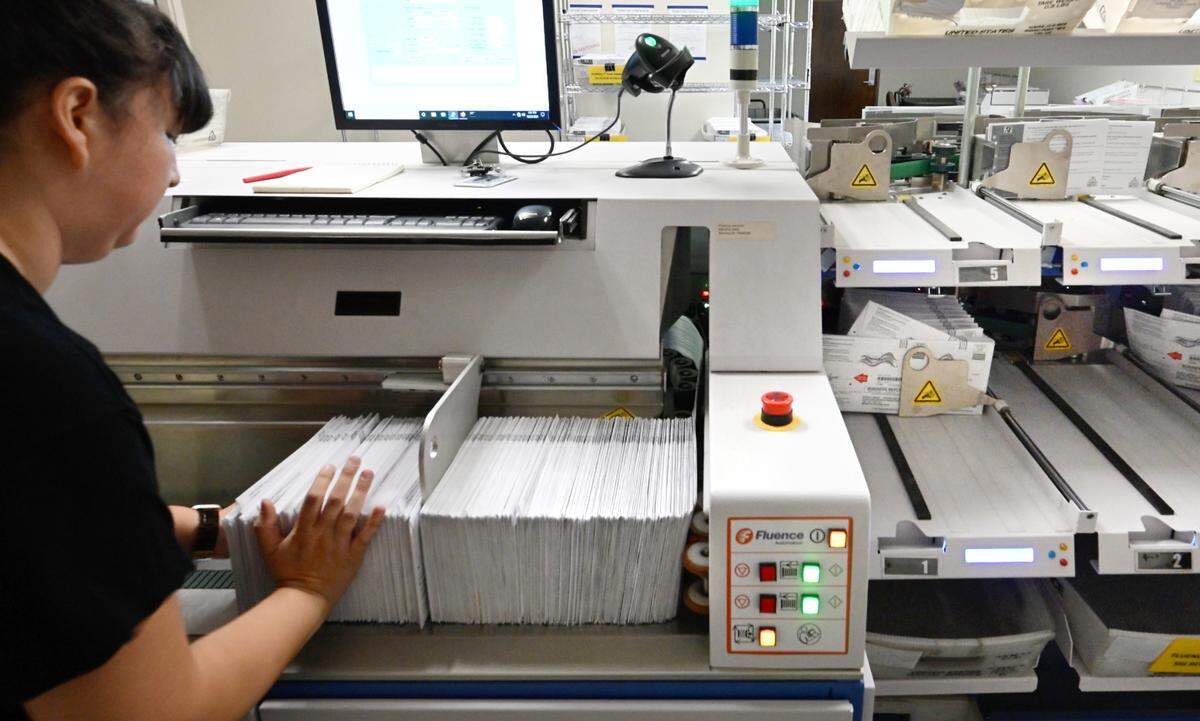
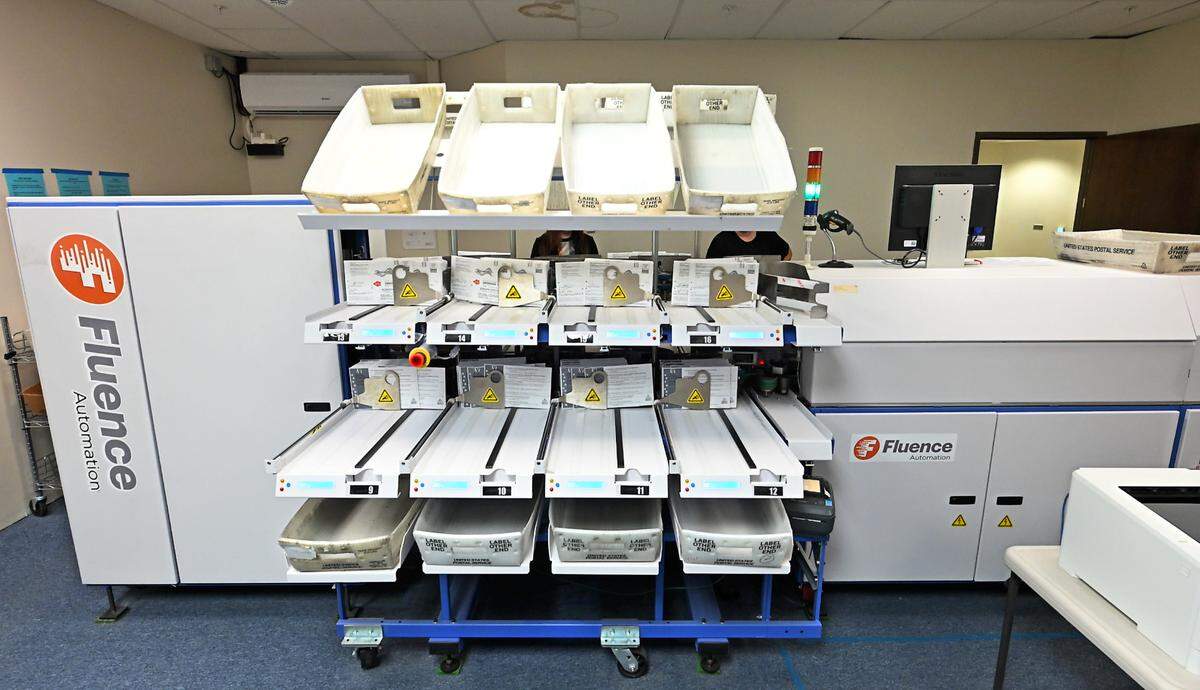
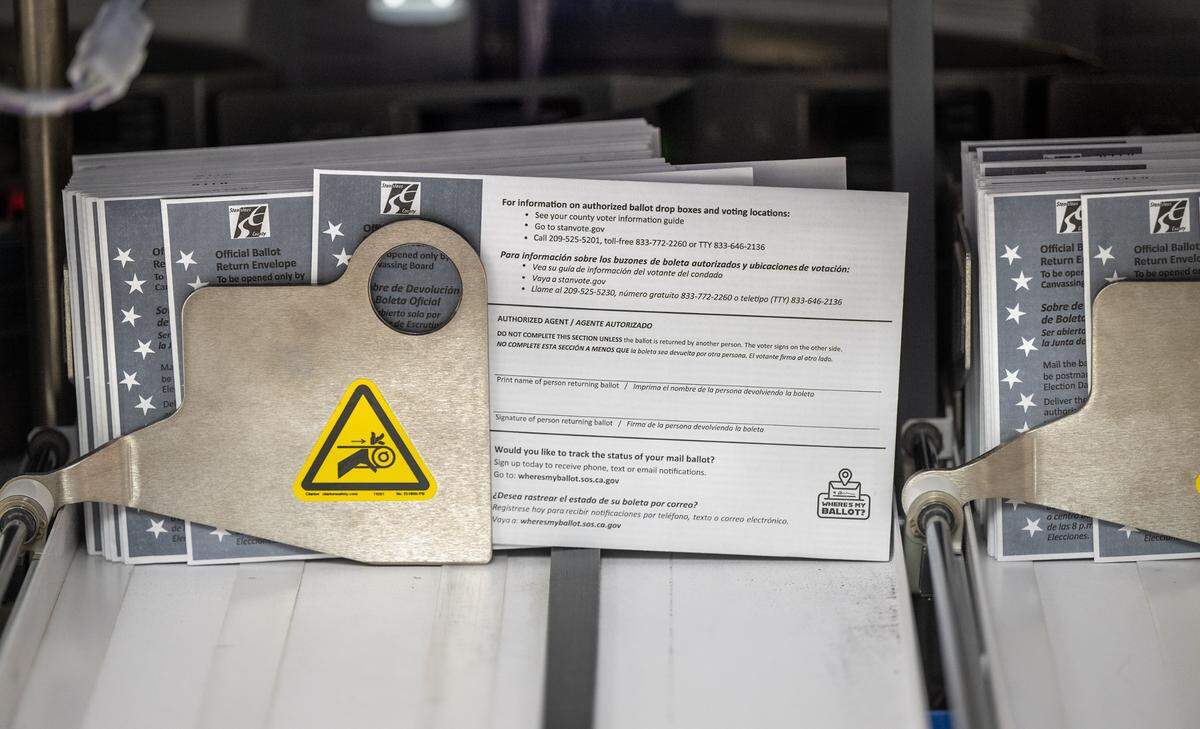
Staff ensures the envelopes are all pointed the same direction, then they are put into a machine that captures an image of the ballot signature and compares it to a voter’s last registration.
The machine will flag any signature that doesn’t appear to match or is absent.
“Your last signature that’s on your registration is compared to that envelope,” Linder said. “If the back row of computers says ‘This is not a match’ or ‘There’s no signature,’ this will have pulled out most of those.”
Downstairs, staff reviews signatures to see if they match by looking at screens that show the voter registration signature on the top and the signature on the voter’s envelope on the bottom.
Line workers are cautious and will forward a ballot to upper management if there is any suspected issue, Linder said.
After review, if there is still an issue, these ballots then go to upper staff that has access to every signature that’s on file for the voter. If there are still questions, a manager makes the final decision on whether it’s a valid signature.
At this point, if there are still issues with an envelope signature, like either it’s not there or it does not match, the voter will be sent a ballot “cure,” which is an opportunity to correct the ballot.
Envelopes that contain ballots that have matching signatures are put into a bin labeled ‘to be opened.’
187 different ballots in county
Linder said her office sorts all 187 ballot types, meaning every ballot for each region and race are separated out. Workers do this to make things easier down the line.
It’s not the law to do so, but she has her office go through this extra step because it makes recounting more efficient if and when there is a challenge to any election results.
“We just sort so that if something happens and we need to pull the ballot types, they’re nicely organized,” she said.
In 2020, the county received 204,000 ballots. The Waterford Unified School District wanted a recount on an issue that had only 5,000 ballots.
“We would have had to look through all 204,000, except that we had already separated them and they were in three boxes,” she said.
Next, staff members tap the ballots down so that when they go through the machine that removes the envelopes, it doesn’t damage the ballot.
The machine cuts the tops and the sides of the envelope and pulls it to the side. A staff member retrieves the ballot from the envelope.
“Your name is covered up, voting is private, so your name is no longer with your ballot,” Linder said.
Essentially, voters’ envelopes go one way and their ballots go the other.
‘Little armies of flatteners’
All of these newly envelope-free ballots are put in a bin marked ‘To be flat.’
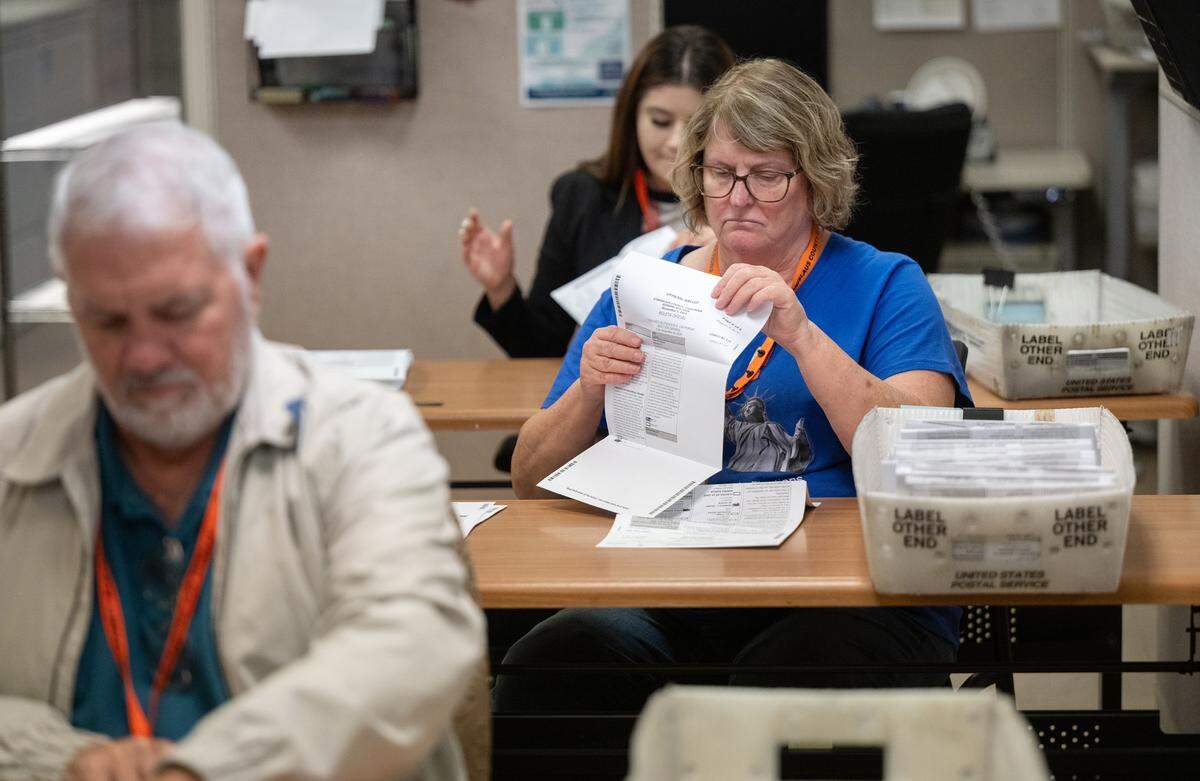
“Flattening is very laborsome, because every single piece of paper has to be flat,” Linder said. “If we have 204,000 ballots with four cards, four times 204,000 is how many pieces of paper you’re trying to flatten.”
The “flatteners” sit at small desks, each with a color-coded bin. One or two people will be assigned a bin and will carefully undo the creases in the ballots. Without this step, the counting machines are not able to process them.
“I call them little armies of flatteners, because it takes a lot of people,” Linder said.
How observers monitor counting
Once that’s done they are put into a cart marked ‘To be counted.’ Ballots in that bin go into the “count room,” a card-key-access-only room observers can look into but may note enter.
“There are only five people that have access to the count room,” Linder said.
There are windows all along the room, and TV screens point outward to the room where observers are stationed.
“In order to be transparent, we have dual monitors,” she said. “So this monitor shows you what that person is looking at, so you can watch as they scan.”
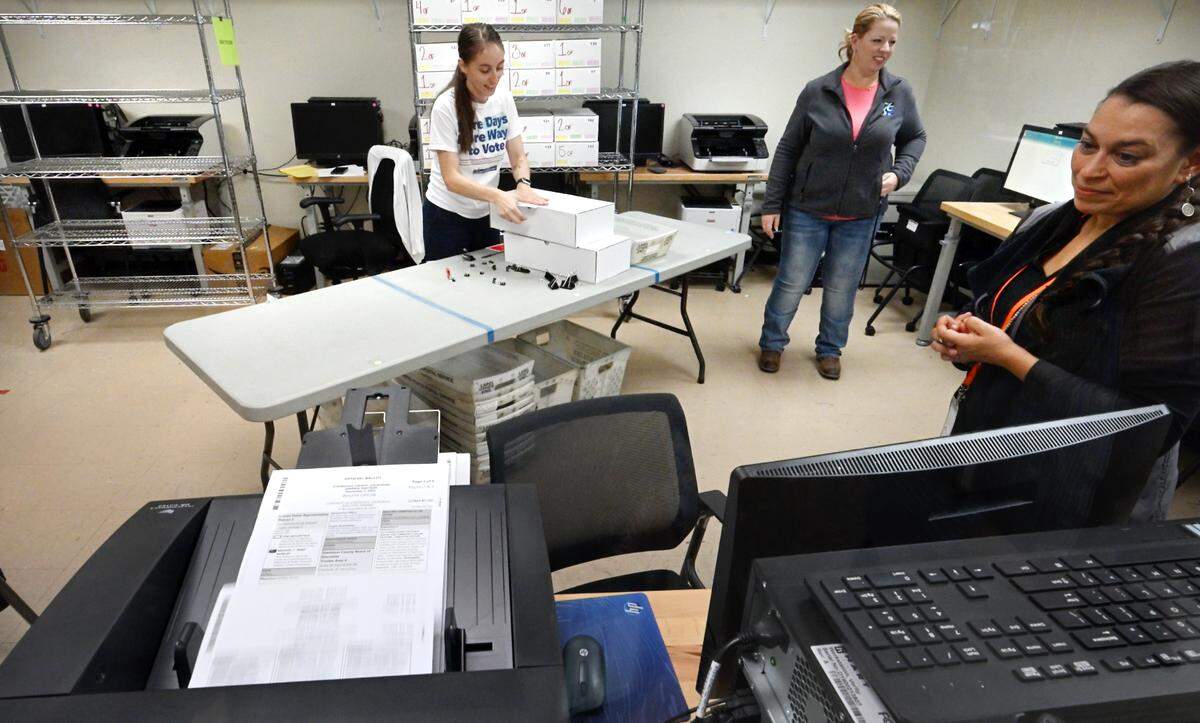
The three computers are called pods. One is a server, and the other two scan the ballots. All of the ballots in the boxes are color-coded to help staffers in the count room keep track of batches of votes.
“On Thursday, we’ll do a random draw of these batches that we’ve been counting and from our vote centers, and we’ll hand count,” Linder said.
How errors, write-ins are handled
“Once they’re done scanning, we do what’s called adjudication,” Linder said.
Sometimes people fill in their ballot in a way that can be difficult to read with the scanner or they may cross out one thing and add in another.
When a ballot has errors, workers use levels of review to determine voter intent. “You’re telling us you don’t want ‘yes’ and you do want ‘no,’ so we give you credit for ‘no,’” Linder said.
This is also where the ballot would go if a voter used a light pencil instead of blue or black ink, and they have to check to see if there is actually a mark there.
“In Stanislaus County we take it a step further, we look at every undercount, too, which means you didn’t vote on something,” Linder said. “We double-check them, because if you put a checkmark and it’s really close to the edge, it might have not quite picked it up.”
If you use a gel pen, for instance, it looks like something exploded on the page, so Linder said she goes back and double-checks those.
This process also involves dual monitors so that observers can see what’s going on for themselves. “Observers can stand here and watch, you can see from the lobby, and so you know they are making the right decision for what the voter wanted.”
The system will also flag write-ins and “They’re either a certified write-in, which means they qualify, or they’re Mickey Mouse and they don’t,” Linder said.
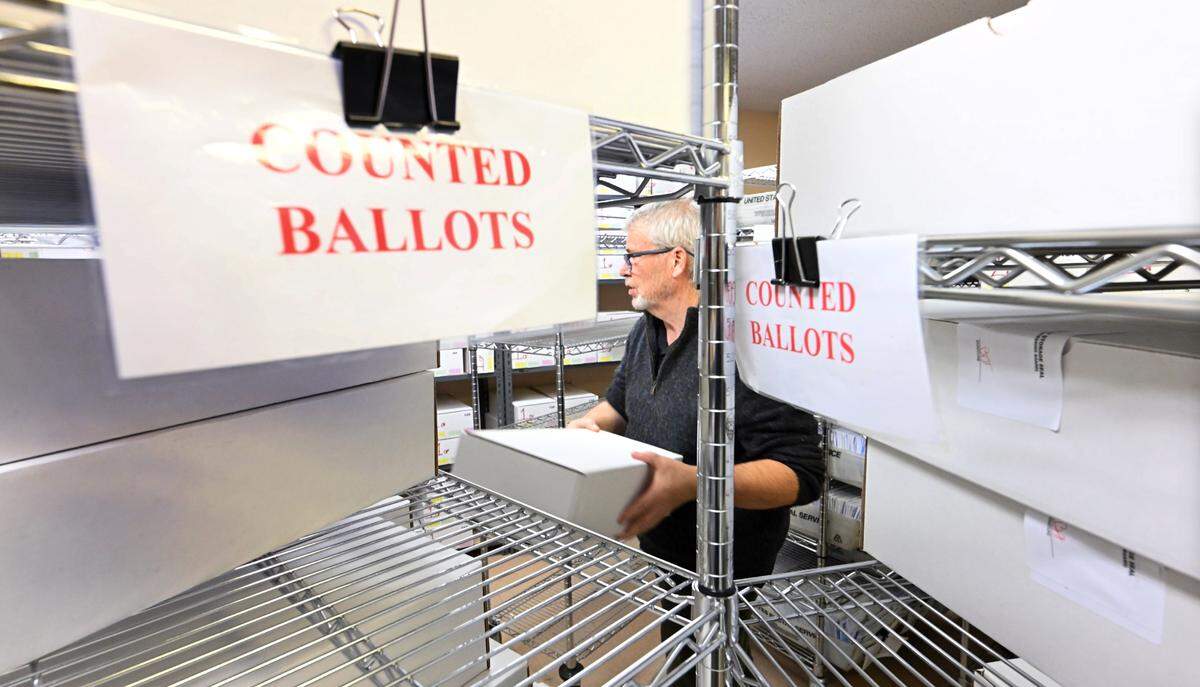
Once scanned, ballots go into sealed boxes.
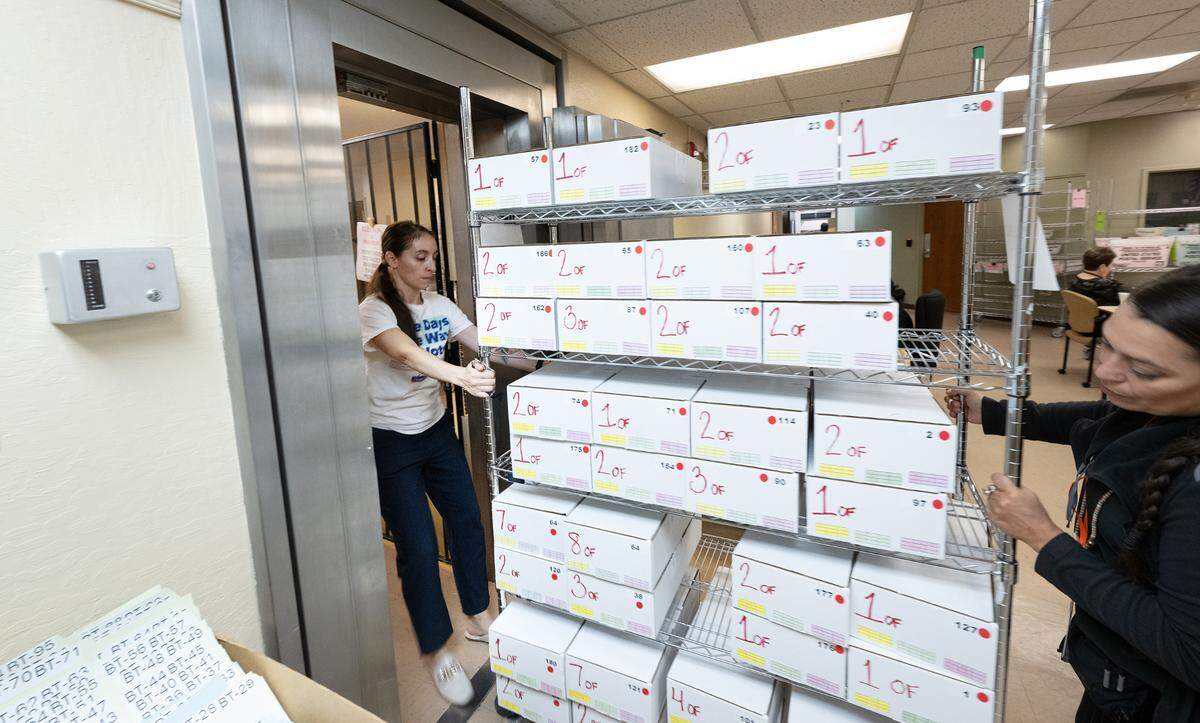
Sealed boxes and the vault
After being counted, but before tallying, votes are kept in a vault.Since the County Registrar’s office used to be a bank, it’s an actual bank vault.
“This is our vault,” she said. “You can’t just come in, no pens, no pencils. Two people always.”
Tallying
Nothing gets tallied until election night. The workers pull the results from each pod and put them into one of two computers. One of the computers is a backup.
Linder said they take the printed report and someone physically types it into the system.
“The actual system isn’t hooked to anything,” she said. “It has to physically be done separately.”
On Election Day at 8 p.m., once all of the vote centers are in, they type the results, send them to the Secretary of State’s Office and wait for confirmation.
That first batch of unofficial results will be just the vote-by-mail ballots. The subsequent updates will be from the vote centers as they come in.
What happens if there is a mistake on your vote-by-mail ballot?
If a voter comes into the registrar’s office to report they have made a mistake and want a new ballot, those ballots are suspended and are put in a bin.
If a voter forgets to sign a ballot or there is an issue with the signature, the county will return the ballot and give a time frame to correct, or “cure,” the ballot. This year, no election will be certified until the time frame has expired, Dec. 3.
Linder said a lot of the vote-by-mail doesn’t come in until Election Day. When voters submit their ballots, they should make sure they’re postmarked by Election Day. Late ballots won’t be counted.
Voters can use ballottrax to keep up-to-date on whether a ballot has been counted and where it is in the process. In-person voting starts Saturday at six locations throughout Stanislaus County and in all 32 vote centers on Nov. 2.
This story was originally published October 28, 2024 at 6:00 AM.