Stanislaus County task force proposed to crack down on unpermitted food vendors
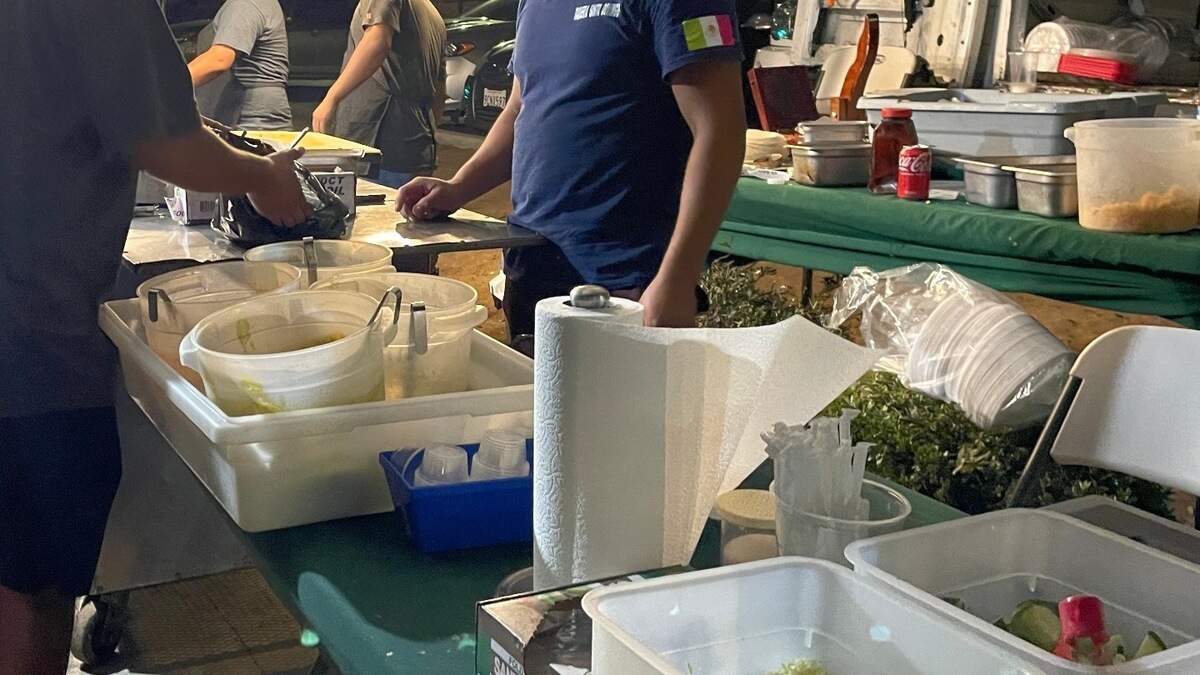
A proposed task force in Stanislaus County would enforce rules against mobile food vendors operating without permits.
County supervisors could establish the interagency task force at their meeting Tuesday. It’s expected to include the county Department of Environmental Resources, the Sheriff’s Office, District Attorney’s Office and participating cities.
The unpermitted vendors, such as food trucks and hot dog carts, handle and prepare food and beverages sold to customers. County environmental resources said the unpermitted vendors often handle food unsafely and ignore temperature control and sanitation standards.
If approved, the task force will be a pilot program. It will provide education and inform potential businesses about the county permitting process before cracking down on repeated violations and businesses that do not comply.
The task force could focus on food facilities including mobile vendors, catering, temporary facilities, commissaries and sidewalk vendors.
A county DER staff report for Tuesday’s meeting noted that unpermitted vendors are unfair competition for the businesses that follow regulations.
Under the California Health and Safety Code, food vendors must have a permit issued by the county Department of Environmental Resources and are expected to cooperate with food safety inspections.
In Stanislaus County, the annual permit fees are $600 for food trucks or trailers, and $300 to $450 for fruit carts, tamale push carts and roving ice cream trucks.
Officials say unpermitted roadside food vendors have proliferated in the county and city jurisdictions, posing a health risk for the public.
Robert Kostlivy, county environmental resources director, wrote in the staff report that efforts to educate unpermitted vendors have not resulted in significant compliance, and there are continual violations. The staff report said city representatives for Modesto, Ceres, Turlock and other cities attended a recent meeting and expressed interest in the task force.
The participating agencies will work on mitigating the problem and could shut down noncompliant food businesses to protect consumers. Enforcement actions will be coordinated among the agencies, so that a business cited in one jurisdiction does not simply pop up in another, the staff report said.
The county will be responsible for enforcing the code in unincorporated areas and also will coordinate the program as cities deal with unpermitted vendors within their own boundaries. The county will handle the administrative duties for violations, fines and penalties.
The Sheriff’s Office will assist with enforcing the law in the county jurisdiction, “including detention when necessary,” the report said. The district attorney could prosecute cases if business owners remain out of compliance.
While food vendor permit violations have been mostly decriminalized in California, code violations may be a misdemeanor punishable by a $25 to $1,000 fine or six months in jail, according to information from DER.
The county did not have data on food-borne illnesses linked to unpermitted food vendors. “Generally, there has been an increase in reports to our office of illness, dissatisfaction and unsanitary conditions related to unpermitted food vendors,” Kostlivy said by email.
The county and cities will be in charge of storing impounded food-preparation equipment seized within their respective jurisdictions. Release of impounded equipment will depend on payment of fines and storage fees.
The task force will emphasize “compliance first” while enforcing the codes. Coordinated enforcement will occur if there are repeated violations.
In February, the Ceres Police Department’s code enforcement unit partnered with the county Department of Environmental Resources on an enforcement operation targeting unlicensed vendors in the city.
Authorities cited two vendors and confiscated their food products and cooking equipment. A news release was issued stating that unlicensed food vending poses significant health and safety risks because “food prepared and sold by these vendors is not subject to established health, safety or quality control standards.”
The enforcement operation was in response to concerns and complaints from Ceres residents and city officials.
The Stanislaus County Board of Supervisors will meet at 9 a.m. Tuesday in the basement chambers of Tenth Street Place, 1010 10th St., Modesto.