Investigation into Modesto water official contradicts his past statements
Editor’s note: A previous version of this story included incorrect calculations that underestimated how much water MID Director Larry Byrd would need to irrigate his out-of-district land.
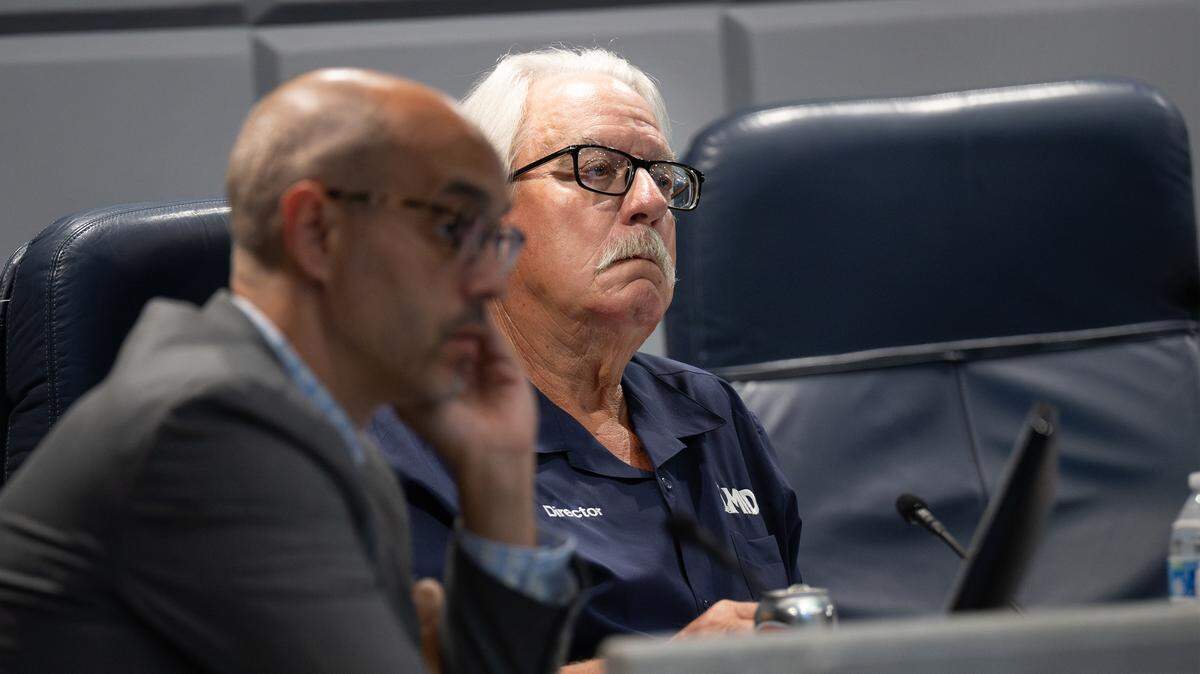
A report based on a months-long investigation contradicts how Modesto Irrigation District Director Larry Byrd says he watered some of his almond trees. But it could not determine if he stole water.
Byrd, who was elected to the district’s Board of Directors in 2011, was placed under an MID investigation after he was publicly accused of using his water allocation to irrigate a portion of his almond orchard that sits outside the district’s boundaries.
If true, the allegations would mean that for nearly a decade, he used millions of gallons of MID water outside of the district. MID stated that if its board of directors found him at fault, he could have his water cut off.
Byrd’s orchard is a 436-acre property known as AB La Grange Ranch, which is about four miles east of Roberts Ferry. About 340 acres of Byrd’s almond trees are within MID’s boundaries and 96 acres are outside of it.
At an MID board meeting Sept. 23, Byrd denied allegations he stole water and said he used groundwater through a well on the property to irrigate the out-of-district trees.
“As I have said from the beginning, the small portion of the orchard outside of the MID boundaries is irrigated with well water,” he said. “This entire issue is based on false claims by a disgruntled former employee who I fired, and that have been repeated over and over as an organized political smear campaign.”
However, the calculations in the investigation say otherwise. On Thursday, the Visalia-based architectural and engineering firm 4Creeks released a 60-page report based on its investigation authorized by MID.
The report states that from 2021 to 2024, there were “substantial groundwater deficits” on Byrd’s out-of-district land and that “groundwater alone could not have met the full irrigation demands of crops cultivated” during that time period.
A low-end estimate would mean Byrd was short by 0.65 acre-feet per acre annually, according to the report, with a high-end estimate showing he was short by approximately 4 acre-feet per acre annually. One acre-foot is equal to 325,851 gallons.
“Given the magnitude of these shortfalls, an alternative source of irrigation water would have been required to supplement groundwater pumping and satisfy the total irrigation water requirements for the Out-MID unit during water years 2021 through 2024,” the report reads.
The estimated yearly deficit of groundwater on Byrd’s out-of-district land is probably an undercount, though. According to 4Creek’s investigation, it “likely overestimates the actual annual groundwater availability for each individual water year.” This is because investigators used pumping estimates over a nine-year period and applied them to just three.
“Despite this conservative approach, the cumulative water balance assessment demonstrates that available groundwater was insufficient to satisfy crop irrigation requirements for the Out-MID unit across the combined four-year period,” the report reads.
While the investigation determined that Byrd could not have pumped groundwater from a well to irrigate his out-of-district trees, it could not determine where the water came from.
The investigation by 4Creeks had two separate studies: one for Byrd’s in-district trees and one for his out-of-district trees. While it’s unknown how Byrd irrigates his out-of-district trees, his in-district trees are nourished by MID allocated surface water.
The study on Byrd’s in-district trees aimed to find out if he had enough MID surface water allocated to irrigate both his in-district and out-of-district trees.
In other words, investigators wanted to determine if he’d done what he was originally accused of. To do this, they used the same method of investigation.
4Creeks’ investigation used both a low and high estimate of how much water was needed to irrigate his in-district trees to determine if Byrd had a surplus, or deficit, of allocated surface water.
But the data was too far apart. If both the low and high estimates were consistent across the years, such as if both estimates showed a surplus across all years, then the investigators could determine if Byrd used that water to irrigate his out-district trees. However, the high estimates showed a surplus and the low estimates showed a deficit.
The report stated this fact “prevents confident determination of whether surface water deliveries consistently met, exceeded, or fell short of crop irrigation requirements.”
“Any conclusion regarding the potential application of MID surface water to Out-MID areas must acknowledge this fundamental uncertainty inherent in the water balance methodology.”
Investigation’s methodology
The amount of water needed to nourish a certain crop is called an irrigation water requirement (IWR). The IWR of a crop, such as an almond tree, is determined through a complex and extensive scientific process outlined in a 300-page United States Department of Agriculture guide.
Investigators used five main dataset inputs — effective precipitation, evapotranspiration, surface water usage records, groundwater usage records and irrigation efficiency — against the IWR to determine its findings.
Byrd uses a microsprinkler irrigation system to draw water from two sources: a groundwater well powered by 200-horsepower diesel pump, which he claimed was used to water his out-of-district trees, and a 250-horsepower electric pump to deliver surface water from an MID canal, according to the report.
Investigators conducted multiple interviews with former and current employees of AB La Grange Ranch, former and current MID staff and the property owners. Investigators also conducted an on-site inspection, according to the report.
The report will be presented at MID’s next board of directors meeting at 9 a.m. on Tuesday at 1231 11th St. in downtown Modesto. Action related to the report can be voted on, according to MID’s meeting agenda. The board will also be appointing a new president, vice president and secretary at the same meeting.
As of Friday afternoon, Byrd had not responded to a request for comment.
This story was originally published December 12, 2025 at 5:10 PM.