Stanislaus County’s air quality among worst in CA. Workshop advocates for change
AI-generated summary reviewed by our newsroom.
- Stanislaus County ranks eighth worst in CA for year-round particle pollution.
- Residents used workshop and data tools to advocate for cleaner air policies.
- Heavy trucking and industrial activity in west Modesto worsen local pollution.
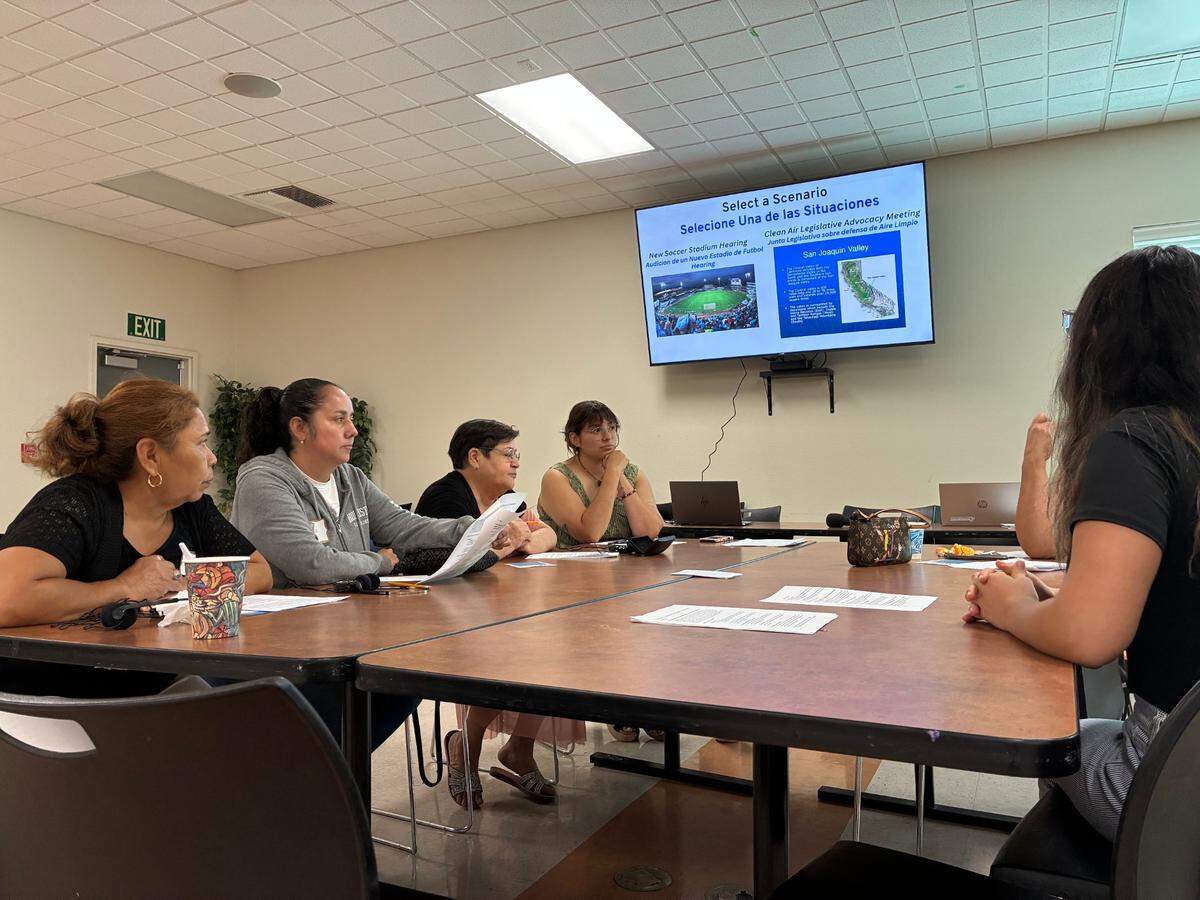
West Modesto residents and community organizers gathered at the King-Kennedy Memorial Center for the second in a series of workshops to help residents learn how to advocate for better air quality in a county that routinely ranks as one of the worst in the state.
The event, “Breath In, Speak Out,” hosted by Valley Improvement Projects and the West Modesto Community Collaborative, reviewed strategies for how the community can speak up for itself about poor air quality in an area residents say is severely neglected.
Edgar Garibay, a project manager for VIP, led the session with a presentation on how to influence policymakers. “You have a lot of power in your community,” Garibay said. “You’re here because you’re invested and you want to see a community that is healthier.”
Laura Plascencia, a VIP community organizer, said it’s important to create safe spaces for people directly affected by issues instead of just posting on social media or expecting community members to make the trek downtown to be heard.
“They’re leaving behind a great demographic of folks that have knowledge and experience– especially living in the area for so long,” Plascencia said. To facilitate attendance at “Breathe In, Speak Out, the event Wednesday evening included childcare, refreshments and Spanish translation.
The session was split into two parts: The first was a presentation on who is responsible for addressing air quality issues and how to convey community concerns, and the second was a role-playing exercise geared toward practicing how to work through problems from industry and resident perspectives.
Garibay stressed the benefits of using data to make a stronger case. “Data helps us to create knowledge,” he said. “It also gives us access to funding.”
He showed data by the American Lung Association ranking Stanislaus County eighth among California counties for worst year-round particle pollution.
Maribel Torres, a youth instructor and facilitator for the West Modesto Community Collaborative, said she went down a rabbit hole looking into all of the information provided in the slides.
“There’s just so much information out there about what counties seem the healthiest,” Torres said. “And when you compare where Stanislaus County is at, it has an ‘F’ — that’s pretty devastating.”
According to the American Lung Association, the county is failing in total ozone days per year and particle pollution, both daily and annually.
Christina Vallejo, a participant and interpreter for the workshop, said one of her biggest takeaways was the importance of using data when presenting to people, like members of the Stanislaus County Board of Supervisors.
“When you want something done, I gathered that you need to pay more attention to the data, not just skim through it, but actually pay more attention,” Vallejo said.
Garibay used an air quality monitor placed outside Mark Twain Junior High School as an example to show a dramatic spike in poor air quality on the evening of July 4 and leading into July 5, indicating that fireworks or related fires may be the cause.
Plascencia said west Modesto is adversely impacted by many different types of air pollutants. An top of pollution from Gallo Glass and water treatment plants, there’s heavy commercial trucking.
“I know there are routes that are allocated for trucks where they are allowed, but we’re seeing that especially in the unincorporated areas, trucks don’t follow those routes,” Plascencia said. “They go by what’s the easiest and shortest route, and because there isn’t much enforcement or regulation on it, these things keep happening.”
One of the presentation slides showed that a census tract in west Modesto was at greater risk for pollution than other nearby areas like Waterford. The data used was provided by the Office of Environment Health Hazard Assessment.
Discussion group looks at soccer stadium impact
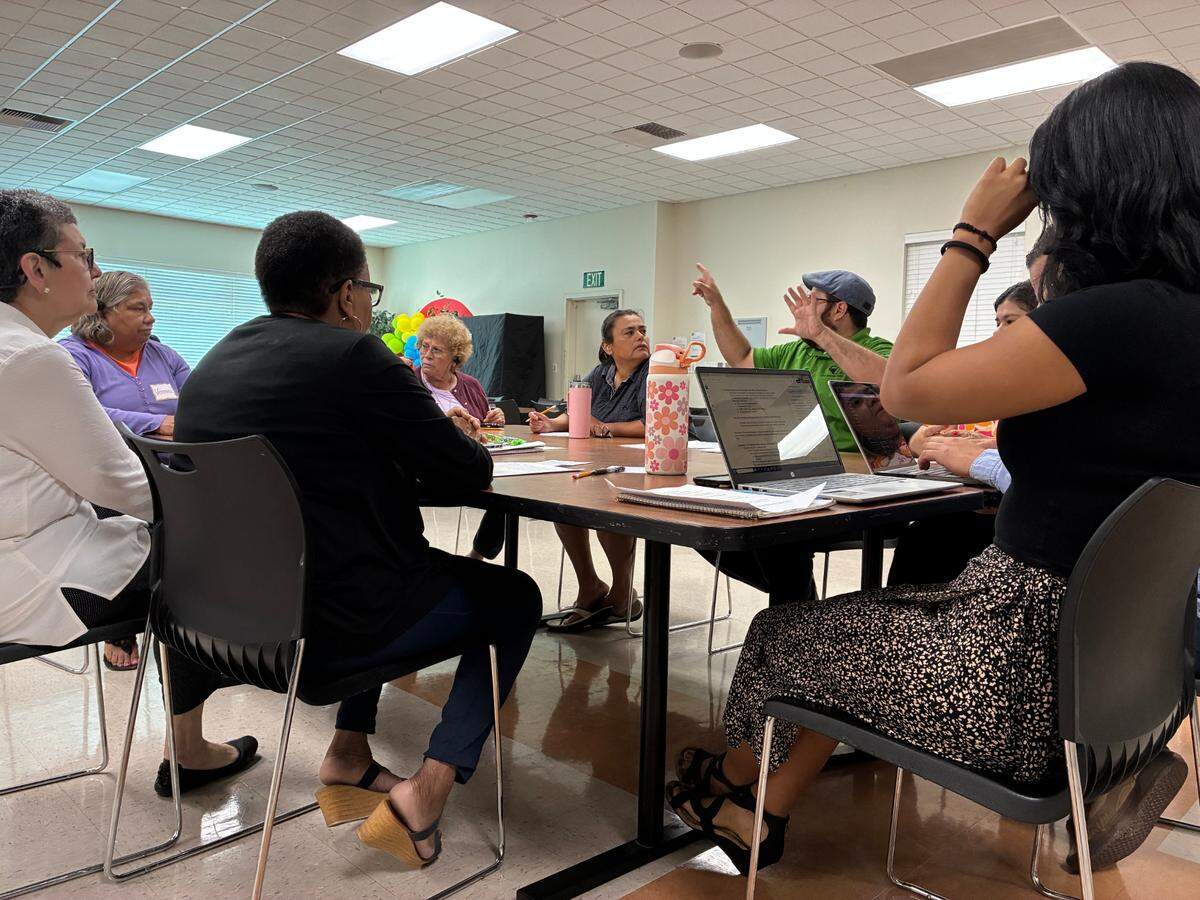
For the second part of the session, participants were split into two groups to explore different perspectives. One group focused on air quality issues in west Modesto and the other talked about a possible new soccer complex, something that will come before the west Modesto community early next week.
Torres said when it comes to community workshops, they often build scenarios from scratch, but she thinks it’s better to offer the community actual situations they deal with every day.
“It’s such a wonderful exercise to be able to work on something that’s literally happening right around the corner,” Torres said.
Andrea Salazar, a resident of west Modesto, said through an interpreter that she loved the way the organizers provided examples on how to share their opinions in front of local representatives, like the City Council. “And also how they gave us different points of view pro and con,” Salazar said.
Sterling Fountain, a director at the King-Kennedy Center, played the role of an industry representative, arguing that a new soccer field would increase property values and possibly attract new services and businesses.
“If you look at the map of things that are on offer in Modesto, everything seems to stop at the railroad tracks,” Fountain said.
Salazar said going through the roleplay helped inform her own opinion on the soccer stadium. When she started the day, she was ready to be fully against it, but after talking with other people during the roleplay, she said she’ll take other opinions into consideration moving forward.
For a nine-month period, the areas of west Modesto, south Modesto/airport neighborhood and the southwest Stanislaus region will be monitored for air quality by a group known as “Aclima.”
“My goal is that more people become civically engaged as is their right protected by the First Amendment,’” said Jose Borroel, a participant and member of Valley Improvement Projects. “To share their fears, their concerns and perspectives for what they may be impacted by positively or negatively.”
Salazar said she wished they could have spent a longer time talking through the issues, because they weren’t able to get through everything.
“It’s a starting point, but you’re your own advocate,” Garibay said to the group. “Collectively, the community carries a lot of power and I hope you feel empowered, too.”