Trump tariffs blamed for decreased revenue in Modesto. City releases budget
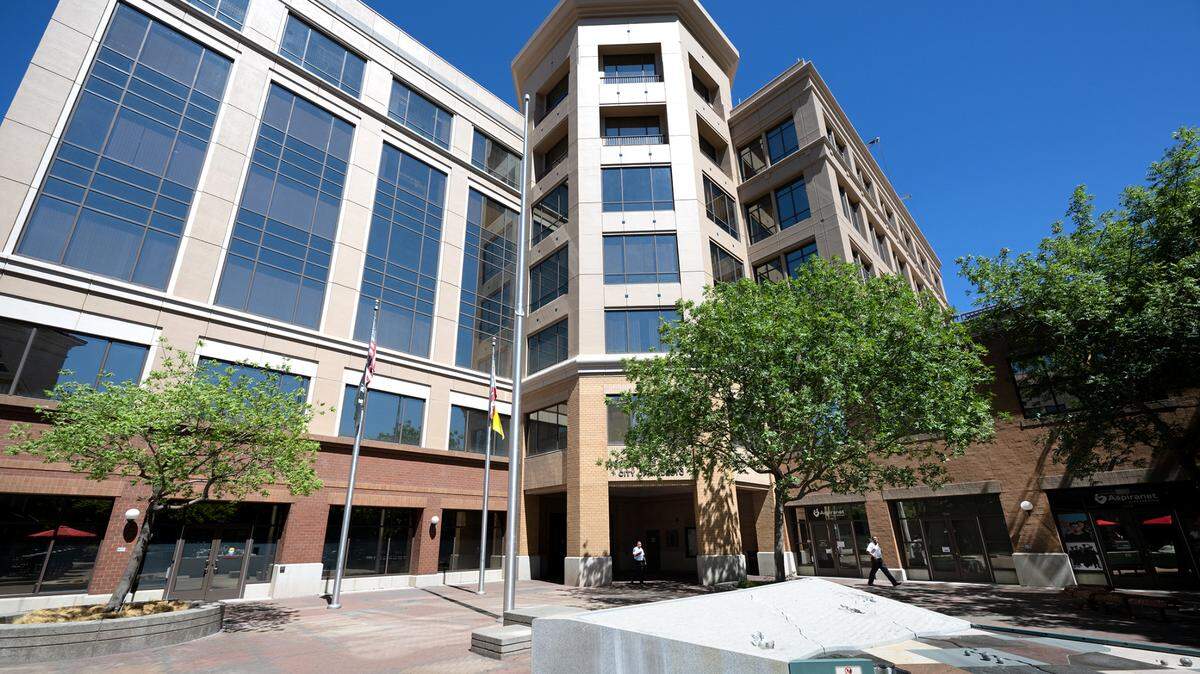
On Tuesday, Modesto’s City Council unanimously approved its $199.9 million budget for the next fiscal year — centering it around a pessimistic outlook for the local economy.
While no cuts to the general fund are anticipated, city officials project a decrease in sales tax caused in part by waning consumer confidence and inflation driven by President Donald Trump’s unpredictable rollout of tariffs.
In April, Trump levied a minimum tax of 10% against most countries, including an initial 145% penalty against China, one of California’s largest trade partners. This was reduced to 35% in May.
However, the moves created economic pessimism across the country. At the statewide level, officials projected California would lose $16 billion in revenue due to Trump’s tariffs, prompting Gov. Gavin Newsom to file a federal lawsuit to stop them. The case was thrown out by a federal judge on Monday.
At the local level, anticipated loss in sales tax will likely contribute to an already growing deficit in Modesto’s general fund. Other factors are playing their part, too, including a loss in federal funds and increased city spending.
“Really, the slowdown in consumer spending is what we’re worried about having the direct impact on future sales tax figures here in the local economy,” said Stephen Christensen, director of Modesto’s Office of Performance of Management and Budget.
From big-box stores like Walmart and Costco to small local businesses, Christensen said increased costs will be passed on to consumers, at least in some part. City Councilmember Nick Bavaro echoed those concerns, calling tariffs a “consumption tax.”
“Even though they say they’re not going to do it right now, they will end up doing that because they have to respond to their stockholders,” Bavaro said. “So it does have an impact.”
Both Bavaro and Christensen said post-pandemic inflation also is to blame, but tariffs exacerbate the issue. City Councilmember Chris Ricci, however, said that tariffs alone may be to blame for the city’s planned financial woes.
“We didn’t start experiencing these issues until now. You know, every year… we’ve been seeing pretty encouraging income levels,” Ricci said. “The changes that the federal government is making in policy [are] having immediate consequences on our ability to fund local government.”
What is the projection and how is the city preparing for it?
City projections for sales tax revenue during the current fiscal year were at about $41 million — a slight increase from the previous year’s actual income of a little over $38 million.
However, current projections show the revenue to decrease about 4% from last year to $36.5 million. For the next fiscal year, it’s projected to drop to $36 million. Sales tax revenue spiked during the early years of the pandemic. However, it’s been steadily declining since.
Measure H is a sales tax passed by voters three years ago to weather the economic downturn caused by the COVID-19 pandemic. Before it was passed, the city was faced with cuts to address its estimated $20.1 million deficit.
The deficit now hasn’t changed much and sits at about $19.6 million. However, since it passed, Measure H has allowed the city to avoid cuts and increase its spending.
Modesto’s budget for the coming fiscal year is actually balanced, but that’s largely due to Measure H supplementing the city’s growing deficit — a method that’s been done at an increased rate since fiscal year 2023-24. This fiscal year, $8.6 million in Measure H funds were used to help fill the deficit gap. Next year, it’s projected to increase to $11.6 million.
During the pandemic, the city relied heavily on federal American Rescue Plan Act funds to continue services. Now that those funds have dried up, $2 million from Measure H will be used to fill the void. But Measure H can’t supplement other funds forever.
For the first time, the city adopted a two-year budget in anticipation of an economic problem. Christensen said this was done to provide flexibility in the budget, given the uncertainty.
As for how long the city can continue to dip into Measure H for general fund help, Christensen said city staff have done “soft calculations” but “there’s a long time before we have to worry about that.” Emergency and reserve funds, otherwise known as rainy-day funds, are being added to every year.
“One of the things that we’re very cognizant of is dipping into the funding for measure H. … We’re very aware we don’t want to have to go out for another sales tax or anything like that. We want to make those funds last,” Christensen said.
Measure H sales tax is projected to decrease by about $1 million during the next fiscal year. In addition to Measure H supplementation, the budget was balanced by a scrubbing of department’s internal budgets and by moving several funds for the Modesto Police Department away from the general fund and into Measure H.