Stanislaus planners OK truck parking facility near Turlock as debate continues
Stanislaus County planners have approved a permit for Lucky Star Logistics to operate a truck parking facility in an agricultural area near Turlock.
But other trucking firms may not be so lucky, as county officials hear increasing complaints about parking of commercial trucks on agricultural land and a county-appointed committee works on new policies for dealing with the “crisis.”
Lucky Star’s permit also raises thorny questions about larger trucks that will complicate efforts to regulate the problem.
County planning staff had recommended the Planning Commission deny the permit for up to 12 trucks and trailers on part of a 10.3-acre parcel on East Greenway Avenue, between Lander Avenue and Golf Road. But the commission voted 5-3 to approve the permit, largely because it met the same criteria as another permitted truck parking facility in that area..
In recommending denial, county staff cited two letters of opposition, Lucky Star’s noncompliance with the code in establishing the business without a permit, and road and intersection improvements that may be required for larger trucks falling under the Surface Transportation Assistance Act.
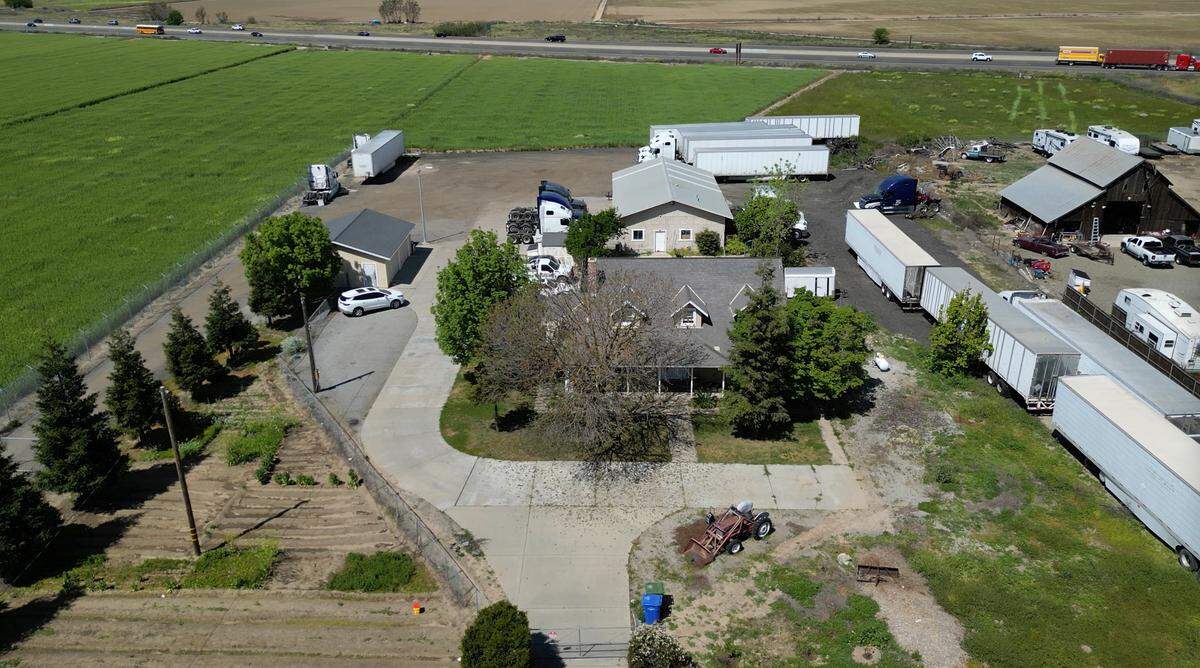
A neighboring landowner urged the county to consider damage to roads and how farmland is being converted for the commercial operations. Another opponent, in a letter, cited the growing prevalence of truck parking in Stanislaus County.
Planning Commission Chairperson Carmen Morad, who voted “no” and is on the committee studying truck parking, said at the April 3 meeting that she would like to see a pause in applications “until we have more answers.” She said the committee is looking at soil contamination and the concentration of truck parking facilities in specific areas, as well as other problems associated with truck parking in the ag zone.
The majority of truck parking facilities, whether permitted or not, are clustered in the unincorporated areas around Keyes, south and west Turlock, and major roads connecting to Highway 99. There are 15 truck parking facilities within a 1.5-mile radius of the Lucky Star site.
Lucky Star purchased the property in 2023 and began parking trucks without a county permit, which led to code enforcement action and the company’s application for a county permit.
Lucky Star uses 1.5 acres of the 10.3-acre parcel for a trucking business that hauls furniture, and also freight for G-3 Enterprises, a packaging and logistics business. Lucky Star does not use refrigeration trailers, owner Rajinder Bhullar told the Planning Commission.
Ten drivers report between trips to the Greenway Avenue location, which has four parking stalls for personal vehicles. The trailers are empty when parked at the site. According to the application, part of the home will serve as the business office, with hours from 8 a.m. to 5 p.m. daily. Employee restrooms are in a shop building.
The county ordinance imposes restrictions on these trucking businesses operating in agricultural territory. It doesn’t allow deliveries, loading or unloading, nor fueling, washing, truck repairs or oil changes.
Bhullar said a planned roadside repair business will be a mobile service. Repairs won’t be done at the site and an employee will park the service’s pickup truck at home.
How the truck parking problem emerged
In 2012, county supervisors amended the zoning ordinance to permit truck parking in the (A-2) agricultural zone. Before that, the ordinance restricted truck parking to vehicles related to farming, harvesting, nut huller operations and processing facilities.
But the 2012 amendments resulted from a phenomenon of general trucking businesses, which haul regular freight, parking their rigs in the ag zone. It sparked a flurry of code enforcement complaints in 2008, prompting a county response to complaints regarding about 20 truck parking facilities.
A number of trucking businesses brought their issues to the county in discussions that also included county residents, farmers and rural homeowners. It led to an ordinance amendment providing two options:
- A business owner can park three semi tractors and three trailers on a residential parcel of one acre or larger if they obtain a home occupation permit.
- Another option allows up to 12 tractors and 24 trailers under a use permit approved by the Planning Commission. The permit requires the owner to live on the property and includes restrictions on the operation.
The county since 2012 has dealt with 28 use permit requests for parking trucks in the agricultural area. Of those, eight have been approved, while 12 have not met the criteria or were withdrawn due to costs of meeting the county standards. Another eight permit applications are under consideration.
Complaints from people living near parking facilities have more recently intensified, resulting in 26 code enforcement cases. In January, Morad and county Supervisor Vito Chiesa were appointed to take another hard look at truck parking and develop policy recommendations.
The committee will evaluate interference with nearby farm operations, increased traffic and noise, damage to roads and whether permitted facilities should be near freeway interchanges. The committee’s work is expected to be complete in August, but county leaders have stopped short of imposing a moratorium on permit applications.
Officials are also cognizant of the need to park trucks somewhere because the Central Valley relies on trucking for domestic and global sales of farm products.
“We are facing an issue in our county and are listening to all sides,” Morad said.
Only recently did county planning staff learn more about larger trucks that fall under STAA rules. Because of their length, height or width, those trucks are required to travel on state highways or designated local roads that can accommodate safe turning and other movements.
According to a staff report, East Greenway Avenue is not an STAA route and an assessment is needed to determine if costly improvements are needed at nearby intersections to meet STAA standards.
Lucky Star’s permit was approved on conditions that parking of STAA-rated vehicles will cease within 30 days of project approval. In addition, the business will need approval from county Public Works for an STAA route from East Greenway to Lander Avenue and also will need an OK from the California Department of Transportation.
Morad said Friday that the STAA requirements are another issue for consideration. Presumably, costs of meeting STAA requirements could discourage truck parking facilities from legalizing their operations.
“Caltrans needs to be involved in this conversation,” Morad said. “We hear complaints from people living in these rural areas that there are too many trucks. It’s 24/7 and they are telling us it’s turning into an industrial setting.”
This story was originally published April 12, 2025 at 6:00 AM.