
Modesto City Council invocations: Whom they’re for, who gives them and why it matters
Over the last five years, almost all invocations before Modesto City Council meetings have been given by Christian faith leaders, but it’s unclear when the practice began or how it might impact civic participation.
Every regular council meeting starts the same. The city clerk calls the roll. Once a quorum is met, the mayor asks those present to stand for the pledge of allegiance, followed by the invocation.
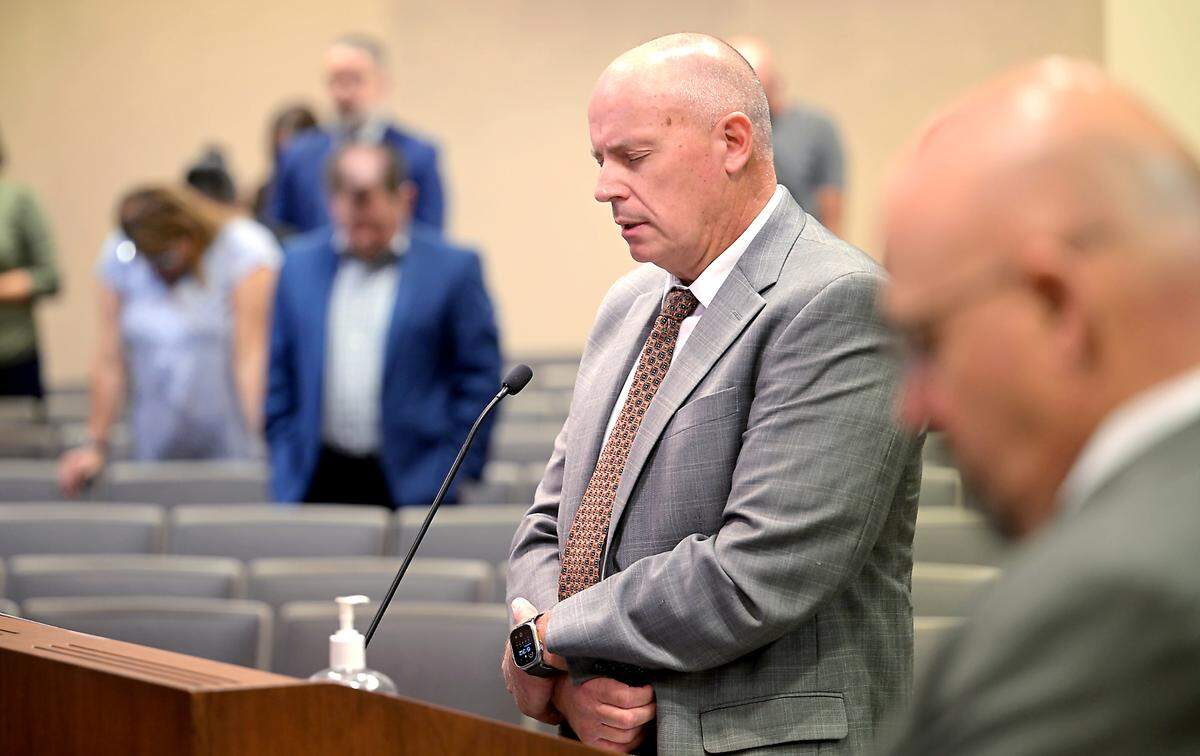
While the invocation is given, audience members remain standing, often bowing their heads as a member of a rotating list — made up almost entirely of Christians — says a public prayer to the council.
Former Congregation Beth Shalom rabbi Shalom Bochner is the only non-Christian to have given the invocations. “I’m aware of the very delicate line between setting an emotional or spiritual tone and preaching, which I was careful not to come close to,” Bochner said.
His invocations centered around setting a spiritual intention. He thanked other faith communities and offered a prayer to the “beyond name oneness.”
“I hope that the care that I put into what I shared was clear, that it was a message of inclusion and diversity and all of us being committed to having Modesto be the best that it can be,” Bochner said.
He was asked to provide invocations by a member of the City Ministry Network, or CMN, a Christian nonprofit organization that administers the list of participants on behalf of the Modesto City Council and Stanislaus County.
“I think typically what you see is pretty much multi-denominational,” said Mike Gunnarson, director of community ministries for the nonprofit. “But we want it to be multifaith.”
The organization has been administering the invocations at the county at least since 2015. But it’s unclear when or why it became involved with the city of Modesto. Its restated articles of incorporation submitted to the state at the end of August stated CMN’s purpose is in part to “to operate a Christian ministry in Northern California.”
What is the process for giving an invocation?
Gunnarson said he sends invitations to faith leaders across the county and encourages them to volunteer for available council meeting dates. Once the calendar is full, he submits it to the city clerk.
When asked about the list of religious leaders who have given invocations, Mayor Sue Zwahlen said she did notice that it was mostly Christians. “I wondered, ‘Who’s on that list? Like who is it sent to?’ I don’t send it out.”
Neither the mayor nor Gunnarson said they know when the relationship with CMN started, and CEO Marvin Jacobo is on sabbatical and unavailable to answer The Bee’s questions.
Gunnarson verified that CMN also administers invocations for Stanislaus County.
Stanislaus County spokesperson Carissa Lucas said in an email that when the county started invocations in 2015, City Ministry Network offered to help and it was accepted because of its “diverse network of faith leaders in the community.”
The city and the county include invocations on their regular meeting agendas.
Who has provided invocations?
City Ministry Network’s current or former members have provided the invocation over 25% of the time. That, Gunnarson said, is because when he reaches out to those set to deliver invocations, some have conflicting commitments. His network connections, he said, are “kind of trying to fill the gaps.”
Jeff Pishney founded the nonprofit Love Stanislaus County and also was the City Ministry director until 2016. The former pastor provided invocations six times in the last five years, and he often preceded them with comments about his charity and events.
Zwahlen said she does not give guidance to invocators before they come before the council, but she does suppose that comments outside of the invocation should be left to the public comment period.
The late former council member Jenny Kenoyer’s son, Bill Kenoyer, has provided the invocation five times and is also on the board of the nonprofit. But when he provides invocation, it is on behalf of Redeemer Church.
Councilman Jeremiah Williams has given the invocation five times on behalf of Revival Church, and Mayor Sue Zwahlen’s son has represented the Church of Jesus Christ of Latter-day Saints, once.
Rabbi Menachem Golomb, CEO of Chabad of Modesto, said he has not been contacted to give an invocation and has not reached out himself. If given the opportunity, he said he would participate.
When listening to invocations, what has made him feel unwelcome is when people invoke the name of Jesus Christ. He said it would be fine if someone used something less specific, like “God,” but as a Jew, it goes against his beliefs.
“It’s wrong. It shouldn’t be done, and it has to be worked on,” Golomb said.
How has the law tackled the question of public prayer?
The practice of invocation in public meetings has a long history and dates to the first Continental Congress. Now, invocation is a point of contention in many communities throughout the state and country.
Legal challenges to public prayer or invocation at the beginning of public meetings have primarily revolved around a perceived violation of the Establishment Clause of the Constitution, which prohibits the government from establishing religion.
In 2002, Rubin v. The City of Burbank banned sectarian prayer after a Jewish member of the public challenged the nature of a prayer given by a member of the Church of Jesus Christ of Latter-day Saints that concluded “in the name of Jesus Christ.”
Concluding prayers in this way is standard for members of the LDS church.
In 2005, a local criminal defense attorney threatened to sue the city of Modesto, citing precedent set by the California appellate court at the time, but it does not appear any lawsuit was filed.
The Supreme Court did not take up the case of Rubin v. Burbank. Instead, invocation in public meetings was upheld by the Supreme Court in 2014 with a case known as Town of Greece v. Galloway in a 5-4 decision.
The current position of the court allows sectarian prayer as long as it does not disparage other religions or coerce members of the public to engage in religious rites and no one of any religion is denied the opportunity to provide an invocation.
In the past five years at City Council meetings in Modesto, one in four invocations mentioned “Jesus” and half made a request or statement to solicit prayer, such as “let us pray” or “we’ll bow our heads in prayer.”
The sectarian nature of prayer
Gunnarson said he provides guidance to people providing invocations to emphasize that they are praying for the council or the supervisors and not on behalf of everyone in the room.
In one invocation, variations of which were provided five times, the invocator said, “Your scriptures tell us to elect those who fear you, and so you have.”
Carlsbad, a community with about half the population of Modesto, removed invocations in 2023. In May of this year, it ordered police and fire chaplains to refrain from praying “in Jesus’ name.” Additionally, in remote Bishop, California, invocation was removed from City Council meetings in 2023.
In Patterson, invocation is given by City Council members. In Salida, invocations aren’t on agendas, but the city did adopt a nonreligious invocation of civility in 2020. In Turlock, there is no official invocation given to the City Council but there sometimes are unofficial invocations before the council sessions begin.
Latricia Beasley-Day is an associate pastor at Victory In Praise Church of Modesto and a community organizer for the multifaith nonprofit Faith in the Valley.
“I think the role of the invocation is to invite peace and calmness, in your own faith, into the room to center and set the tone for the upcoming meeting,” she said.
Gunnarson said he sees the role of an invocation as a mostly shared moral foundation.
Other religious groups
In Stanislaus County, religiously unaffiliated people make up 17% of the population while 6.2% identify as non-Christian, according to the 2023 PRRI Census of Religion.
Places of worship for those in the religious minority in Modesto, such as the Buddhist Tzu Chi Foundation, Wat Tepnimit, Chabad of Modesto, Shree Ram Mandir Hindu temple and the Sikh Gurudwara Modesto, have not had representatives at Modesto City Council within the past five years and likely beyond.
The new Rabbi at Beth Shalom, Caitlin Bromberg, said she has not yet been reached out to but would be willing to give an invocation if asked.
Recently, the multifaith leaders in the community merged with the Stanislaus Interfaith Council, Beasley-Day said.
“We love having representation from Hindu leaders, Buddhist leaders, Jewish leaders, Christian leaders and Latter-day Saints in our space,” she said. “It makes for a very healthy conversation.”
Referencing the lack of religious diversity in Modesto City Council invocations, Gunnarson said he has made a concerted effort to reach out to the Sikh community.
“I don’t know why it hasn’t been in a wider range, but I don’t think it’s because there was a lack of invitation,” he said. “I think you trust who you know, and if you don’t walk in deep relationships, people don’t always trust it.”
Imam Ahmed Kayello at the Islamic Center of Modesto was on the agenda three times in 2022 but was not present at the time of the meetings, so the invocations were instead given by a Christian representative.
Kayello said he has given invocations in the past, but a few years ago he was denied the opportunity by someone working for Stanislaus County after he did not put his hand over his heart during the pledge of allegiance.
“When it comes to the pledge of allegiance, I do stand up out of respect, but I don’t put my hand on my heart,” he said. “I don’t do any pledge. I’m also Lebanese and I don’t do this in Lebanon, either. My allegiance is to God and it’s the freedom of religion.”
After talking with Jacobo from City Ministry Network, whom Kayello considers a friend, and members of the county Board of Supervisors, he said he feels the issue has been resolved.
Over the past few years, he has been incredibly busy helping refugees settle into Stanislaus County, he said. But he said he did receive an email from Gunnarson and is willing to provide invocations at either county or city meetings moving forward.
The religious breakdown of Modesto overwhelmingly favors Catholics. According to the 2020 Religion Census, there are over 115,000 residents who identify as such in Stanislaus county, constituting over 20% of the population. However, the Rev. Ramon Bejarano, then of St. Stanislaus, now a bishop in San Diego, has been the only member of the Catholic Church to provide an invocation.
“The church believes that public prayer, conducted with respect for diverse beliefs and in a conscientious manner, can foster a spirit of unity,” said the Rev. Myron J. Cotta, bishop of Stockton. “The church also recognizes the power of prayer and the positive impact that such public expressions of faith can have on the community.”
When a Hindu faith leader, Rajan Zed, gave the invocation for Oakdale and Waterford in 2013, it made local headlines. He also provided an invocation before the U.S. Senate in 2007.
Vidhu Mehra is a trustee and member of the Hindu Temple of Modesto, currently in the final stages of securing a new location on College Avenue.
Mehra said she’s noticed that invocations are largely Christian but has heard that other areas have invited people of all different religions to attend. She thinks that should be the general practice. “God is one with different names, so it doesn’t bother me if they are saying ‘Jesus’ or ‘Allah’ or whoever.” Mehra said.
Chris Holland said his organization, Stanislaus Humanists, never has been asked to participate, but he would. However, he is worried about how it would be received.
He said he remembers being singled out as a child for not engaging in public prayer at school and said he feels that same pressure now, at City Council, to stand during the invocation or bow his head.
“They don’t shove you in lockers or give you wedgies as an adult, but it still sets the same tone,” he said. “In City Hall, suddenly they’re doing this, and I feel like an outsider all over again.”
Zwahlen said she believes listening to people pray in their faith is an opportunity to learn and listen and she would be open to people of any faith or lack thereof giving an invocation at City Council.
“I would have no objection whatsoever,” she said. “I would welcome them.”
There hasn’t been a non-Christian providing the invocation since Bochner in 2022 He moved out of Modesto in 2023 and is rabbi and educational director at B’nai Israel Jewish Center in Petaluma.
“I think currently, we need to have more diversity,” Zwahlen said. “Because the record speaks for itself.”
This story was originally published November 7, 2024 at 6:00 AM.
CORRECTION: This story has been updated to show that Mayor Sue Zwahlen’s son has given the invocation only once, representing the Church of Jesus Christ of Latter-day Saints. This version also correctly states that it was former council member Jenny Kenoyer’s son who provided the invocations five times.