
Water rates could rise sharply for Turlock Irrigation District farmers
A vote Tuesday could more than double water rates in the Turlock Irrigation District, but farmers appear to be taking it in stride.
The proposal has not generated much public outcry since it emerged in November, perhaps because TID water still would be among the cheapest in California.
The staff proposed the increase to bring income in line with operating expenses and to pay for upgrades, including high-tech controls on canal flows.
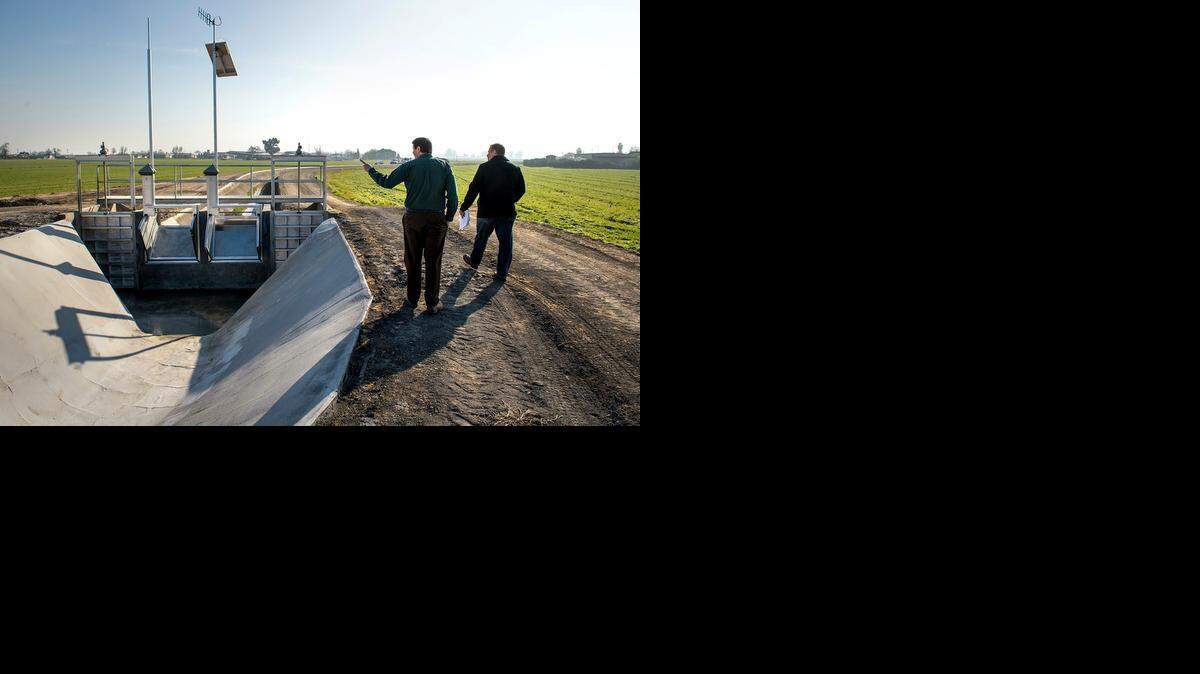
“It’s a big jump,” said Brad Koehn, civil engineering department manager, during a visit last week to one of the improvement projects near Hilmar. “The main thing is we tried to be as transparent as possible with the rate analysis.”
The typical charge for an acre-foot of water in a normal or wet year would go from $8.25 to $17.50. The dry-year price would rise from $15.50 to $36.50.
Compare that with parts of the western and southern San Joaquin Valley, where drought has many farmers paying several hundred dollars per acre-foot.
“No one likes rate increases, but (TID customers) understand that they have a good, strong district and they want to keep it strong,” said Wayne Zipser, executive director of the Stanislaus County Farm Bureau.
Under state law, the district board could not approve the proposal if more than half of the affected customers file protests at or before Tuesday’s hearing. That rarely has happened in the law’s nearly 20 years.
TID has kept its rates low thanks to strong rights to the Tuolumne River and income from its hydroelectric plants. The Modesto Irrigation District, TID’s partner in Don Pedro Reservoir, has done the same. So have the Oakdale and South San Joaquin districts on the Stanislaus River.
State and federal mandates are putting pressure on rates. One state law requires that water prices be more closely tied to the amount used by farmers, with the goal of encouraging conservation. This has prompted TID to spend about $10.9 million over three years on new canal gates – the devices that let water onto fields and orchards. They measure water much more accurately than the older gates and have controls that farmers and TID workers can operate via smartphones and laptops.
The rate increase would help with this project and others at TID, such as the canal near Hilmar, known as Lateral 8. It is getting a $2.2 million makeover that includes radio-controlled devices to operate the 11 “drops” – the points along the waterway where the level can be raised or lowered to meet customer demand.
Nearby, another $2.3 million is being spent this winter to fix up a small reservoir that used to be part of the water-treatment plant for Hilmar residents. It will catch unexpected high flows on the Highline Canal, just upstream of Lateral 8, that used to spill into the Merced River. The project is expected to save 2,550 acre-feet a year at first, and as much as 9,000 with a future expansion.
TID delivers nearly 360,000 acre-feet in an average year, so the savings might not seem like much. But district officials said they are preparing for possible reductions in irrigation supplies because of state and federal efforts to protect river fish. And then there’s drought, which in 2014 was especially harsh, forcing the district to cut deliveries to about 40 percent of normal.
A small part of the rate increase would help with the cost of lobbying and other efforts to protect the supply. Some of the money would go to a water master plan, which could identify conservation and other projects, and to renovation of a Turlock building into a water operations hub.
Tim Sanders, an almond grower near Ceres, said the increase would not be onerous.
“We’re just covering the cost of delivering the water,” he said. “We’ve been spoiled with the low rates.”
From 1996 to 2003, the district charged $14 per acre for the basic allotment of water, which varied with watershed conditions. When rain and snow were abundant, farmers could get 4 acre-feet, each costing just $3.50. TID has raised its rates several times since then.
The district’s power customers long have covered some of the water system costs, on the grounds that they benefit from cheap hydropower. This has not been as controversial as in MID, which could soon raise its own water rates substantially.
Zipser, with the Farm Bureau, said TID water users “knew that the district had to invest in their infrastructure.”
This includes the Hilmar-area upgrades, which are scheduled to be done before the start of the 2015 irrigation season. Crews have been installing flow sensors, remote controls and other high-tech equipment on a canal built in 1911 with the aid of draft horses.
“This system has served us very well,” said Matt Hazen, an associate engineer for TID, “but it has its drawbacks and that is what we are trying to fix.”
Bee staff writer John Holland can be reached at jholland@modbee.com or (209) 578-2385.
WATER RATE HEARING
WHEN: 9 a.m. Tuesday
WHERE: TID office, 333 E. Canal Drive, Turlock
PROCESS: Under state law, the district board could not approve the proposed increase if more than half of the affected customers file protests at or before the hearing.
MORE INFORMATION: www.tid.com/irrigation-rate
This story was originally published January 10, 2015 at 5:08 PM with the headline "Water rates could rise sharply for Turlock Irrigation District farmers."