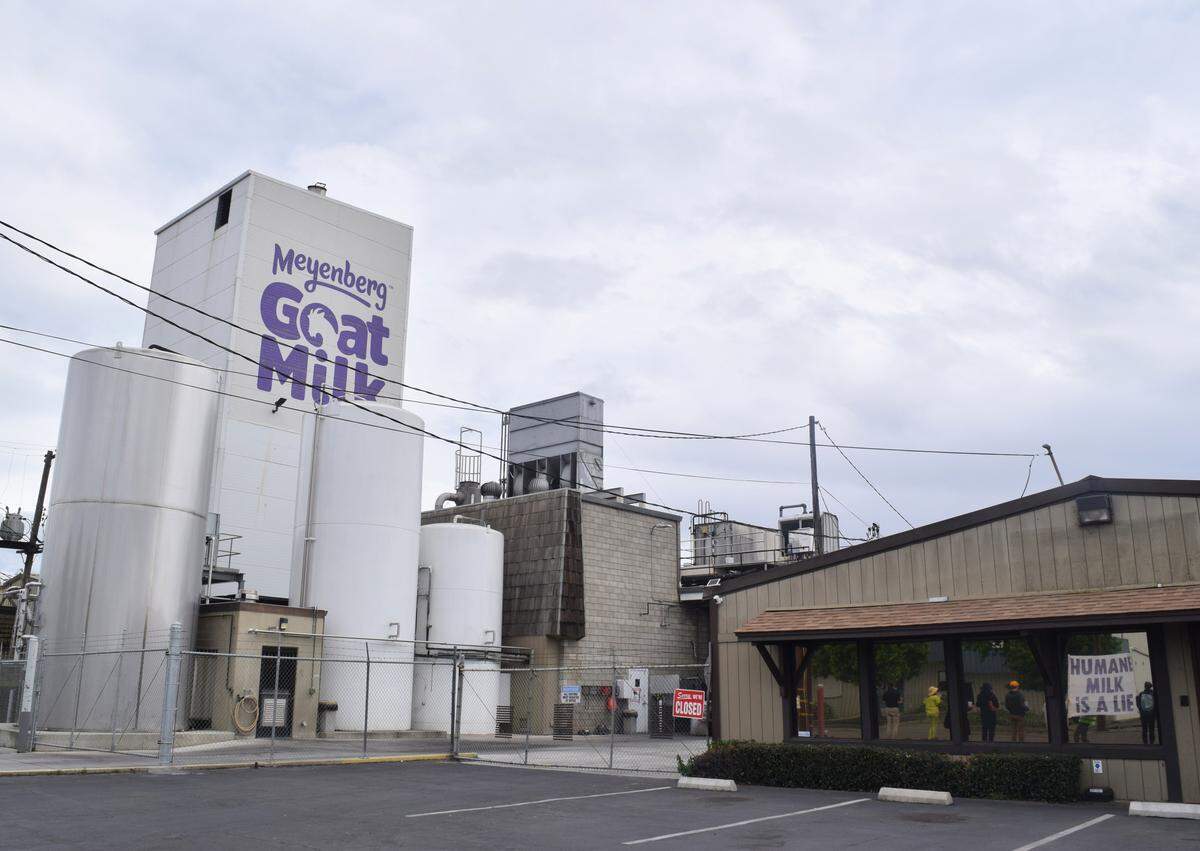
Animal rights activists protest Turlock goat milk over alleged cruelty of supplier
A dozen animal rights activists protested Saturday at a goat milk processing plant in Turlock after felony charges were filed against four people for “rescuing” two sick baby goats from the plant’s supplier.
The protest was at the Meyenberg Goat Milk processing plant in Turlock, followed by a “die-in” at a nearby Raley’s, which sells some of the company’s dairy products. Members of the group Direct Action Everywhere held signs reading “Compassion is not a crime” and “Meyenberg lies, animals die.”
Vera Goat Dairy is a supplier to Turlock-based Meyenberg Goat Milk, which is sold at Whole Foods, Sprouts, Walmart and many other nationwide grocery chains. Meyenberg milk is marketed as “certified humane,” which the activists claim is a marketing scam.
Bay Area-based Direct Action Everywhere alleges the four arrested were rescuing two baby goats that were in immediate need of medical attention. The incident was last May at Vera Dairy in Stratford in Kings County.
After the goats were removed from the dairy, they were examined by a veterinarian and found to have pneumonia and conjunctivitis.
The Kings County District Attorney’s Office charged Carla Cabral, Sally Zito, Tajnder Uppal and Joseph Allman with grand theft of livestock, conspiracy to commit a crime and trespassing. The individuals each face up to six and a half years in prison if convicted on all charges.
“What gives me hope is that by facing charges, standing trial, we get to talk about the things that we saw with our own eyes on this facility, and we can share the stories of the animals … who are just a few of the thousands of victims here,” Allman said Saturday at the protest.
In 2021, Vera Goat Dairy was cited by the Central Valley Regional Water Quality Control Board for improperly disposing of dead animals. Last year, Direct Action Everywhere documented that dozens of dead goats were regularly being dumped into a pit on the farm property, suggesting that the operation experiences high rates of mortality. The group said it observed several animals on the farm appearing ill and being handled roughly by workers.
Cabral said she remembers seeing the hoof of one of the goats protruding from the dead pile. “It was like something out of ‘The Walking Dead,’” she said Saturday. “That image will stay with me.”
Allman said another concern he’s seen is that other animals at the Vera facility, like stray dogs and cats, eat the dead, diseased bodies.
Assembly Bill 411 went into effect this year, creating a legal path for ranchers to compost dead animals on their land rather than at specialized rendering facilities, which they were required to do so before.
“When you report these illegalities to the authorities, it turns out it happens to be easier for them to just change the law,” Allman said.
The Kings County Sheriff’s Office and District Attorney’s Office found no evidence that animals were being mistreated or that dead animals were disposed of in an open pit, according to their investigations. In a letter from the DA’s Office to the dairy farm’s owner, a sheriff’s investigator did find goat carcasses under piles of manure, but said the practice aligns with “evolving state guidance.”
The District Attorney’s Office found that the complaints were “unfounded” and that there was evidence of the individuals partaking in “criminal activity.”
Meyenberg customer relations representative Ellen Campbell told The Fresno Bee last month that the company was alarmed to hear about the “upsetting allegations of animal mistreatment,” adding that it does not own Vera Dairy.
“However, we do buy milk from Vera Farm. We have followed up with on-site visits and have found no evidence to support the claims being made against Vera Farm,” according to the statement.
Campbell said Meyenberg sources milk only from farms that meet “certified humane” standards. That’s a paid certification producers can put on their labels after undergoing independent inspections and ongoing monitoring by Humane Farm Animal Care, a nonprofit focused on improving the welfare of farm animals in food production. Vera Farm was recertified in October 2025, according to Campbell.
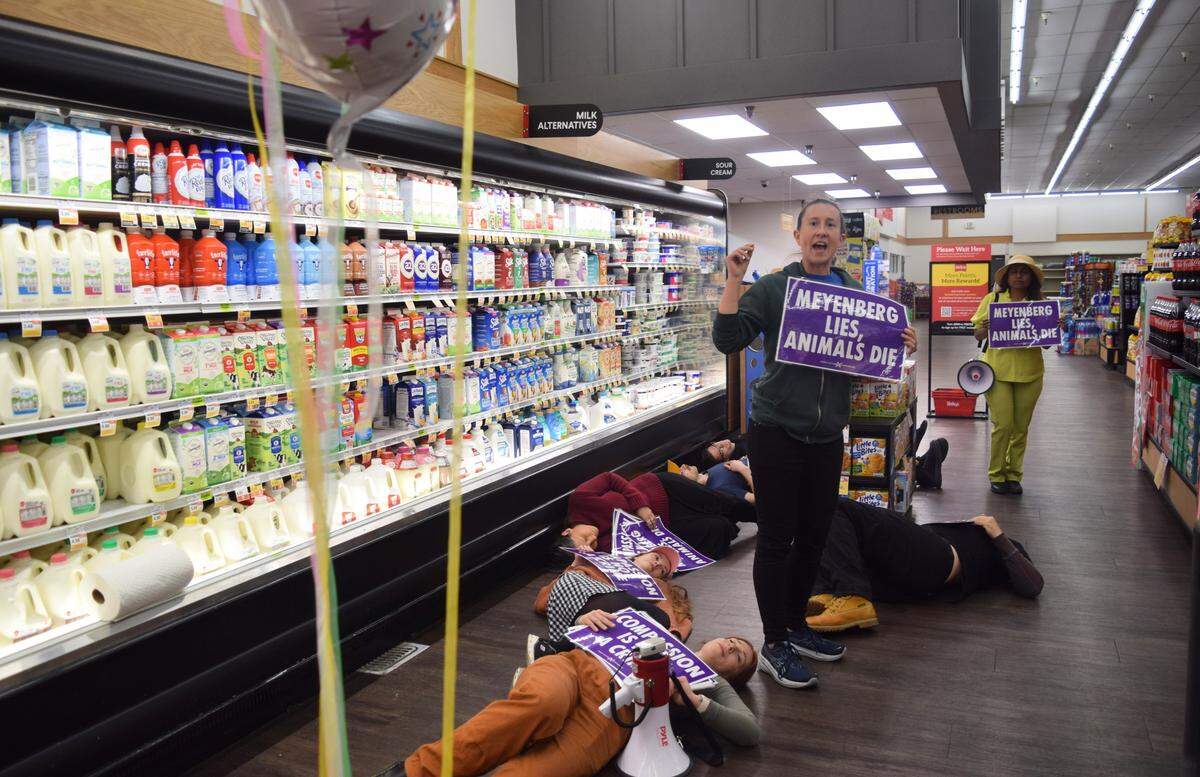
During the die-in at Raley’s, the protestors lay on the ground in front of the dairy aisle, simulating being dead, while one person spoke through a megaphone, reciting their demands.
At one point, the store’s alarm went off, and a manager called for security. The group left peacefully, and continued to rally outside the store, passing out flyers calling on individuals to write to the King’s County District Attorney’s Office.
As of April 13, 28,881 emails have been sent, calling on the office to “prosecute animal cruelty, not animal rescuers.”