New details emerge in stabbing at Turlock High School during hearing for suspect
A judge will decide this week whether the boy accused of bringing a knife to school and stabbing a fellow Turlock High Student 22 times should be tried in juvenile or adult court.
The defense for the youth argued that there isn’t enough evidence to prove the attack was premeditated and that the boy suffered from a serious mental health disorder.
The prosecution said the suspect planned the attack for at least a year and had a list of five other students he planned to “get in the same way.”
The attack occurred Nov. 5, 2021, when both the victim and the suspect were 17-year-old seniors at Turlock High. According to testimony, the suspect approached the victim between first and second periods, began punching then stabbing him in the head, neck and torso using a knife with a three-inch blade.
A teacher intervened and kept the suspect calm until a school resource officer got to the scene and arrested him on suspicion of attempted murder. The victim made his way to the school nurse and was later flown to a Modesto hospital.
The victim thought he was going to die of blood loss. He testified that he has scars from the attack and lasting damage to the ligaments in his hands. He said he now suffers from depression and anxiety and has lost weight since the attack.
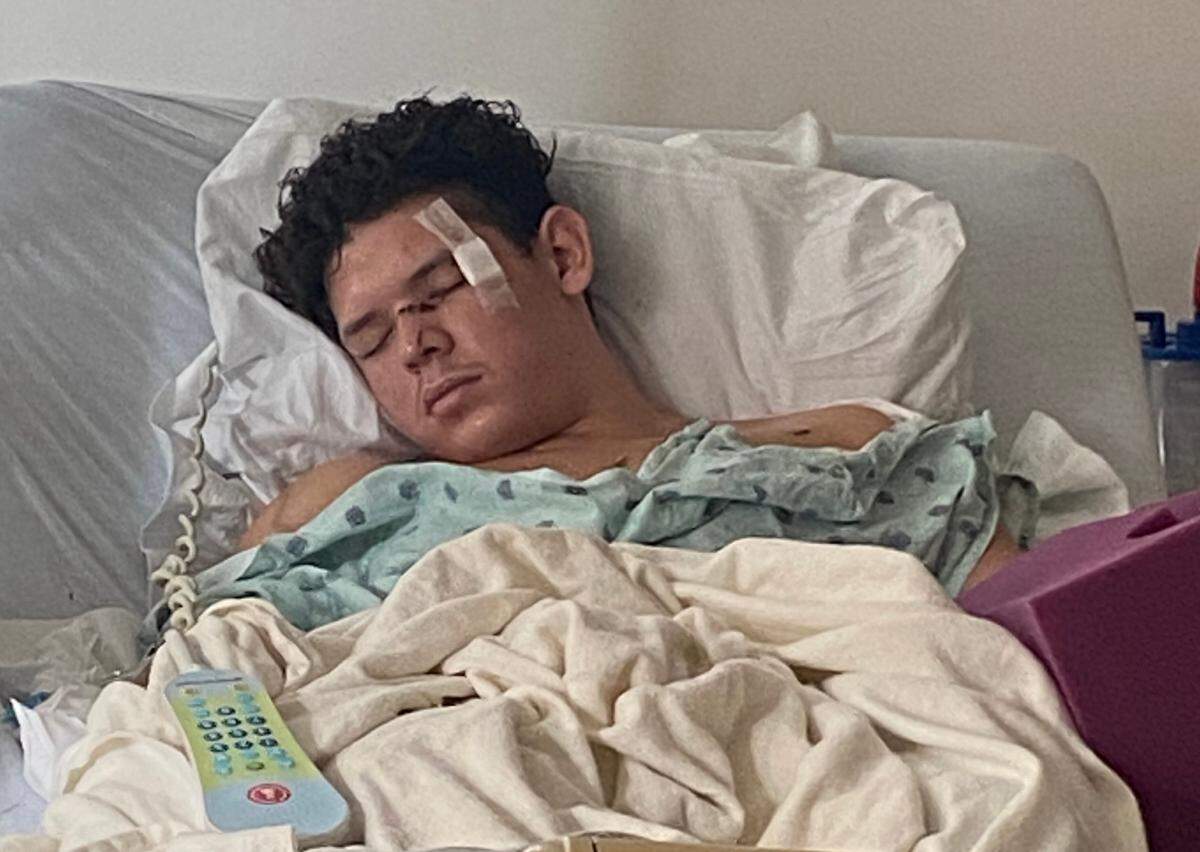
The victim testified during an approximately four-day transfer hearing in Stanislaus Superior Court this month.
Transfer hearings are held for a judge to determine whether a person who commits a crime as a juvenile should be tried as an adult. Judge Ruben Villalobos will make the decision based on legal factors including the degree of criminal sophistication exhibited by the minor; the circumstances and gravity of the offense; his criminal history and any progress in attempts to rehabilitate him prior to the attack; and whether he can be rehabilitated prior to the expiration of the juvenile court’s jurisdiction.
Juvenile court’s jurisdiction ends when a youth turns 25 so he cannot be incarcerated beyond that age. If the suspect in this case is transferred to adult court and convicted of first degree attempted murder, he faces a possible sentence of 25-years to life in prison but as a youthful offender would be eligible for early parole.
According to testimony by Stanislaus County Probation Officer Manny Dhillon, the victim and suspect played football together in the past but were not close. No words were exchanged between the two prior to the attack.
“This crime was heinous. This crime was vicious. It was unprovoked and uncalled for,” Deputy District Attorney Jon Appleby said during his closing arguments.
The only perceivable negative interaction between the two was a previous comment made by the victim calling the suspect a, “white boy.” The victim told Dhillon the comment was meant to be descriptive, not derogatory.
James Rokop, a clinical psychologist hired by the defense, interviewed the suspect and reviewed police reports about the incident. He testified that the suspect has a tendency to “overinterpret minor slights,” which could be the result of his mental disorder. Rokop said the youth has a diagnosis of schizophrenia, a disorder that is uncommon in children, according to the Mayo Clinic.
Rokop said the suspect is, “a very hypersensitive individual” who is “very sensitive to perceived slights, whether real or imagined, ... that (make him) feel embarrassed and ridiculed.”
A list of other students
Less than a week after the suspect was booked, a mental health clinician working in Juvenile Hall contacted the Turlock School Resource Officer who arrested him.
Officer Jessica Clark testified that the clinician provided her with a list of five other students that the suspect said he wanted to “get in the same way he got (the victim).”
Clark testified that she identified all but one of the people on the suspect’s list and notified them of the threat. One boy said he knew the suspect and had previously had an argument with him over a vape pen but that they hadn’t had any issues since. Two girls on the list said they knew of the suspect but had no interactions with him and another girl said she didn’t know him at all.
The suspect told Rokop during his evaluation that he’d planned to harm the victim for over a year and had a previous plan to harm him and the people on his list by hitting them in the back of the head with a crowbar.
Rokop testified that he interpreted the suspect’s statements to mean that he, for a year, “struggled with these feelings of wanting to harm individuals that he’s felt wronged by, as a byproduct of his delusions.”
Both Rokop and probation officer Dhillon concluded, based on the facts of the case and their interviews with the suspect, that he should remain in juvenile jurisdiction and not be transferred to adult court.
They said the offense lacked criminal sophistication because the suspect used a “novelty” knife with his name on it; walked right up to the victim instead of attacking him from behind; didn’t try to evade capture and admitted to the offense once detained.
Appleby pointed out that the suspect told Rokop he chose the knife among others he had because it was the sharpest and held onto the victim’s backpack during the attack to prevent him from escaping.
Recent trauma
The suspect had no prior arrests but his mother told Dhillon that he’d pushed her once and threatened to kill her, according to testimony.
She’d been seeking help for her son, who had begun taking an antidepressant about two weeks before the attack.
When evaluating criminal sophistication, the judge can give weight to the minor’s age, maturity, intellectual capacity, and physical, mental, and emotional health at the time of the alleged offense, as well as effects of his family and community environment and childhood trauma.
Rokop testified the suspect is of average intelligence and had a good childhood.
But the suspect experienced several traumatic events in the year or two before the attack. A close friend died by suicide. He also had a cancerous tumor in his leg that caused immense pain and required multiple surgeries, according to testimony. Rokop said distance learning during the pandemic also led the suspect to become more isolated and resulted in conflicts with his mom.
Rokop testified that chronic pain can lead to depression and hopelessness.
“It also fed into his kind of delusions that he thought other people might have caused his tumor,” Rokop testified.
The suspect’s attorney, Lawrence Niermeyer, argued that his client should not be transferred to adult court due to his mental state at the time of the offense and the lack of evidence that the attack was planned.
Rokop testified that the suspect’s psychological state has improved significantly with the use of medication while in juvenile hall.
“He still hears voices but can determine which ones were real and which were not,” Rokop said. “He maintained control when being teased.”
He also said that the suspect is only in the beginning stages of his treatment and stability, that he needs a high level of psychiatric care to ensure his safety and the safety of others, and that he will need to take medication for life.
Appleby argued adult court is appropriate for the suspect, who he said has shown no remorse for the attack or expressed any indication that he no longer plans to carry out attacks on the five people on his list.
Judge Villalobos will issue his ruling Thursday morning.
This story was originally published July 25, 2023 at 11:02 AM.