
Monday Q&A: Turlock resident advocates for bicycling, walking
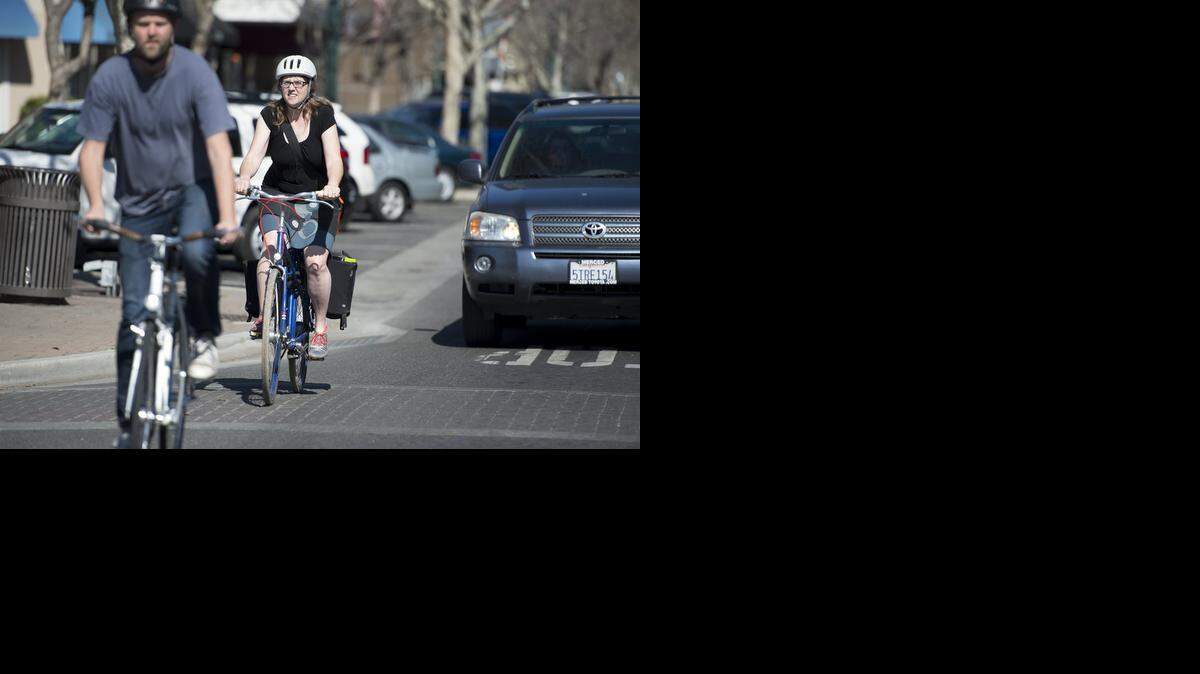
Elizabeth Claes bicycled to a meeting Friday at City Hall, watching for traffic and pavement hazards.
She spends much of her time advocating for cyclists and pedestrians as road improvements are planned in Turlock and the rest of Stanislaus County.
Claes has plenty of experience: She and her family decided nearly five years ago to go car-free. Her group, Bike Turlock, would like to see better-connected routes and pavement repairs, something that could benefit drivers as well.
Claes, 41, also is on the Citzens Advisory Committee for the Stanislaus Council of Governments. She and her husband, John Claes, have two sons: Jack, 10, and Elliott, 8.
She reflected on the cause for The Modesto Bee:
Q: How did you come to be a car-free family?
A: In the summer of 2010, we needed a new car, and when we started looking, we quickly realized that buying a reliable used car would require me to go back to work. Our kids were still young and one was in preschool, so having me work just for a car didn’t make sense to us. My husband, John, had already been bike-commuting to work for over a year, so we decided to try out going without a car for a short period of time. I personally was fearful of biking, but was willing to try because it made the most sense for our family. At the end of our three-month trial, I never wanted to go back to car ownership, and so here we are 4 1/2 years later.
Q: Are there any challenges to being car-free?
A: There are challenges to every type of transportation that people choose. For me, the benefits of choosing to use a bicycle as our family’s main way of transportation far outweigh the challenges. Healthy transportation and cost effectiveness are just a few of these benefits.
Q: What can be done in Turlock and other parts of Stanislaus County to make things safer and more enjoyable for cyclists?
A: First, I prefer the term “person who bikes” to “cyclist” because that is who I am. I choose the bicycle as a way to get myself around Turlock on short trips averaging about 2 1/2 miles. As we look to the future, I believe that our policies for transportation and road design need to accommodate all forms of transportation. Cars have their place, but the heavy reliance on them has come with many costs to taxpayers, our own health and the environment. By shifting the focus in road design to include all types of transportation – be it biking, walking, transit or car – we will create safer, more livable, and less stressful communities that we are proud to call home.
Q: Can these projects go hand-in-hand with road improvements aimed at motor vehicles?
A: For people who bike, poor road conditions are more than just a frustration. They can cause accidents and major damage to our bikes. Thus any road surface improvements benefit people who bike.
Q: Would more people bike and walk if the routes were better?
A: When I talk to people about why they choose to bike or not in Turlock, the main thing that frustrates both groups is unconnected bike infrastructure (bicycle lanes that start and stop), poorly designed signaled intersections and poor street conditions, all of which makes biking more dangerous and inconvenient. Even small improvements in this area would help many more people feel comfortable riding their bikes.
Q: Are transportation planners picking up on these ideas?
A: I can only speak for Turlock. My interactions have been very positive on the local level, but change is slow. For the past 50 years, transportation policy and implementation in the U.S. has been focused on one mode of transportation: the car. So changing the vocabulary and the values to look at how roads can be made to accommodate all modes of transportation is a process. It takes time, but it is worth it.
Q: Can they be a part of the sales tax increase that StanCOG is considering for the November 2016 ballot?
A: Better roads help people on bicycles, but beyond that, having dedicated funding for biking infrastructure would actually save money for individuals and communities over the long term. This can be seen in health care cost reduction and healthier citizens. In addition, there would be less wear and tear on roads as people choose to not use their cars as much for local trips.
Q: Why is all this important?
A: Good complete street design benefits all people no matter which type of transportation each individual chooses to use. When we expand opportunities for safe and convenient biking and walking throughout Turlock and Stanislaus County, we become more connected to our communities. People save money when they reduce car usage. People who bike tend to spend more money in easily accessible local businesses, which boosts local economies. Health care costs are reduced significantly and people are generally healthier. Children benefit by being able to concentrate better in school and learn how to live healthier lives into adulthood. Traffic is calmed, and people like where they live. Though I had lived in Turlock for over a decade when my family decided to go car-free, I did not fall in love with this community until I started riding my bicycle. I am confident that as more people feel comfortable and supported in riding their bicycles, Turlock will become an even better place to live.
Bee staff writer John Holland can be reached at jholland@modbee.com or (209) 578-2385.
This story was originally published March 8, 2015 at 9:41 PM with the headline "Monday Q&A: Turlock resident advocates for bicycling, walking."